My Nagoya Business Trip: How Itadaki Became the Highlight
 gotowp
Not long ago, a guest came in during our Tuesday lunch service — a business traveler who had just wrapped up meetings near Nagoya Station. He had two hours to spare before his Shinkansen back to Tokyo, pulled out his phone, searched on Google Maps, and somehow found us tucked away on the second floor of a building in Osu. He told me afterward that he almost didn't come. "It didn't look like a typical restaurant listing," he said. "But something made me walk over anyway."
That kind of discovery — stumbling onto something real, something that wasn't in the guidebook — is exactly what Itadaki was built for. And if you're heading to Nagoya for work, or passing through on a longer Japan itinerary, I'd like to share why this city — and this corner of it — might surprise you in ways you won't forget.
Who This Is For
- ✅ Business travelers visiting Nagoya who want to make the most of a lunch break
- ✅ Repeat visitors to Japan looking for experiences beyond the Golden Route of Tokyo, Kyoto, and Osaka
- ✅ Anyone curious about where Japanese food enthusiasts actually go to eat in Nagoya
- ✅ Wagyu lovers who have tried the famous brands and want to discover what else Japan has to offer
- ✅ Travelers staying in Nagoya before or after day trips to Shirakawa-go or Takayama
Nagoya Is Where Repeat Japan Travelers Are Eating Now
There's a pattern I've noticed over the four years since Itadaki opened. The guests who seem most genuinely excited when they arrive — the ones who linger over their bowl and ask the most thoughtful questions — are rarely first-timers to Japan. They're on their third trip. Their fifth. In some cases, their tenth.
Research backs this up. Among Hong Kong visitors, nearly 30% have been to Japan ten or more times. Among Taiwanese travelers, close to one in five have. And where are these repeat visitors going? Increasingly, they're skipping the crowded Golden Route and heading to places like Nagoya — a city that's been Central Japan's hub for centuries but remains underrepresented in most English-language travel guides.
Nagoya is the birthplace of Japan's three great unifiers — Oda Nobunaga, Toyotomi Hideyoshi, and Tokugawa Ieyasu. It's home to Nagoya Castle, Atsuta Shrine (one of the most sacred Shinto sites in the country), and the gateway to Shirakawa-go and Takayama. And yet, for most international visitors, it's still treated as a place to change trains rather than a destination in its own right.
That gap between what Nagoya actually offers and how it's perceived is exactly where the best discoveries happen.
Osu: The Neighborhood That Mainsteam Travel Guides Miss
Even among Nagoya's own neighborhoods, Osu occupies a specific place in the local imagination. Ask any Nagoya resident where they go to find something genuinely interesting — not touristy, not Instagrammed to death — and they'll often say Osu.
Itadaki sits in the middle of this neighborhood. The Osu Shopping Street, one of Japan's oldest covered shopping arcades with over 400 years of history and more than 1,200 shops, stretches in every direction. Osu Kannon Temple anchors one end. Vintage electronics stalls, anime shops, Taiwanese noodle restaurants, and hand-rolled incense sellers fill the lanes between. It's a neighborhood that has somehow managed to absorb every era of Japanese culture without losing its own identity.
We're a four-minute walk from Yabacho Station Exit 4 on the Meijo Subway Line. From Nagoya Station, that's roughly a ten-minute ride — Higashiyama Line to Sakae, transfer to the Meijo Line, one stop to Yabacho. Simple enough for a lunch break between meetings, and close enough to Hisaya-odori Garden Flarie (a free-admission garden just three minutes from the station) to make an afternoon of it if your schedule allows.
✓ Key Takeaways
- Nagoya is increasingly the destination of choice for repeat Japan visitors seeking authentic experiences beyond the Golden Route.
- The Osu district is one of Nagoya's most distinctive neighborhoods — lively, layered, and largely absent from mainstream English travel guides.
- Itadaki is a four-minute walk from Yabacho Station, making it genuinely accessible for business travelers with limited time.
The Restaurant That a Google Maps Search Revealed
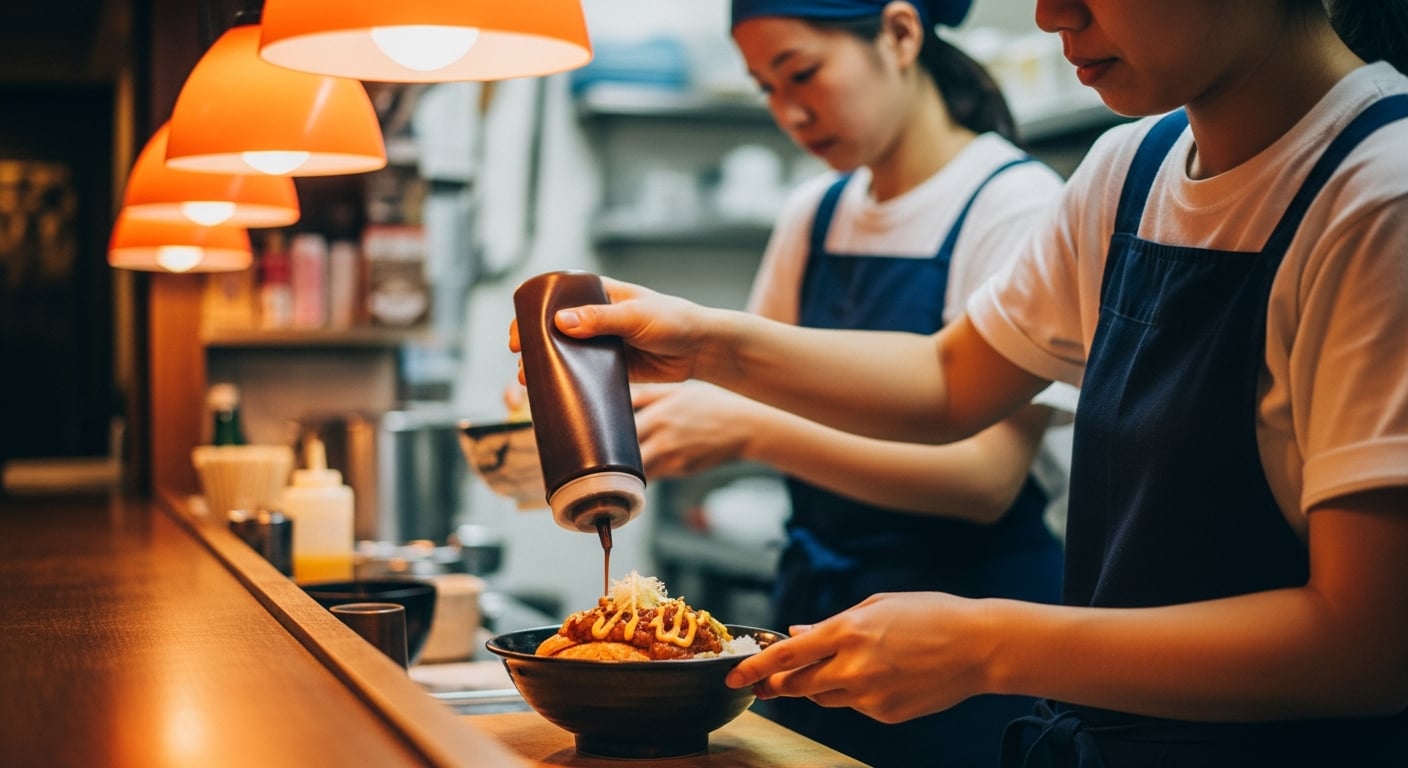
I founded Itadaki in April 2022 with a specific question in mind: why does every other Japanese rice bowl — katsudon, oyakodon, kaisendon — have a celebrated, high-end version, while gyudon has always been associated with fast-food chains? The gyudon deserved better. Or rather, the ingredients deserved better.
Horai Wagyu, for example. Produced by only three farms in Aichi Prefecture's Okumikawa region, with just 300 heads raised annually across all of Japan. These cattle are fed on sake lees from Horaisen Sora, a premium local sake brewery — a practice that shapes both the marbling and the delicate flavor profile of the meat. Out of approximately 500,000 wagyu raised in Japan every year, only 300 are Horai Wagyu. We serve it here, in a gyudon bowl, limited to ten portions a day.
The technique required to serve it "rare-style" safely took time to develop. Our proprietary two-stage cooking method brings the beef to over 70°C at the core — fully meeting Japan's Ministry of Health, Labour and Welfare food safety standards — while preserving the soft, silky texture that makes rare wagyu so remarkable. It's not a shortcut. It's a culinary innovation that no other gyudon restaurant offers.
Everything else in the bowl — the rice, the sauce, the egg, the pickles, the shiso — comes from Aichi Prefecture. The "Aichi no Kaori" brand rice. White soy sauce from Hekinan City, blended with wine for what we call our "magic sauce." A Nagoya Cochin egg from Yamada Poultry Farm. Atsumi Ichō-zuke pickles from the Atsumi Peninsula. This isn't a sourcing policy we put on a menu to sound interesting. It's the foundation the restaurant was built on — a commitment to showcasing what this prefecture can produce.
"I discovered Itadaki through Google Maps and it became the best meal of our Japan trip."
— Guest review
That review means something particular to me. Not because it's flattering, but because of how it happened — a search, a small gamble, a second-floor staircase in Osu. That's the kind of discovery that stays with you. Not because someone told you to go, but because you found it yourself.
What to Know Before You Visit
We're open for lunch only — Tuesday, Monday, Saturday, Sunday, and public holidays (public holiday hours are 9:00–15:00; all other days 11:00–15:00). Wednesday, Thursday, and Friday are our regular days off, though irregular closures do happen. Our monthly business calendar is posted on Instagram, so it's worth checking before you plan around us.
For the Horai Wagyu Gyudon — our Shinkoccho (100g beef, 200g rice, ¥2,700) — advance reservation via Tabelog is genuinely recommended. When you reserve, paste 鳳来牛希望 into the notes field to request the Horai Wagyu specifically. Reservations can be made in English on the Tabelog site. If you're coming as a walk-in, our Mikawa Beef Rare Gyudon is always available and prepared with the same two-stage cooking technique — a worthy experience in its own right.
Our menu is printed in English, Simplified Chinese, and Korean, and includes a five-step visual guide to enjoying the dish. We welcome international guests warmly, and translation apps work well in the space. The restaurant has 18 seats — counter seats for solo diners, sofa tables for groups — and every seat is non-smoking.
"The English menu with clear serving instructions made the experience stress-free."
— Guest review
Making It the Highlight, Not Just a Lunch Stop
Business travel in Nagoya often centers on Toyota-related industries, MICE events, or the various manufacturing and logistics companies headquartered in this region. The schedules are tight, the days are full, and lunch can easily become an afterthought.
What I hear from guests who come during a work trip is that Itadaki gave them something the meetings didn't — a story. A bowl of Horai Wagyu with a 300-head-per-year production story, a proprietary cooking technique, and a neighborhood they'd never have explored otherwise. That's the kind of discovery that turns a functional trip into a trip worth remembering.
If you have time after lunch, Osu Kannon Temple is a five-minute walk. Hisaya-odori Garden Flarie — a free-admission garden with themed spaces including a European-style Harmony Garden and a glass greenhouse — is three minutes from Yabacho Station. The shopping street itself is worth an hour if you let yourself wander. This neighborhood rewards the kind of slow, curious exploration that a business trip rarely allows but sometimes makes possible.
For our complete menu, access details, and store information, visit our official page at https://itadaki8.com/english/.
If you're planning a visit, securing your Horai Wagyu in advance is the simplest way to make sure it's waiting for you: Reserve Your Rare Wagyu Experience. And for the most current business calendar and scheduling updates, Check Our Monthly Schedule on Instagram before your visit.
We'll see you on the second floor.