When You Book Itadaki, You Reserve More Than Just a Meal
 gotowp
A few weeks ago, I was chatting with a group of visitors from Singapore who had just finished their lunch at Itadaki. One of them pulled out her phone and showed me the photo she'd taken of her bowl — the deep-red wagyu fanned over white rice, the golden egg yolk sitting on top, the ceramic bowl framing it all like a painting. She looked up and said, "My followers have been sending me messages all afternoon asking what this is." She hadn't even left the table yet.
That moment stayed with me. Because what she was describing wasn't just a good photo — it was a story that had started traveling before she did. And it made me think hard about what it really means when someone books a seat here. They're not just reserving a bowl of beef and rice. They're reserving something they'll still be talking about when they get home.
Who This Is For
- ✅ Travelers who want their Japan trip content to stand out from the usual Tokyo sushi and Kyoto temple posts
- ✅ Food lovers searching for a Nagoya experience that comes with a genuine story — not just a famous name
- ✅ Visitors exploring Osu district who want one lunch that becomes the centerpiece of their entire itinerary
- ✅ Instagram-minded travelers who know a stunning photo is only half the equation — the caption matters too
- ✅ Anyone who wants to discover something in Japan that their friends back home simply won't have heard of yet
The Osu Moment That Nobody Plans For
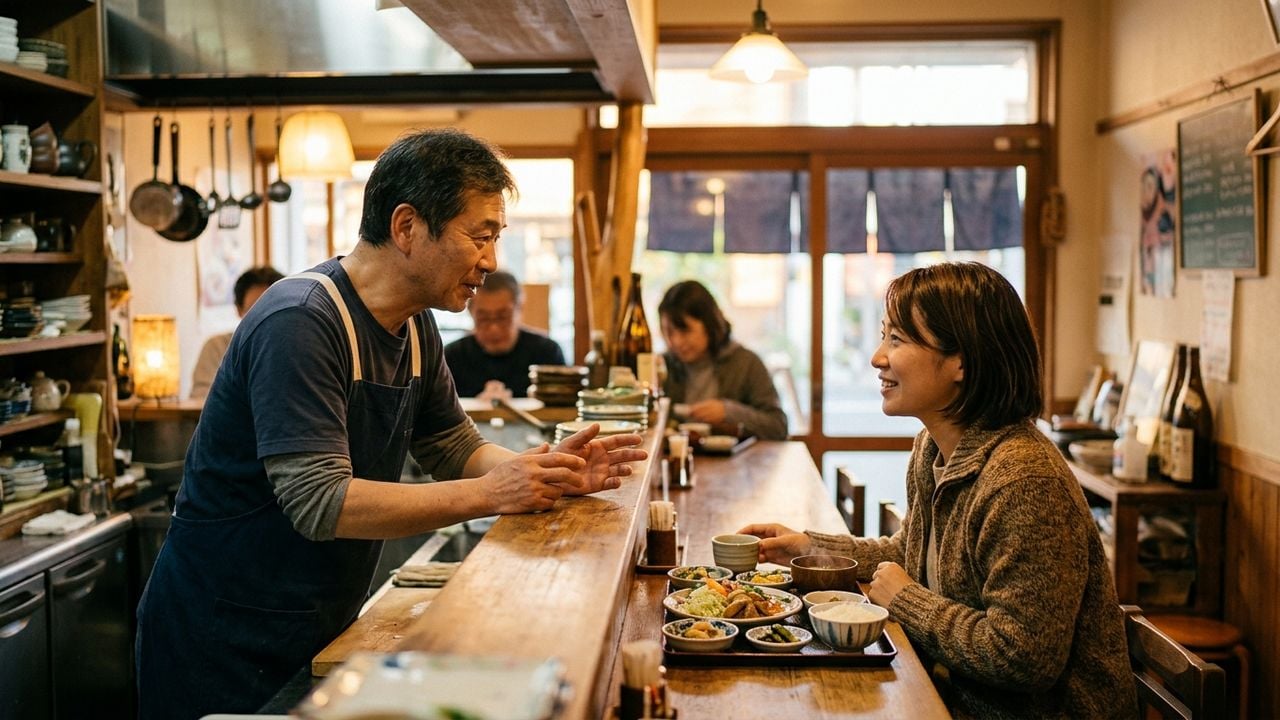
Osu has a way of surprising people. You walk in expecting temples and vintage shops, and you end up down a side street you didn't know existed, looking up at a sign you weren't searching for. That's exactly how many of our guests find us. One of our favorite pieces of feedback captures it perfectly:
"I discovered Itadaki through Google Maps and it became the best meal of our Japan trip."
— A visitor who found us while exploring Osu
There's something about an unexpected discovery that makes the story even better. "We weren't even planning to stop here" is the kind of sentence that makes everyone lean forward. Osu is one of Nagoya's most layered districts — more than 1,200 shops, a 400-year-old shopping street, the Osu Kannon Temple, subculture shops, and food from a dozen countries. It rewards the kind of traveler who walks slowly and looks up.
Itadaki sits on the second floor of a building on Osu 4-chome, a four-minute walk from Yabacho Station Exit 4 on the Meijo Subway Line. It doesn't shout for attention from the street. Which is, honestly, part of the appeal. The people who find it feel like they've earned it.
You've already seen how Horai Wagyu sells out — ten bowls a day, gone before midday on busy weekends in September. Before you plan your Osu itinerary around this lunch, there's one thing worth checking: whether we're actually open on the day you're visiting. Our monthly business calendar — including irregular closures — is posted here so you can confirm before you build your day around it.
Why the Story Behind the Bowl Matters More Than You'd Expect
Here's the thing about shareable travel content: a stunning photo lasts about three seconds before people scroll past. What stops the scroll is when someone genuinely doesn't know what they're looking at. When the caption starts with "You won't believe what this is" and they actually believe it.
Itadaki's Rare Wagyu Gyudon gives you both — the visual and the narrative. The dish is genuinely striking: marbled wagyu arranged over premium Aichi-grown rice, a vivid orange Nagoya Cochin egg yolk placed at the center, served in a traditional Japanese ceramic bowl with carefully arranged pickles and shiso leaves. It photographs beautifully in natural light, and the presentation has a deliberate, almost architectural quality to it.
But the caption is where it gets interesting. Our signature bowl features Horai Wagyu — a Japanese black wagyu raised in the Okumikawa region of Aichi Prefecture, fed on sake lees from Horaisen Sora, one of Japan's most respected premium sake breweries. Only 300 heads are produced annually across just three farms in the entire country. To put that in perspective: there are roughly 500,000 wagyu cattle in Japan. Horai Wagyu represents a fraction of a fraction of that number.
When your followers ask "What are you eating?", you don't just say "Japanese beef." You say: "This is Horai Wagyu — 300 of them exist in Japan each year, fed on sake lees from a 200-year-old brewery, and this bowl is one of only ten served today." That's not a food post. That's a story.
And September is a particularly good time to be in Osu. The worst of summer heat has passed, the streets are walkable again, and the district has the kind of energy that comes with the autumn season beginning to settle in. The Asian Games are unfolding across Nagoya this month, bringing visitors from across Asia and beyond — and Osu is right in the middle of the city's momentum.
✓ Key Takeaways
- Itadaki is located in Osu — one of Nagoya's most storied districts — and is often discovered by visitors exploring the area on foot
- Horai Wagyu (limited to 10 bowls daily) gives your post a narrative that goes far beyond a beautiful plate — it's a story about rarity, craft, and Aichi's food culture
- The dish is designed to be experienced in five deliberate steps, each of which creates its own moment worth capturing
The five-step experience and the Horai Wagyu story are exactly what makes this lunch worth planning — but that story only happens if you secure your bowl before the ten daily servings are gone. Reservation via Tabelog takes just a few minutes and locks in your seat so the day unfolds the way you've imagined it.
The Five-Step Experience — and Why It Makes for Better Content
Most restaurant experiences are linear: food arrives, you eat, you leave. What makes Itadaki different is that the dish is designed to unfold. Our team shares a five-step guide with every guest, and it changes the way people engage with the meal entirely.
You begin by separating the Nagoya Cochin egg — the white goes into the miso soup, and the yolk is placed over the wagyu. Then you taste the beef on its own first, letting the texture and the flavor of the Horai Wagyu speak without anything else in the way. From there, you fold in the yolk for a richer, silkier bite. Then come the condiments: pickled ginger from Kimura Farm in Inazawa, chopped seaweed from Himakajima in Mikawa Bay, dried whitebait from Minamichita, and Itadaki's original eight-spice blend. Finally, a touch of wasabi as a clean, bright finish.
Each step is a different photo. Each step is a different part of the story. By the time you're done, you haven't just eaten — you've moved through something. And that's what people remember when they get home. Not just that the food was good, but that the meal had shape.
If you're spending a day in Osu and want to build your itinerary around a lunch that anchors everything else, the walk from Osu Kannon Temple to Itadaki takes about five minutes. The Hisaya-odori Garden Flarie — a free-admission urban garden just three minutes from Yabacho Station — makes for a lovely before or after stop, and is particularly photogenic in its own right.
For visitors who've been wearing kimono while exploring the shopping street, or arriving in cosplay for events in the area, we'd love to see you just as you are — Itadaki welcomes everyone, dressed however they've chosen to experience Osu that day. You might find it useful to read about pairing a kimono stroll through Osu with lunch at Itadaki, or if subculture events are part of your Nagoya plans, how Itadaki fits naturally into a day at Osu for cosplayers and WCS visitors.
What You're Actually Reserving When You Book
Itadaki is open for lunch only — Thursday through Sunday and on public holidays — with the Horai Wagyu limited to ten bowls each day. On busy days, those bowls are gone before most people have finished their morning plans. That scarcity isn't manufactured. It reflects the actual supply of a beef so rare that sourcing it directly from the farms required building a partnership, not just placing an order.
When you make a reservation via Tabelog, you're not just securing a seat. You're securing the ten-bowl count. You're making sure the story you want to tell is still available when you arrive. We've had guests travel to Nagoya specifically for this lunch — and we want that journey to be as smooth as possible.
Our menu is available in English, Simplified Chinese, and Korean. The five-step guide is illustrated, so even without a shared language, the experience is clear. Staff are trained to welcome international guests warmly, and the layout — 18 seats, all sofa-style seating, with counter spots for solo visitors and larger tables for groups — is designed to feel comfortable, not rushed.
"The English menu with clear serving instructions made the experience stress-free."
— A visitor to Itadaki
For anyone coming from outside Nagoya, the access is straightforward: four minutes on foot from Yabacho Station Exit 4 (Meijo Subway Line). From Nagoya Station, it's roughly ten minutes total — Higashiyama Line to Sakae, then transfer to the Meijo Line and one stop to Yabacho. The Osu area itself rewards arriving a little early and wandering.
A Lunch That Travels Home With You
I started Itadaki in 2022 with a question that had been nagging at me for a while: why did every Japanese food category have a premium version except gyudon? Katsudon, oyakodon, kaisendon — all of them had elevated interpretations. The beef bowl had been left behind. So we built one from scratch, using only Aichi Prefecture ingredients, a cooking technique we developed ourselves, and a commitment to sourcing that meant partnering directly with the farmers raising some of the rarest beef in Japan.
The name Itadaki comes from itadakimasu — the expression of gratitude spoken before a meal in Japan. It's a word that acknowledges everyone involved in bringing food to the table: the farmer, the land, the craft. That's what every bowl here is meant to represent.
When you sit down at Itadaki, you're not just eating. You're receiving something that took years to build — a concept, a supply chain, a technique, a philosophy — all compressed into a ceramic bowl that fits in both hands. And when you take that photo and post it and your followers ask what they're looking at, you'll have more than an answer. You'll have a story that carries the whole trip.
For our complete menu, access details, and store information, visit our official page at https://itadaki8.com/english/
You've read the story — the 300 heads a year, the sake lees, the five steps, the ceramic bowl that photographs like a painting. The only thing left is to make sure it's waiting for you when you arrive. Horai Wagyu is limited to ten bowls each day, and September in Osu is busy. Book your seat now so the best meal of your Japan trip doesn't become a near-miss.
Reserve Your Seat at Itadaki — Only 10 Horai Wagyu Bowls Daily