8-Min Walk from Conrad Nagoya: Rare Wagyu Beef Bowl Osu Locals Love
 gotowp
You've done your research. You've got Nagoya Castle on the list, maybe a morning at Atsuta Shrine, and an afternoon wandering Osu Shopping Street. But somewhere between browsing travel forums and scrolling through Instagram, a quieter question keeps surfacing: What's the one meal — the one moment — I'll actually be telling people about years from now?
Not another sushi omakase. Not another Kobe beef set menu at a tourist-facing restaurant. Something you found. Something with a story behind it. Something that makes your followers stop mid-scroll and ask, "Wait — what is that?"
If you're staying at Conrad Nagoya, you're already closer to that answer than you think. Itadaki — the restaurant that invented the Rare Wagyu Gyudon — is an 8-minute walk from the hotel, tucked on the second floor of a building in the heart of Osu district. And the story behind what they serve is exactly the kind of content that turns a great trip into an unforgettable one.
Who This Is For
- ✅ Travelers staying at Conrad Nagoya who want a discovery-worthy lunch within easy walking distance
- ✅ Anyone who wants their Japan trip content to stand out — not just sushi and Kobe beef posts
- ✅ Foodies looking for a dish that combines visual impact with a genuinely rare ingredient story
- ✅ Visitors to Osu district who want to understand how to enjoy the Rare Wagyu Gyudon experience to its fullest
- ✅ Repeat Japan travelers who feel they've "done" the Golden Route and are ready for something new
The Dish That Stops Your Followers Mid-Scroll
Let's be honest: most food photos from Japan look the same after a while. Ramen in a dark broth. Sushi on a wooden plank. Matcha everything. Beautiful, yes — but your audience has seen it before.
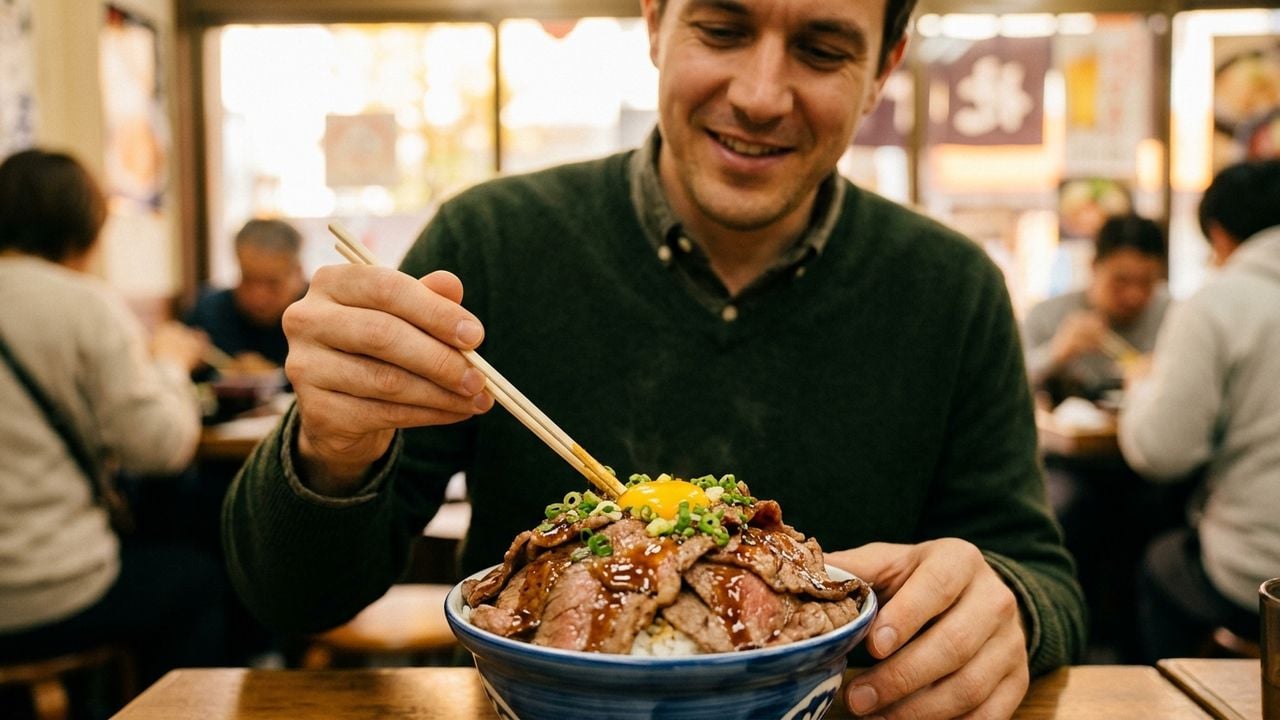
Now picture this: a traditional Japanese ceramic bowl, filled with glistening rice topped with thinly sliced wagyu that's been prepared using a proprietary two-stage cooking method — rare in texture, safe by Japan's food safety standards, and visually unlike anything else on your feed. A golden Nagoya Cochin egg yolk sits at the center. Shiso leaves add a flash of green. The whole arrangement looks like it belongs in a culinary magazine, but you found it on the second floor of a building in Osu, 8 minutes from your hotel.
That contrast — the intimacy of the setting versus the extraordinary quality of what's on the plate — is exactly what makes the story worth telling.
One guest put it simply: "I discovered Itadaki through Google Maps and it became the best meal of our Japan trip." That's the kind of discovery people remember. Not because someone told them to go, but because they found it themselves — and it exceeded every expectation.
You're planning a lunch that becomes a story worth posting — but Itadaki's Horai Wagyu is limited to 10 bowls a day, and the monthly schedule isn't fixed. Our Instagram shows the exact days we're open each month, so you can build your Osu afternoon around a confirmed slot. Takes 30 seconds to check before you finalize your itinerary.
The Story Behind the Bowl (Because Your Followers Will Ask)
A great photo needs a great caption. Here's the story you'll have ready.
Itadaki was founded in 2022 by Masayuki Goto, a Nagoya restaurateur with 18 years in the industry. During the COVID-19 pandemic, he watched small Aichi Prefecture farms — producers of some of Japan's most exceptional ingredients — struggle with unsold harvests. His response wasn't just to source from them. It was to build an entire restaurant concept around them.
The centrepiece of that concept is Horai Wagyu: a Japanese black wagyu raised in the Okumikawa mountains of Aichi Prefecture. Of the roughly 500,000 wagyu cattle in Japan, only 300 heads of Horai Wagyu are produced each year, across just three farms. What makes it exceptional isn't just the scarcity — it's the feeding method. These cattle are raised on sake lees from Horaisen Sora, one of Aichi's finest sake breweries. The result is a beef with both delicate marbling and genuine lean meat character — a combination that's genuinely rare in the wagyu world.
Goto's team serves just 10 bowls of Horai Wagyu per day. That's it. When they're gone, they're gone. If your followers ask "How did you get one?" — the honest answer is: you planned ahead.
"I've had Kobe beef and Matsusaka beef, but Horai Wagyu at Itadaki was on another level."
The entire menu — rice, miso soup, pickles, egg, even the sauce — is sourced from Aichi Prefecture. The rice is "Aichi no Kaori," a premium Aichi-grown variety. The miso soup is made with Hatcho miso from Okazaki City. The pickles are traditional Atsumi Ichō-zuke from the Atsumi Peninsula. The shiso leaves are the Aikei No.1 variety from Toyohashi. It's not just a wagyu bowl. It's an edible map of one prefecture's food culture.
Itadaki has been featured on 8 major Japanese TV programs, including NHK, and is recognized as the originator of the "Rare Wagyu Gyudon" culinary concept. Goto himself holds a Certified Food Sanitation Supervisor qualification and is a licensed restaurant operator under the Aichi Prefecture Public Health Center — details that matter when you're reading about rare-style beef preparation and wondering whether it's safe.
✓ Key Takeaways
- Horai Wagyu is produced at only 3 farms in Japan, with just 300 heads annually — Itadaki serves just 10 bowls per day
- Every ingredient on the plate is sourced from Aichi Prefecture, making this a complete expression of regional Japanese food culture
- The dish is visually striking and comes with a genuine story — exactly the kind of content that stands out on a travel feed
The five-step experience and the Horai Wagyu story are both worth planning for — but 300 heads a year across 3 farms means 10 bowls a day disappear faster than most guests expect. Securing your bowl in advance via Tabelog means you arrive knowing it's waiting for you, not hoping it hasn't sold out.
How to Enjoy the Experience — The Five-Step Way
Part of what makes the Rare Wagyu Gyudon so memorable is that eating it isn't passive. There's a five-step guide printed on the English menu — and following it transforms the bowl from "a very good lunch" into a full culinary journey.
It starts with separating the Nagoya Cochin egg: the white goes into the miso soup (try it — the texture is something else), and the yolk goes directly on top of the beef. From there, you taste the wagyu in its purest form first — no mixing, just the rare preparation and the "magic sauce" made with white soy sauce from Hekinan City, blended with wine. Then you introduce the yolk, which creates a rich, silky second note. Then the condiments on the table: pickled ginger from Kimura Farm in Inazawa City, chopped seaweed from Mikawa Bay, chirimen jako (tiny dried whitebait from Minamichita), and Itadaki's original 8-spice blend. Finally, a touch of wasabi for a clean, refreshing finish.
Five distinct moments in a single bowl. Each one photograph-worthy in its own right.
If you're sitting at one of the counter seats — five of them, ideal for solo diners — you can take your time with each step without feeling rushed. If you're visiting as a group, the sofa-style table seating makes the whole thing feel like a shared event rather than just a meal. All 18 seats feature comfortable sofa seating, which guests staying at Conrad Nagoya often appreciate after a morning of sightseeing.
For a broader look at how Itadaki fits into a Nagoya stay near Yabacho Station, this guide to the best lunch spots around Yabacho Station during the Asian Games period covers the access and neighborhood context in more detail.
Making the Walk Count: Osu Before or After Your Bowl
The 8-minute walk from Conrad Nagoya to Itadaki takes you through the edge of Osu district — and that walk itself is worth building into your day. Osu Kannon Temple is 5 minutes from the restaurant. The 1,200-shop Osu Shopping Street starts just below. Hisaya-odori Garden Flarie — a free-admission urban garden featured in major English travel guides — is a 3-minute walk from Yabacho Station, which is the nearest subway stop.
September in Nagoya is one of the better months to be walking the district. The intense summer heat has begun to ease, and the streets around Osu Kannon take on a calmer rhythm. If you're in Nagoya for the Asian Games 2026 (running through late September and October), this part of the city offers a genuinely different energy from the main event venues — something more local, more layered.
A practical note for planning: Itadaki is open for lunch only, from 11:00 to 15:00, on Saturdays, Sundays, Mondays, and Tuesdays (with some holiday variations). Wednesday through Friday are closed. The restaurant follows a monthly business calendar posted on Instagram — worth checking before you leave the hotel. Horai Wagyu sells out fast during peak hours, and reservations via Tabelog are the recommended way to secure your bowl.
If your Nagoya stay also includes time at any of the Asian Games venues, this article on where to eat near the Aichi-Nagoya 2026 Asian Games venues gives a useful overview of the broader dining context.
The Meal You'll Still Be Talking About
Travel stories have a shelf life. Some meals feel special in the moment and fade by the time you're back at the airport. The ones that last — the ones you're still describing to friends two years later — are usually the ones that had something to say. A real ingredient. A genuine origin story. A specific place, a specific time, a specific bowl.
That's what Itadaki is built around. Not a concept designed for tourists, but a restaurant that started with a question: why has gyudon — Japan's most beloved everyday bowl — never had a premium version worth discovering? Goto's answer became a restaurant. His restaurant became a reason to come to Nagoya. And for more than a few visitors, it became the best meal of their Japan trip.
The Rare Wagyu Gyudon using Horai Wagyu starts at ¥2,700 for the standard size (Shinkoccho: 100g beef, 200g rice) — with the Mikawa Beef version starting at ¥1,800 for those who'd like to try the concept without the Horai allocation. There are no set menus; everything is à la carte, and you're welcome to add side dishes, seasonal options, or one of the Aichi-sourced beverages as you like.
For our complete menu, access details, and store information, visit our official page at https://itadaki8.com/english/
An 8-minute walk from Conrad Nagoya, a dish limited to 10 bowls a day, and a wagyu story your followers genuinely won't have seen before — that combination doesn't stay available for long on any given day. Reserving through Tabelog is the one step that turns a great plan into a confirmed lunch.