What Should I Eat Between Matches at Asian Games Nagoya?
 gotowp
Here's something most Asian Games visitors won't expect: the most memorable part of their Nagoya trip might not be the competition itself — it could be what they eat between events. A striking number of international sports travelers report that a single exceptional meal becomes the highlight of the entire trip, even above the athletic events they flew thousands of kilometers to watch. If you're attending the 2026 Asian Games or Asian Para Games in Nagoya and wondering how to spend the gap between morning sessions and afternoon events, this article is for you.
Who This Is For
- ✅ Asian Games 2026 spectators looking for a memorable lunch option in Nagoya
- ✅ Travelers who have heard of wagyu but are cautious about eating rare-style beef
- ✅ Visitors with a limited window between events who want a focused, fulfilling meal
- ✅ Food lovers seeking a genuinely unique experience beyond standard sports-venue dining
- ✅ Anyone curious whether rare wagyu is actually safe to eat in Japan
What Kind of Lunch Actually Fits an Event-Day Schedule?
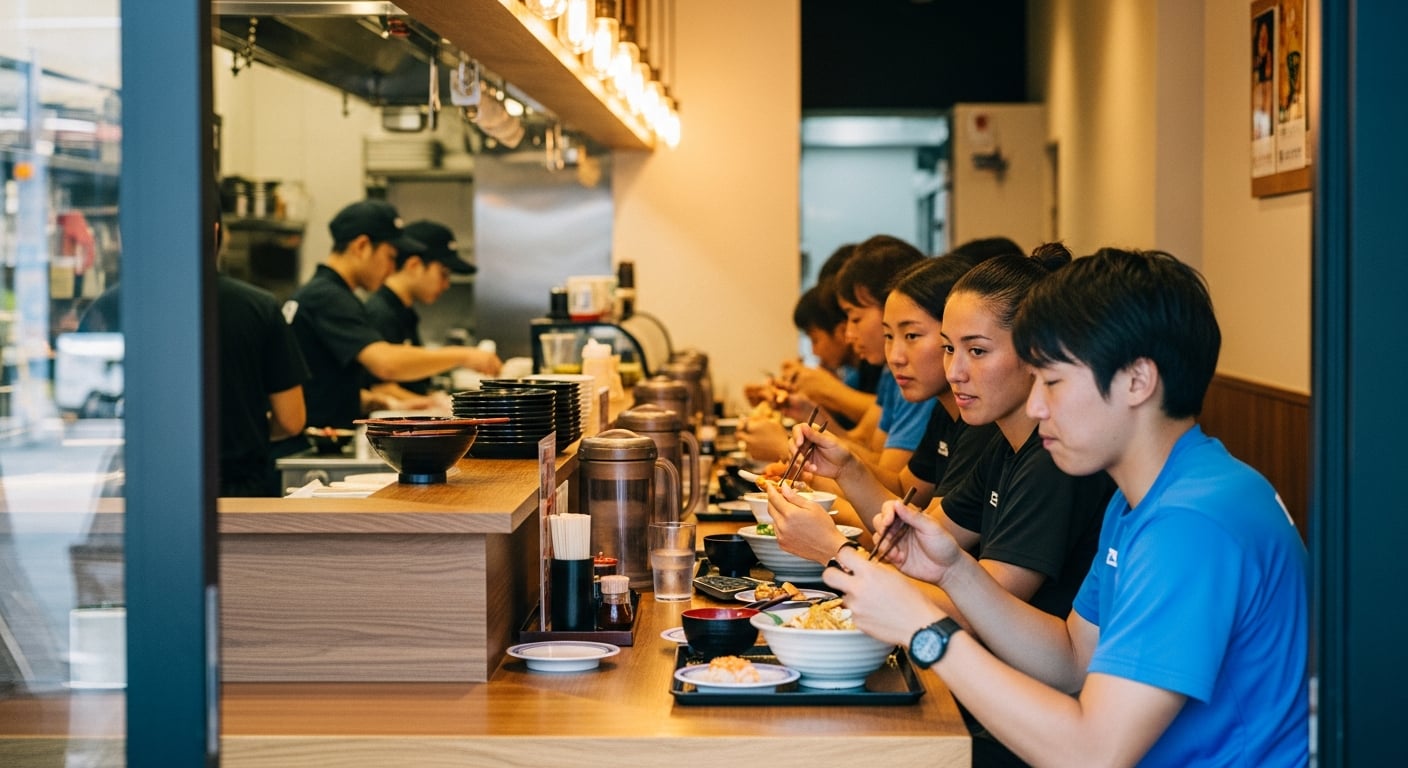
Between morning heats and afternoon finals, the window is often tight — sometimes as little as 90 minutes from venue exit to re-entry. That rules out long tasting menus and multi-course kaiseki. What you need is a lunch that is fast to reach, requires no lengthy wait, delivers a complete experience, and leaves you energized rather than heavy.
Itadaki — located in Osu, just a short subway ride from Nagoya's city center — is built precisely around this format. It operates as a lunch-only specialty, open from 11:00, with last order 30 minutes before closing. The entire experience, from being seated to finishing your bowl, typically takes 30 to 45 minutes. You won't be rushed, but you won't lose your afternoon either.
From Yabacho Station (Meijo Subway Line), the restaurant is a 4-minute walk. From Nagoya Station, the journey takes roughly 10 minutes by subway — Higashiyama Line to Sakae, then transfer to the Meijo Line and get off at Yabacho. Clean, predictable, and easy to work into any event-day itinerary.
Is Rare Wagyu Actually Safe to Eat? What Every Visitor Needs to Know
This is, genuinely, the most common question we receive from international guests — and it deserves a direct, honest answer.
In the United States and across much of Europe, public health authorities advise against consuming undercooked beef due to risks associated with E. coli and other bacterial contamination. That guidance shapes how most Western travelers think about beef — and encountering something described as "rare-style" wagyu understandably raises flags.
Here is what actually happens in our kitchen at Itadaki.
Our rare wagyu is prepared using a proprietary two-stage cooking technique developed by founder Masayuki Goto, who holds certification as a Food Sanitation Supervisor under Japan's Ministry of Health, Labour and Welfare. The process heats the beef to over 70°C at the core — the threshold fully required by Japan's strict national food safety standards. The result is a texture and appearance that resembles rare beef, but the interior has been brought to a temperature that eliminates the bacterial risks commonly associated with undercooked meat.
This is not a workaround or a gray area. Japan's food safety framework is among the most rigorous in the world, and Itadaki operates as a Licensed Restaurant under the Aichi Prefecture Public Health Center. Every bowl served is the product of that legal standard, applied consistently across every service.
The beef itself adds another layer of assurance. Itadaki sources exclusively from Aichi Prefecture — specifically Horai Wagyu (produced by only 3 farms across Japan, with just 300 heads raised annually) and Mikawa Beef from the Mikawa region. Both are raised under rigorous quality control by farms with direct supply relationships with Itadaki. This is not commodity beef moving through anonymous supply chains. The origin is known, the farming practices are trusted, and the traceability is real.
What Goto set out to create was a culinary experience that no other country could replicate — rare texture, genuine safety, ultra-local sourcing. The technique took years to develop and is the intellectual foundation of Itadaki's entire concept.
✓ Key Takeaways
- Itadaki's rare-style wagyu is cooked to over 70°C at the core, fully meeting Japan's national food safety standards — it is not raw beef.
- The two-stage cooking technique was developed by a certified Food Sanitation Supervisor and is the heart of Itadaki's culinary identity.
- All beef is sourced directly from trusted Aichi Prefecture farms, with full traceability from field to bowl.
Will I Be Able to Order Without Speaking Japanese?
This concern comes up almost as often as the food safety question, and the answer is straightforward: yes, completely.
Itadaki offers a fully printed menu in English, Simplified Chinese, and Korean, with photographs, prices, and detailed ingredient explanations for every item. But what visitors consistently find most useful is the visual five-step guide included in the menu — a photographic walkthrough that shows exactly how to experience the dish: how to separate the Nagoya Cochin egg, when to mix the golden yolk into the beef, which complimentary condiments to add at each stage, and how to close with wasabi for a clean, refreshing finish.
One guest summed it up perfectly:
"The English menu with clear serving instructions made the experience stress-free."
Guest review
That five-step guide transforms what could feel like an unfamiliar ritual into something intuitive and genuinely enjoyable. You don't need to ask. You don't need to guess. The menu walks you through it, and the dish reveals itself at each stage.
Staff at Itadaki are welcoming to international guests, and translation apps work comfortably in the restaurant. The point-and-order format means language is never a barrier to getting exactly what you came for.
Should I Reserve in Advance, or Can I Walk In on Event Day?
During major events like the Asian Games, Nagoya's lunch scene will be significantly busier than usual — and Itadaki, with 18 seats and a lunch-only model, fills up faster than most visitors anticipate.
For the Horai Wagyu Rare Gyudon specifically, daily availability is strictly limited to 10 bowls. This is not a marketing figure — Horai Wagyu is produced by only 3 farms in Japan with approximately 300 heads raised annually. The supply is genuinely limited, and the kitchen cannot simply order more. On peak days, those 10 bowls sell out before noon.
Advance reservation via Tabelog Online is strongly recommended for anyone who wants to guarantee a seat and secure a Horai Wagyu bowl. When making your reservation, please copy and paste the following phrase into the notes field to request Horai Wagyu: 鳳来牛希望 (this is the Japanese text the kitchen team will recognize).
If you're visiting as a walk-in, the Mikawa Beef Rare Gyudon is always available and prepared with the same two-stage cooking technique. Arriving right at the 11:00 opening gives you the best chance of securing Horai Wagyu without a reservation.
Itadaki operates on scheduled business days — Saturday, Sunday, Monday, and Tuesday — including public holidays (with opening at 09:00 on those days). The restaurant is closed Wednesday through Friday. During the Asian Games period, please check the monthly business calendar on Instagram before planning your visit, as irregular closures may apply.
Where Is Itadaki, and What Else Is Nearby?
Itadaki is located on the 2nd floor at 4-1-20 Osu, Naka-ku, Nagoya — in the heart of the Osu district, one of the city's most distinctive neighborhoods. Look for the sign that reads 元祖レア牛丼 頂 at street level and take the stairs up.
Beyond the meal itself, Osu is worth arriving early to explore. Osu Kannon Temple is a 5-minute walk from the restaurant — one of Central Japan's most important Buddhist sites, and a genuinely atmospheric place to spend 20 minutes before lunch. Hisaya-odori Garden Flarie, a free-admission urban garden featuring themed garden spaces including a European-style Harmony Garden and a Crystal Garden greenhouse, is just 3 minutes from Yabacho Station and offers a quiet contrast to the energy of the nearby shopping street.
If you're traveling in a group of up to 18 — perhaps a team delegation, athletes' families, or a group of fellow spectators — full restaurant buyout is available for private events. Inquire via Instagram DM in advance to check availability.
Between the food safety clarity, the multilingual support, the manageable timing, and the genuine rarity of what's in the bowl, Itadaki offers something that event-day dining at a sports venue simply cannot: a story you'll still be telling long after the closing ceremony.
For our complete menu, access details, and store information, visit our official page at https://itadaki8.com/english/
Ready to make it part of your Asian Games itinerary? Secure your seat — and your Horai Wagyu — here:
Reserve Your Rare Wagyu Experience
And to confirm we're open on the day you're planning to visit:
Check Our Monthly Schedule on Instagram