How I Made Itadaki My Regular Business Lunch Spot in Nagoya
 gotowp
A few weeks ago, I got a message from a business traveler who had been visiting Toyota's supplier network in Aichi for nearly a year. He wrote to tell me he'd walked past our building three times on his first visit — once on the wrong street entirely, once on the right street but heading the wrong direction, and once standing directly below our sign without looking up. He found us on the fourth attempt. "I almost gave up," he admitted. "I'm glad I didn't."
That message stayed with me. Because he's not alone. I hear versions of the same story regularly from visitors who know exactly where they want to go — Itadaki, 4-1-20 Osu, Naka-ku — but find the streets of Osu don't behave the way Google Maps suggests they should. So I want to walk you through exactly how to get here, what to look for, and why it's worth every step of the walk.
Who This Is For
- ✅ Business travelers visiting Nagoya for Toyota-related sites, technical visits, or MICE events who want a reliable, memorable lunch between meetings
- ✅ First-time visitors to Osu district who find the shopping street maze a little disorienting
- ✅ Anyone who has tried to use Google Maps around Osu and ended up slightly lost
- ✅ Travelers wanting to understand what Itadaki actually looks like from the street — so they don't walk past it
- ✅ Repeat visitors to Japan who are ready to discover Nagoya's less obvious culinary side
Why Osu Feels Like a Maze — And Why That's Actually a Feature
Osu is one of Nagoya's oldest commercial districts, with roots going back over 400 years. The streets weren't designed for GPS navigation — they were designed for foot traffic, market stalls, and temple pilgrimages. The result is a neighborhood that genuinely rewards wandering: 1,200 shops, covered arcades, unexpected temple courtyards, and side alleys full of things you didn't know you were looking for.
For a business traveler with a 90-minute lunch window, though, "rewarding wandering" and "please just help me find the restaurant" are two different things. So let me give you both — the directions, and a little of the neighborhood's character along the way.
Itadaki sits at 4-1-20 Osu, on the second floor of a building just off the main shopping street. The ground floor has a staircase and a sign. The sign is what you're looking for: 「元祖レア牛丼 頂」 (pronounced Ganso Rea Gyudon Itadaki, meaning "The Original Rare Wagyu Gyudon, Itadaki"). Once you see that sign, you've found us. Take the stairs up.
The Simplest Route: From Nagoya Station to Yabacho in About 10 Minutes
Here's the route I tell every first-time visitor, whether they're staying near Nagoya Station or heading in from a hotel in Sakae or Fushimi.
From Nagoya Station:
- Take the Higashiyama Line (the yellow line) eastbound toward Fujigaoka.
- Ride two stops to Sakae Station.
- At Sakae, transfer to the Meijo Line (the purple line) — follow signs for Kanayama direction.
- Ride one stop to Yabacho Station.
- Exit at Exit 4.
- Walk approximately 4 minutes toward the Osu shopping area.
Total travel time from Nagoya Station: roughly 10 minutes on the train, plus the walk. If you're already staying in Sakae, Kamimaezu is also within comfortable walking distance — and Osu Kannon Station (on the Tsuruma Line) will bring you out right at the temple entrance, which is another useful landmark.
The landmark trick: Once you exit Yabacho Exit 4, you're a short walk from the outer edge of the Osu Shopping Street. Keep Osu Kannon Temple generally to your right as you navigate. The temple's distinctive red gate is visible above the rooftops and works as a reliable compass point when streets start to feel repetitive. Itadaki is close to the shopping arcade — not inside the covered passage itself, but just adjacent to it.
The sign to look for on arrival: At street level, look for 「元祖レア牛丼 頂」. That's your signal. The entrance is a staircase going up to the second floor. Don't expect a ground-floor dining room — we're upstairs, and that's exactly where the calm begins after the sensory bustle of Osu below.
✓ Key Takeaways
- From Nagoya Station: Higashiyama Line to Sakae → Meijo Line to Yabacho → Exit 4 → 4-minute walk. Total: approximately 10 minutes by train.
- Look for the sign reading 「元祖レア牛丼 頂」 at street level and take the stairs to the second floor.
- Osu Kannon Temple is a reliable visual landmark when Google Maps loses its precision in the shopping district.
What to Expect When You Arrive — The Inside Details Most Guides Don't Mention
One thing I've noticed about business travelers who become regulars here: the first visit has a small learning curve, and after that, everything is effortless. So let me share what actually happens when you walk through the door.
Itadaki has 18 seats — five counter seats near the window, and a mix of sofa tables for two, four, and five people. The sofa seating is intentional. This is a lunch destination, not a fast-turnaround counter. We want you to sit down properly, decompress from the morning, and eat without rushing. Solo business travelers tend to gravitate toward the counter, which has a good view of the kitchen prep area and a quieter energy suited to someone reviewing notes between bites.
We're open Tuesday, Monday, Saturday, and Sunday from 11:00 to 15:00 (last order at 14:30). On public holidays, we open earlier at 9:00. Wednesday, Thursday, and Friday are closed. If your Nagoya schedule falls on a closed day, I'd recommend checking our monthly calendar on Instagram before planning — irregular closures can also apply depending on the season.
The menu is fully printed in English, Simplified Chinese, and Korean. There's no language barrier at the table. One of the things guests tell us most often is that the multilingual menu removes the anxiety of ordering at a specialty Japanese restaurant they've never visited before.
"The English menu with clear serving instructions made the experience stress-free."
— Guest review
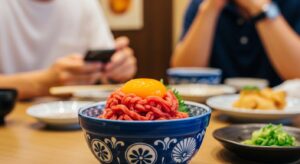
That's exactly what we designed it for. The menu includes a five-step visual guide for enjoying the rare wagyu gyudon — how to separate the egg, when to add condiments, how to use the wasabi at the end. It turns what could feel like an unfamiliar experience into something you move through with confidence.
The Business Lunch Case: Why Itadaki Became a Repeat Destination
Here's something I don't often talk about publicly, but it's worth saying plainly: Itadaki was conceived during a difficult period — the pandemic years — when I was thinking seriously about what makes a restaurant genuinely worth returning to, not just visiting once. The answer I kept coming back to was this: the sourcing has to mean something.
Every ingredient at Itadaki comes from Aichi Prefecture. The beef — either Horai Wagyu from Okumikawa or Mikawa Beef from the Mikawa region — is sourced directly from local farms. The rice is Aichi no Kaori, grown in Aichi. The egg is from Yamada Poultry Farm's Nagoya Cochin chickens. The miso soup uses Hatcho miso from Okazaki. The pickles come from the Atsumi Peninsula.
For a business traveler spending time in Aichi — visiting Toyota facilities, meeting local suppliers, attending industry events — there's something meaningful about eating a lunch where every element comes from the prefecture you're working in. It's not a tourism pitch. It's an honest expression of what this region produces.
The Horai Wagyu in particular is worth planning around. Only 300 heads are raised annually across just three farms in Japan. At Itadaki, we serve a maximum of 10 bowls per day. If you're planning your visit around the Shinkoccho (our standard-size Horai Wagyu bowl at ¥2,700), I'd recommend making a reservation via Tabelog in advance — and noting 鳳来牛希望 in the reservation comments to request it specifically. For walk-in visits, Mikawa Beef Rare Gyudon is always available and prepared with the same two-stage cooking technique.
The technique itself is worth a brief mention, especially for visitors with food safety questions about rare-style beef. Our proprietary two-stage cooking method heats the beef to over 70°C at the core — fully meeting Japan's Ministry of Health, Labour and Welfare food safety standards. The rare texture is real; the safety concern is resolved. It's one of the things we're most quietly proud of at Itadaki, because achieving that result consistently required genuine culinary problem-solving, not just a stylistic choice.
"I've had Kobe beef and Matsusaka beef, but Horai Wagyu at Itadaki was on another level."
— Guest review
Making It Work With Your Nagoya Schedule
Most business travelers I speak with have similar constraints: a morning of meetings, a lunch window somewhere between 11:30 and 13:30, and an afternoon commitment they can't miss. Here's how Itadaki fits into that shape.
From the major business districts in central Nagoya — around Nagoya Station, Fushimi, or Sakae — Itadaki is 10 to 15 minutes by subway. The meal itself, from seating to finishing, typically takes 45 to 60 minutes. That gives you a comfortable margin for a 90-minute lunch block.
If you're coming from Toyota City or other locations outside the city center, the JR and Meitetsu lines connect to Nagoya Station, and from there the Higashiyama-to-Meijo transfer takes you to Yabacho in about 10 minutes. The full journey from Toyota City to Itadaki is roughly 50 to 60 minutes depending on your starting point — so it works best as a dedicated lunch excursion rather than a quick detour.
For those exploring the Osu district before or after lunch: Osu Kannon Temple is a 5-minute walk, and Hisaya-odori Garden Flarie — a free-admission urban garden that's genuinely worth 30 minutes — is just 3 minutes from Yabacho Station. If you arrive a little early, that garden is a good place to decompress before sitting down to eat.
We don't offer dinner service — Itadaki is lunch only, 11:00 to 15:00 (last order 14:30). That's a deliberate choice rooted in our commitment to freshness. Every bowl is prepared from the morning's sourcing, and the quality we maintain is only possible within that window.
If you're ready to plan your visit, I'd encourage you to lock in your reservation in advance — especially if Horai Wagyu is on your list. For our complete menu, access details, and store information, visit our official page at https://itadaki8.com/english/.
The business traveler who walked past three times ended up coming back four more times during his Aichi project. He now sends the access instructions to colleagues before their first visit. That's the kind of regular I most appreciate — not just someone who enjoyed the meal, but someone who understood what the meal was about.
We'll leave the light on at the top of the stairs.
Reserve Your Rare Wagyu Experience — and if you're checking our open days before you book, our monthly business calendar is updated regularly on Instagram: Check Our Monthly Schedule on Instagram.