Osu District Dining During Asian Games 2026: Nagoya's Hidden Rare Beef Bowl
 gotowp
You're walking through Osu after a session at the Asian Games venues, phone in hand, scrolling through the photos from the day — the stadium energy, the street scenes, the temple shots. Then a familiar frustration sets in: the food photos all look the same. Ramen. Conveyor-belt sushi. Another curry. Beautiful, sure. But nothing that makes your followers stop mid-scroll and ask, "Wait — what is THAT?"
That gap — between eating well and eating something genuinely worth telling a story about — is exactly what this post is for. If you're spending time in Osu during the Asian Games 2026, there's something nearby that I think deserves a place on your itinerary not just for your stomach, but for your story.
Who This Is For
- ✅ Asian Games visitors exploring Osu district between events and looking for a lunch that stands out
- ✅ Travelers who've already done Kobe beef or Matsusaka and want to discover what's next
- ✅ Anyone building a Japan food itinerary where every meal needs to be worth sharing
- ✅ Foodies drawn to dishes that have a real story behind them — not just a high price tag
- ✅ Visitors to Nagoya who want to come home with content their followers will genuinely ask about
The Dish Nobody Outside Japan Knows About Yet
Let me tell you something we don't say loudly enough: there are approximately 500,000 wagyu cattle raised in Japan each year. Of those, only 300 are Horai Wagyu.
Three hundred. Raised across just three farms in Aichi Prefecture's Okumikawa region. Fed on sake lees from Horaisen Sora — one of Aichi's most respected premium sake breweries. The flavor profile that creates is genuinely unlike anything else in the wagyu world: a lightness in the fat, a cleanness in the finish, something almost delicate beneath the richness. It's not a flavor that marketing invented. It's a flavor that geography and farming practice built over time.
When I started Itadaki in Osu back in April 2022, Horai Wagyu was one of the ingredients I knew we had to build around. Most visitors to Japan — even serious wagyu enthusiasts — have never heard of it. That's not because it isn't extraordinary. It's because the supply is so limited that it rarely leaves the farms that produce it.
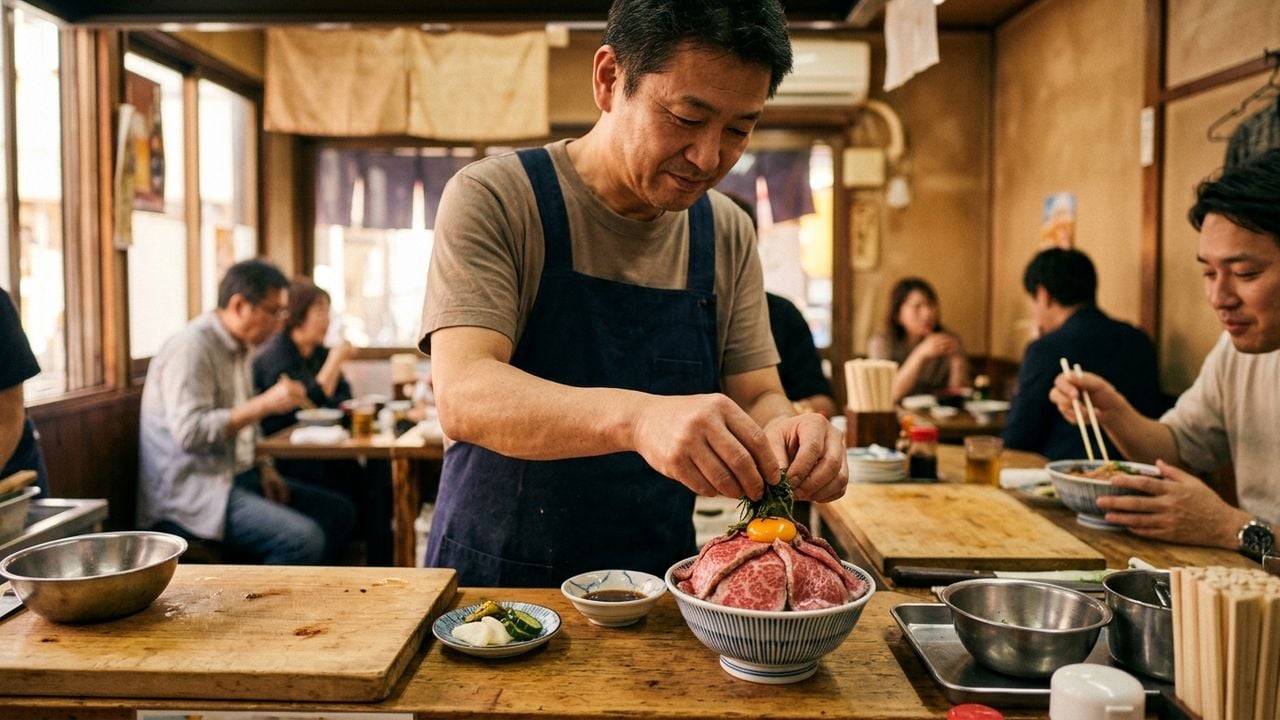
We serve it in a form that nobody had tried before: as the centerpiece of a rare-style gyudon — Japan's classic beef bowl, reimagined from the ground up. And because we limit Horai Wagyu to just 10 bowls per day, the people who do eat it tend to feel like they've found something the rest of the world doesn't know yet. In the age of social media, that feeling is surprisingly rare. And it's exactly the kind of thing worth posting about.
You're planning around the Asian Games schedule, and the last thing you want is to arrive on the wrong day. Itadaki operates on a set weekly schedule with occasional irregular closures — our Instagram posts the monthly business calendar so you can confirm before you commit. Takes thirty seconds to check.
What We Don't Say Out Loud (But Shapes Everything on the Plate)
Here's the part that rarely makes it into a menu description.
The "rare" texture in our Horai Wagyu gyudon isn't an accident, and it isn't a loophole. It's the result of a proprietary two-stage cooking technique that we developed over time — a method that heats the beef to above 70°C at the core, fully meeting Japan's Ministry of Health, Labour and Welfare food safety standards, while preserving the mouthfeel of wagyu that hasn't been overcooked. That combination is technically difficult to achieve. Most restaurants don't attempt it.
Why does this matter to you as a visitor? Because when you see that beautifully arranged plate arrive — the wagyu resting on Aichi no Kaori rice, the golden Nagoya Cochin egg yolk waiting to be broken, the shiso leaves and pickled radish in place — you're not looking at a dish built for aesthetics alone. Every element earned its place through testing, iteration, and an obsessive commitment to getting it right.
The sauce, for instance, is built on white soy sauce sourced from Hekinan City, blended with wine and seasonings we've refined since opening. The onions are simmered in the same sauce that briefly coats the beef before the second stage of cooking. The miso soup carries Hatcho miso from Okazaki alongside Atsumi aosa seaweed from the peninsula south of Nagoya. The tabletop condiments — pickled ginger from Kimura Farm in Inazawa, dried whitebait from Minamichita, chopped seaweed from Himakajima in Mikawa Bay — are all there to open new dimensions of flavor as you work through the five-step eating guide included with every bowl.
Every single ingredient comes from Aichi Prefecture. That's not a marketing line. It's a constraint we set deliberately, and one that shapes every sourcing decision we make.
✓ Key Takeaways
- Horai Wagyu is among the rarest wagyu in Japan — only 300 heads produced annually, available at Itadaki in Osu as a strictly limited 10-bowl daily offering
- The "rare" texture is achieved through a proprietary two-stage cooking method that fully meets Japanese food safety standards — not a compromise, a craft achievement
- Every ingredient on the plate is sourced exclusively from Aichi Prefecture, creating a coherent "taste of Aichi" that no other restaurant replicates
Horai Wagyu is limited to 10 bowls a day — and during the Asian Games period, Osu foot traffic will be higher than usual. Reserving via Tabelog is the only way to guarantee your bowl is waiting when you arrive. The reservation form is in Japanese, but the process is straightforward.
Why the Story Matters as Much as the Taste
I travel whenever I can. Exploring restaurants abroad, understanding how different food cultures express their identity through ingredients and technique — it's something that never stops fascinating me. And one thing I've noticed is that the meals people remember longest aren't always the most expensive ones. They're the ones with a story attached.
"We ate wagyu at this tiny place in Nagoya's Osu district — you've never heard of this breed, but it's fed on sake lees from a famous local brewery and only 300 are raised per year in the whole country." That's a story. It has specificity. It has rarity. It has the kind of detail that makes the person listening lean forward.
One of our guests put it simply after their visit:
"Instagram-worthy presentation and unforgettable taste. My followers keep asking about it."
That reaction isn't something we engineer. It happens because the dish genuinely looks as striking as it tastes, and because the narrative behind it — the farms, the sake lees, the cooking technique, the Aichi-only sourcing — is the kind of thing people want to explain to their friends. You're not just sharing a photo. You're sharing a discovery.
If you're visiting Nagoya during the Asian Games 2026 and you want one meal that becomes a permanent part of your travel story, this is the one I'd point you toward. Itadaki is a four-minute walk from Yabacho Station Exit 4 on the Meijo Subway Line — the same line that connects central Nagoya to most of the Games' central areas. From Nagoya Station, you're looking at about ten minutes total by subway. The Osu Kannon Temple is a short walk away, and combining an Osu sightseeing morning with lunch here makes for a genuinely satisfying half-day without needing to travel far.
Practical Notes for Asian Games Visitors
A few things worth knowing before you come, especially during what promises to be a busy September in Nagoya.
We're open for lunch only — 11:00 to 15:00, with last order at 14:30. During the Asian Games period, Osu will be livelier than usual, and we expect our Horai Wagyu allocation to sell out earlier in the day than normal. If you have your heart set on Horai Wagyu, reserving in advance via Tabelog is the surest way to secure it. Walk-ins are welcome, but availability of Horai Wagyu cannot be guaranteed after peak hours.
Our regular business days are Saturday, Sunday, Monday, and Tuesday. September 17 falls on a Thursday, which is one of our regular rest days — so if you're planning around a specific date, checking our monthly business calendar on Instagram before you finalize your plans is the most reliable way to confirm we're open on the day you're visiting. We post our schedule monthly and update for any irregular closures.
For groups who want to make the lunch a proper occasion — perhaps a team meal, a family gathering, or a celebration during your Asian Games trip — we can accommodate full restaurant buyout for groups of up to 18 people. Reach out via Instagram DM in advance to arrange.
We have printed menus in English, Simplified Chinese, and Korean, along with a photographic five-step guide for enjoying the dish. You don't need Japanese to have a great experience here. Our team is prepared to welcome international guests, and the dish itself is designed to communicate across language.
If you want to understand the broader food landscape around the Asian Games venues and how Osu fits into Nagoya's dining geography during this period, this guide to dining near the Aichi-Nagoya 2026 Asian Games venues covers the practical context well.
One Bowl. One Story. Worth the Walk.
The Asian Games bring together athletes and visitors from across Asia and beyond — people who are already primed to experience something they couldn't find at home. Osu, with its layered identity (temple, shopping street, subculture, hidden restaurants), is exactly the kind of neighborhood that rewards curiosity.
Itadaki sits in the middle of it, on the second floor of a building on Osu's main street, serving something the rest of the world hasn't named yet: the original rare wagyu gyudon. The concept exists because of a question asked during a difficult time — "why doesn't Japan's most beloved comfort food have a premium version?" — and the answer turned out to be a dish worth traveling for.
When your followers ask what you're eating in that photo, you'll have something real to tell them. Not just "wagyu in Japan." The story behind every bowl at Itadaki is specific, honest, and — in all the ways that count — genuinely rare.
For our complete menu, access details, and store information, visit our official page at https://itadaki8.com/english/
You've read about the 300-head rarity, the two-stage cooking technique, and the Aichi-only sourcing — now the only thing standing between you and that photo your followers will keep asking about is a confirmed seat. Horai Wagyu sells out on busy days, and the Asian Games period is one of the busiest Osu will see.