4-Min Walk from TIAD Nagoya (Autograph Collection): 10-Bowl Daily Rare Wagyu
 gotowp
You've just settled into your room at TIAD Nagoya, Autograph Collection, and you pull up your Japan food list. Near the top: Itadaki, the restaurant that invented Rare Wagyu Gyudon — and it's a 4-minute walk from your hotel. You think, perfect, I'll just walk in at lunch. Then you read the line that stops you cold: only 10 bowls of Horai Wagyu per day.
That number is not a marketing angle. Horai Wagyu is raised by just 3 farms in Aichi Prefecture, with only 300 heads produced annually across all of Japan. Out of roughly 500,000 wagyu cattle raised nationwide, 300 are Horai. The math means that on any given lunch service, the moment those 10 bowls are claimed — by reservation or by early walk-ins — they're gone. If you're on a tight Nagoya itinerary, arriving to an empty board is not a recoverable situation.
This article walks you through the exact steps to make sure that doesn't happen to you.
Who This Is For
- ✅ Guests staying at TIAD Nagoya or nearby hotels who want to plan a Horai Wagyu lunch without guesswork
- ✅ Travelers with only one or two days in Nagoya who cannot afford a sold-out surprise
- ✅ Visitors unfamiliar with Tabelog or Japanese reservation platforms who want a clear, step-by-step guide
- ✅ Anyone who has already tried Kobe or Matsusaka beef and wants to discover what makes Horai Wagyu genuinely different
- ✅ Solo diners, couples, and small groups who want to understand their walk-in options if they can't reserve in advance
Step 1 — Understand Why 10 Bowls Is the Real Number
Before you plan your visit, it helps to understand what you're actually dealing with. Horai Wagyu is a Kuroge Wagyu (Japanese Black) cattle breed raised in Okumikawa, deep in the mountains of Aichi Prefecture. What sets it apart from most wagyu is the feeding method: these cattle are raised on sake lees from Horaisen Sora, a renowned local premium sake. The result is a beef with an unusually balanced profile — delicate marbling alongside clean lean-meat flavor — a combination that's rare even within the wagyu world.
With only 3 farms producing 300 heads per year, the supply reaching Itadaki on any given day is genuinely finite. Founder Masayuki Goto, who holds direct-supply partnerships with the Horai Wagyu farms, made the decision not to overextend the allocation. Ten bowls per day is not a soft cap — it is the ceiling, and it reflects an honest commitment to ingredient quality over volume.
Goto launched Itadaki in April 2022 in Osu, just a 4-minute walk from Yabacho Station (Meijo Subway Line) — the same station you'd use from central Nagoya. The concept grew from a straightforward question he posed during the pandemic: if katsudon, oyakodon, and kaisendon all have premium versions, why does gyudon only exist as fast food? That question became a restaurant, and that restaurant has since been featured on 8 major Japanese TV programs, including NHK.
Itadaki's business calendar includes irregular closures that aren't reflected in static listings — and your visit window from TIAD Nagoya may be just one or two days. The monthly schedule, including any closure dates for your specific visit period, is published on Itadaki's official Instagram before each month begins. A quick check now saves you from arriving on a closed day.
Step 2 — Reserve via Tabelog (It's Easier Than You Think)
Tabelog is Japan's leading restaurant review and reservation platform. If you've never used it outside Japan, the name might be unfamiliar — but the reservation process itself is straightforward in English, and this is the only online reservation channel Itadaki accepts.
Here is the process, broken into clear steps:
- Go to the Tabelog reservation page. You can find the direct booking link from Itadaki's official English page at itadaki8.com/english/, where you'll also find the full menu, access map, and business hours.
- Select your date and party size. Itadaki is open Tuesday, Monday, Saturday, Sunday, and public holidays (11:00–15:00, with last order at 14:30). Wednesday through Friday are closed. On public holidays, the restaurant opens at 9:00. Always confirm the current monthly schedule on Instagram before finalizing your plans, as irregular closures do apply.
- In the notes or special requests field, copy and paste this phrase: 鳳来牛希望 — This tells the restaurant you are specifically requesting Horai Wagyu. Without this note, your reservation secures a table but not the Horai Wagyu allocation.
- Complete the reservation in English. Tabelog's reservation interface is usable in English. You do not need to write Japanese yourself — just paste the phrase above.
That phrase, 鳳来牛希望, translates to "Horai Wagyu requested." It is the single most important thing you can do to guarantee that when you walk through Itadaki's door from TIAD Nagoya, your bowl is already waiting.
✓ Key Takeaways
- Horai Wagyu is capped at 10 bowls per day — not because of marketing, but because of genuine supply limits (300 heads/year across 3 farms in Japan).
- Advance reservation via Tabelog, with the note 鳳来牛希望 in the special requests field, is the only reliable way to guarantee Horai Wagyu availability.
- The Tabelog reservation process can be completed in English — no Japanese fluency required.
You now know the one phrase — 鳳来牛希望 — that secures Horai Wagyu when you reserve. Without it in the notes field, your table is confirmed but the bowl isn't. The Tabelog reservation page takes only a few minutes to complete in English, and it's the only way to guarantee all 10 daily bowls aren't already claimed when you arrive.
Step 3 — Your Walk-In Options If You Can't Reserve
Not everyone can plan days ahead. If you're a spontaneous traveler or if your schedule shifts — which happens often in Japan — there are still two strong options.
Arrive at 11:00 opening. Walk-in guests who arrive right when the doors open have the best chance of accessing Horai Wagyu without a reservation. Peak lunch hours see the allocation disappear quickly, but the first wave of guests at opening often includes walk-ins who planned ahead in a different way: by simply arriving first.
Order Mikawa Beef Rare Gyudon. This is Itadaki's second signature dish, and it's always available for walk-in guests. Mikawa Beef is raised in Aichi's Mikawa region on a distinctive okara feed with lactic acid bacteria gut management — producing a clean, lean-cut beef (uchimomo) with its own character. It's prepared using the exact same proprietary two-stage cooking technique as the Horai Wagyu version: heated to over 70°C at the core to fully meet Japan's Ministry of Health, Labour and Welfare food safety standards, while preserving that signature rare mouthfeel that makes Itadaki unlike any other gyudon restaurant.
The Mikawa Beef Rare Gyudon starts at ¥1,800 for the Fumoto size (100g beef, 200g rice). Every accompanying ingredient — the Aichi no Kaori rice, the Hatcho miso soup, the Atsumi Ichō-zuke pickles, the Nagoya Cochin egg from Yamada Poultry Farm — is sourced entirely from Aichi Prefecture, just like the Horai Wagyu version.
"I traveled to Nagoya specifically to eat here — it was 100% worth it."
— A guest who made Itadaki the reason for their Nagoya visit
That kind of commitment — traveling to a city specifically for one bowl — speaks to what this experience delivers. And the practical reality is: whether you're having Horai Wagyu or Mikawa Beef, the culinary concept, the cooking technique, and the complete Aichi ingredient story remain intact.
Step 4 — How to Get There from TIAD Nagoya
From TIAD Nagoya, Autograph Collection, Itadaki is a 4-minute walk. The restaurant is located on the 2nd floor at 4-1-20 Osu, Naka-ku. If you prefer to orient by subway, Yabacho Station Exit 4 (Meijo Subway Line) is the closest stop — also just 4 minutes on foot from the station to the restaurant.
There is no dedicated parking, but coin parking lots are available in the Osu area within a 1–3 minute walk. Public transportation is the most practical option for this neighborhood.
Itadaki is also within walking distance of Sakae Station, Kamimaezu Station, and Osu Kannon Station — so if your hotel itinerary includes a morning visit to Osu Kannon Temple or a stroll through Hisaya-odori Garden Flarie (3 minutes from Yabacho Station), you can chain those experiences naturally into a lunch visit without backtracking.
If you're curious how other travelers have structured a full day around this part of Nagoya, this account of combining Nagoya sightseeing and Rare Wagyu in a single day gives a useful real-world itinerary to reference.
Step 5 — What to Expect When You Arrive
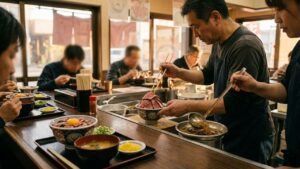
Itadaki has 18 seats total — all table seating with comfortable sofa chairs — including 5 counter seats ideal for solo visitors. There are no private rooms. The atmosphere is relaxed and unhurried, designed for guests who want to eat with attention rather than rush.
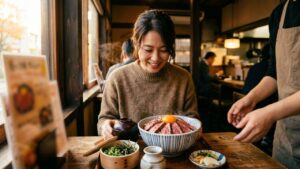
The English menu is printed and available on arrival. A photographic five-step guide walks you through how to enjoy the dish — from separating the Nagoya Cochin egg (white into the miso soup, yolk over the beef) to layering in the complimentary condiments at your own pace. Staff are accustomed to welcoming international guests, and the experience is designed to be stress-free even without Japanese.
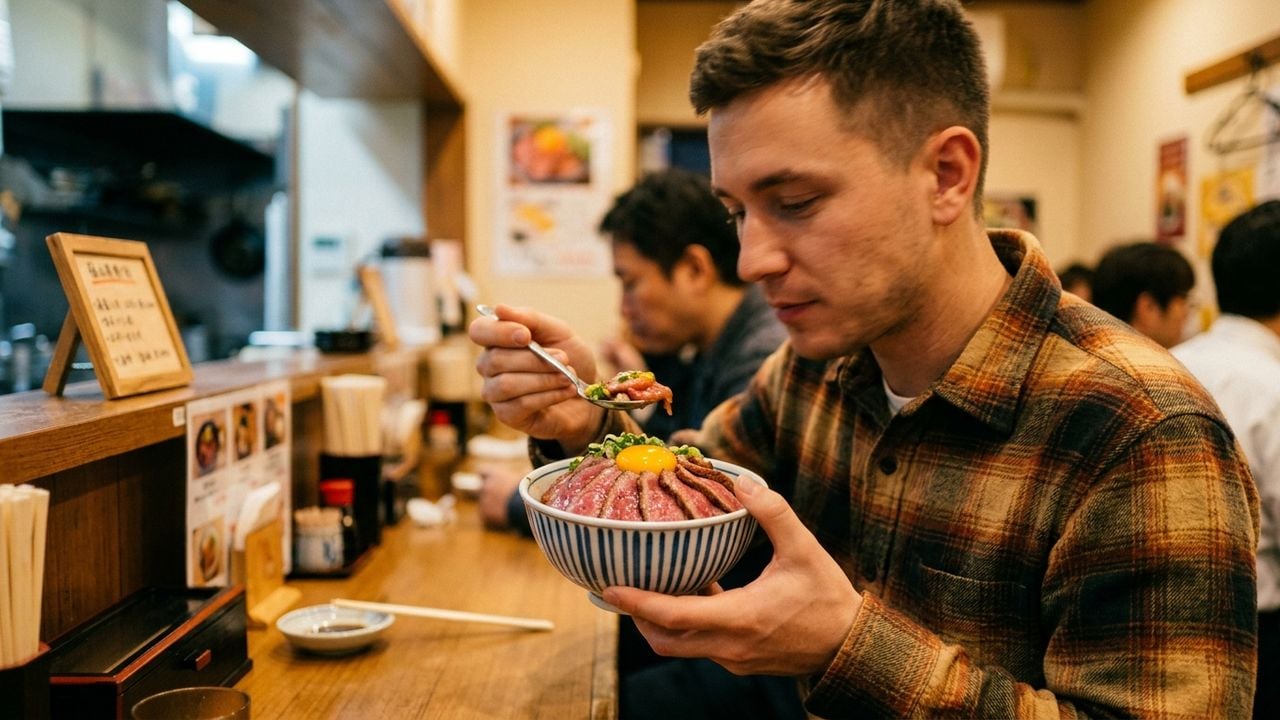
One practical note on the five-step eating guide: take it seriously. The dish is built to be experienced in sequence — the Horai Wagyu in its pure rare form first, then with the yolk, then with pickled ginger and nori, and finally with wasabi for a clean finish. Each stage genuinely tastes different. Guests who skip the steps and mix everything at once miss what the dish is actually doing.
You may also want to explore Itadaki's full beverage selection — all made with Aichi specialties, including Kinshachi Beer (Nagoya's craft beer pioneer) and the Chita Highball using whisky from Aichi's Chita Distillery. These are à la carte additions, not bundled with any course.
For guests who have previously explored Nagoya's historic side — Nagoya Castle, Atsuta Shrine, or the samurai districts — and are now looking for a food experience that ties into Aichi's regional identity, this first-person account of moving from Nagoya Castle to a Rare Wagyu bowl captures that particular kind of day well.
Before You Leave TIAD Nagoya
If Horai Wagyu is on your Japan food list, the steps are clear: reserve via Tabelog, add 鳳来牛希望 in the notes field, and arrive knowing your bowl is secured. If you're traveling on shorter notice, walk in at 11:00 or order Mikawa Beef — the same craft, the same Aichi story, always available.
Either way, the 4-minute walk from TIAD Nagoya leads somewhere worth the planning. Itadaki's entire existence is built on the idea that gyudon — Japan's most everyday dish — deserves to be made with the same care and intentionality as any fine dining experience. That idea shows up in every bowl, whether it carries Horai Wagyu or Mikawa Beef.
For our complete menu, access details, and store information, visit our official page at itadaki8.com/english/.
You've read every step — the 10-bowl limit, the Tabelog process, the 鳳来牛希望 note, and what to do if you're walking in without a reservation. The only thing left is to lock in your seat before your Nagoya day fills up. Horai Wagyu moves fast once the doors open.