7 Signature Elements of Itadaki's Rare Wagyu Gyudon Experience
 gotowp
September in Nagoya has a particular energy to it. The summer heat hasn't fully lifted, but there's a shift in the air — and the streets of Osu are buzzing. Visitors are pouring into the district from every direction: some here for the shopping, some for Osu Kannon Temple, some just following Google Maps down narrow covered arcades, not entirely sure where they'll end up.
That uncertainty is familiar to a lot of guests who find their way to Itadaki. Osu is one of those rare neighborhoods that rewards the explorer — but it can also swallow up a lunch reservation if you're not quite sure where to look. We hear from visitors regularly who almost missed us because they were searching at street level and didn't realize we were one floor up.
So before we walk through the seven elements that define the Rare Wagyu Gyudon experience here, let's start with the thing that matters most: actually getting through the door.
Who This Is For
- ✅ First-time visitors to Nagoya who find Osu's winding streets confusing to navigate
- ✅ Wagyu enthusiasts who've tried Kobe and Matsusaka beef and want to discover what else Japan is hiding
- ✅ Travelers with a tight lunch window who need to plan their route before arriving
- ✅ Anyone wondering what makes a wagyu gyudon experience genuinely different from bowl to bowl
- ✅ Solo diners, couples, or families visiting Osu and looking for a meaningful lunch stop
Finding Itadaki: The Part Nobody Warns You About
Here's the situation a lot of guests describe: they've saved Itadaki on Google Maps, they've found the right block, and then they walk straight past us. It happens more often than you'd think, and the reason is simple — we're on the 2nd floor of the building at 4-1-20 Osu, Naka-ku. At street level, what you're looking for is a sign that reads 「元祖レア牛丼 頂」 (pronounced Ganso Rea Gyudon Itadaki). That's your landmark. Find the sign, find the staircase, come up.
The most reliable route from Nagoya Station takes about 10 minutes total. Take the Higashiyama Line from Nagoya Station toward Sakae, then transfer at Sakae to the Meijo Line and ride one stop to Yabacho Station. Come out of Exit 4, and Itadaki is a 4-minute walk from there. You can also reach us on foot from Sakae Station, Kamimaezu Station, or Osu Kannon Station — all are within comfortable walking distance depending on where you're starting.
If you're staying near Osu Kannon Temple or the main Osu Shopping Street entrance, use those as your orientation anchors. Hisaya-odori Garden Flarie is just a 3-minute walk from Yabacho Station — many guests pair a stroll through the garden with lunch at Itadaki on the same afternoon.
One practical note: Google Maps is occasionally imprecise in this part of Osu due to the density of small streets and the building's upper-floor location. We'd recommend using the direct Google Maps link on our website rather than searching by address alone. For our complete access details and a map link, visit our official page at Itadaki's English information page.
✓ Key Takeaways
- From Nagoya Station: Higashiyama Line → Sakae → Meijo Line → Yabacho (Exit 4), then 4 minutes on foot. Total: approximately 10 minutes.
- Look for the sign 「元祖レア牛丼 頂」 at street level — Itadaki is on the 2nd floor, accessed by staircase.
- Google Maps can be imprecise here; use the direct link on our website for accurate navigation.
Horai Wagyu is capped at 10 bowls a day — and September is a busy time in Nagoya, with visitors moving through the city before and after the Asian Games. If you've already decided this bowl is on your itinerary, the practical next step is locking in your seat before you arrive in Osu. Reservations are handled through Tabelog online.
You've got the route mapped and the staircase spotted — but Itadaki's schedule isn't fixed week to week, and an irregular closure on the day you planned could mean missing the only 10 Horai Wagyu bowls served that afternoon. Our monthly business calendar, including any closures, is posted every month on Instagram before your visit turns into a wasted trip. Takes less than a minute to check.
Once You're Upstairs: The 7 Signature Elements
The journey to the table is only half the story. What follows is what guests actually talk about afterward. Here's how the experience unfolds — and why each element is deliberate, not incidental.
Element 1 — Horai Wagyu: 300 Out of 500,000
Japan raises roughly 500,000 wagyu cattle at any given time. Horai Wagyu, produced in the Okumikawa highlands of Aichi Prefecture, accounts for just 300 heads annually — across only 3 farms. That's not a marketing number. It's a genuine constraint of how the beef is raised: slowly, on a diet that includes sake lees from Horaisen Sora, a premium local sake, which shapes a flavor profile you simply can't replicate at scale.
One guest put it plainly after their visit: "I've had Kobe beef and Matsusaka beef, but Horai Wagyu at Itadaki was on another level." That reaction isn't uncommon — and it often surprises even seasoned wagyu enthusiasts who arrive with high expectations. The difference isn't just marbling. It's a balance of light fat and lean meat flavor that's unusually clean for wagyu.
"I've had Kobe beef and Matsusaka beef, but Horai Wagyu at Itadaki was on another level."
— A guest who visited Itadaki during their Nagoya stay
Because availability is genuinely limited — just 10 bowls of Horai Wagyu per day — we recommend reserving your bowl in advance via Tabelog, especially if you're visiting during peak hours. If you'd like to understand more about how this beef compares to what you may have tried before, this account from a wagyu enthusiast's first rare gyudon experience gives a vivid sense of what to expect.
Element 2 — The Two-Stage Cooking Technique
Founder Masayuki Goto spent years developing the method that makes this dish possible. The beef is cooked using a proprietary two-stage process that brings the core temperature above 70°C — fully satisfying Japan's Ministry of Health, Labour and Welfare food safety standards — while preserving the silky, rare-style texture that defines the dish.
This isn't a shortcut or a workaround. It's a genuine technical achievement, and it's why guests can enjoy the sensation of rare wagyu without any of the safety concerns that come with truly raw beef. The technique took years to refine and represents one of Itadaki's most significant contributions to Japanese culinary innovation.
Element 3 — The Magic Sauce
The sauce is deceptively quiet. Built on a base of white soy sauce from Hekinan City in Aichi Prefecture and blended with wine, it does two jobs: it briefly dips the beef before plating, and it simmers the onions that accompany the bowl. The result is a flavor that enhances the wagyu without competing with it — slightly sweet, deeply savory, and unlike anything you'd find in a mass-produced version.
Element 4 — Everything From Aichi
The rice is Aichi no Kaori, grown in Aichi Prefecture. The egg is a Nagoya Cochin egg from Yamada Poultry Farm. The pickles are traditional Atsumi Ichō-zuke from the Atsumi Peninsula. The shiso leaves are Aikei No.1 from Toyohashi. The miso soup is made with Hatcho miso from Okazaki City.
Every element on the table traces back to a specific farm, region, or producer within Aichi. This isn't branding — it's a commitment Goto made when he conceived Itadaki during the pandemic, when small local farms were struggling with unsold harvests. The bowl you're eating is a direct expression of that commitment.
Element 5 — The Five-Step Eating Ritual
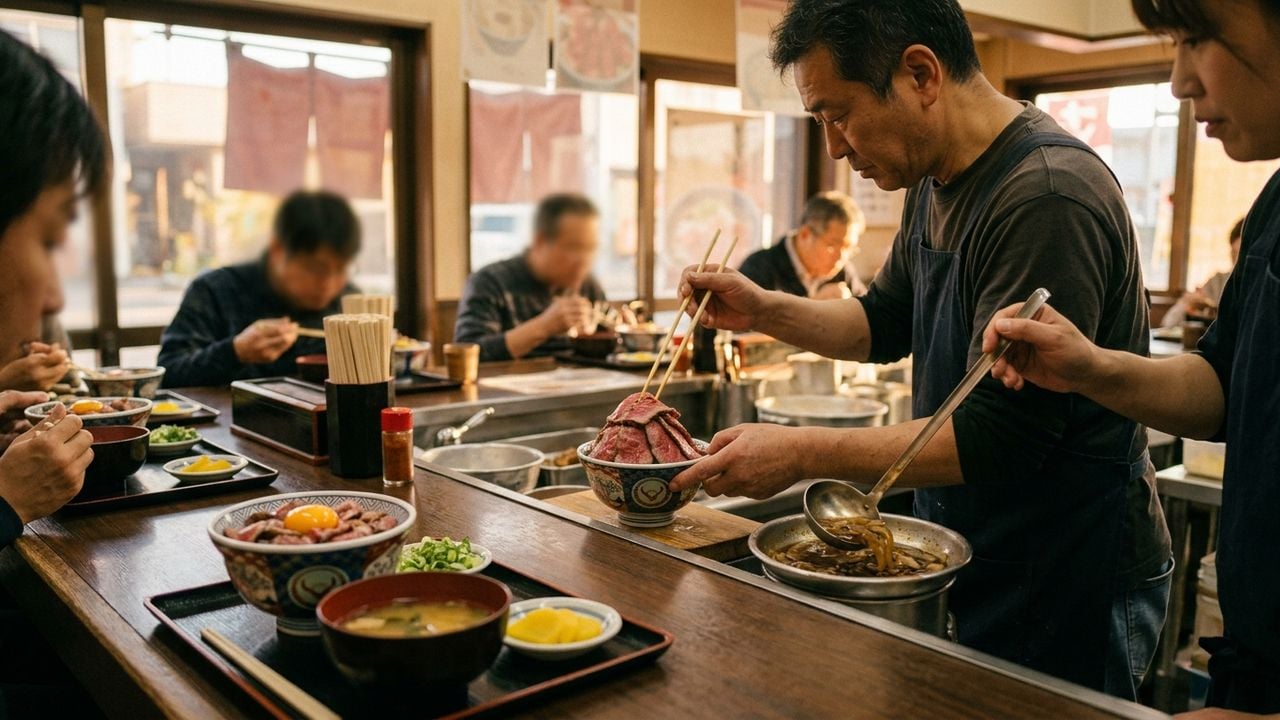
When the bowl arrives, it comes with a printed guide (available in English, Simplified Chinese, and Korean) that walks you through five deliberate steps for enjoying the dish. Separate the Nagoya Cochin egg — white into the miso soup, yolk onto the beef. Taste the wagyu first in its pure form. Then fold in the yolk for a richer, silkier bite. Add the complimentary condiments — pickled ginger, dried Mikawa Bay nori, chirimen jako from Minamichita, Itadaki's original 8-spice blend — to discover new layers. Finish with wasabi for a clean final note.
Guests consistently mention this guide as one of the things that made the experience feel considered rather than rushed. It also gives solo diners a natural pace to follow, which is why the counter seats — five of them, facing the open kitchen — work so well for visitors dining alone.
Element 6 — The Complimentary Condiment Table
The small jars and dishes arranged at your table are not afterthoughts. Pickled ginger from Kimura Farm in Inazawa City. Chopped nori from Himakajima island in Mikawa Bay. Chirimen jako (dried whitebait) from Minamichita. Itadaki's original 8-spice blend — also available as a souvenir to take home. Each one is there to change the character of the bowl as you work through it, so the last bite tastes genuinely different from the first.
Element 7 — The Story You'll Tell When You Get Home
Some meals are forgettable. Some stay with you because of what you tasted. And some stay with you because of what you understood while you were eating — where the beef came from, what it took to raise it, why someone decided the world needed a Rare Wagyu Gyudon when no one else had thought to make one.
Goto named the restaurant Itadaki — a word drawn from itadakimasu, the Japanese expression of gratitude spoken before every meal. That name reflects something real about how every bowl here is prepared: with respect for the farmers, the craft, and the guest who's traveled, sometimes quite far, to sit down for lunch in a second-floor restaurant in Osu.
If you'd like a deeper look at how this concept came to be, the story behind Itadaki as the original Rare Wagyu Gyudon traces the full journey from idea to bowl.
Planning Your Visit
Itadaki is open for lunch only — 11:00 to 15:00 on Saturdays, Sundays, Mondays, and Tuesdays, with last order 30 minutes before closing. On public holidays, doors open at 9:00. We're closed Wednesday through Friday. The restaurant has 18 seats in total: five counter seats, and a mix of sofa table seats that work well for couples, families, and small groups.
Because Horai Wagyu is limited to 10 bowls per day and can sell out during peak hours, a reservation via Tabelog is strongly recommended. Our monthly business calendar — including any irregular closures — is posted on our official Instagram account.
For our complete menu, access details, and store information, visit our official page at https://itadaki8.com/english/.
The seven elements above only fully make sense when they arrive at your table together — the rare texture, the Horai Wagyu's clean fat, the five-step ritual unfolding bowl by bowl. With just 10 Horai Wagyu servings available each day, the one thing that can disrupt that experience is arriving without a reservation. Secure your spot now through Tabelog so the only thing to think about on the day is which exit to take from Yabacho Station.