What Is Itadaki and Why Is It the Original Rare Wagyu Gyudon?
 gotowp
September in Nagoya carries a particular kind of energy. The Asian Games are underway, Osu district is buzzing with visitors from across Asia and beyond, and travelers everywhere are hunting for that one experience — the meal, the photo, the story — that will define their Japan trip long after they've returned home. Not just something that tasted good. Something they can actually tell people about.
If that's what you're looking for, Itadaki is where the search ends.
Itadaki is the world's original Rare Wagyu Gyudon specialty restaurant — the place that invented an entirely new category of Japanese cuisine by reimagining the humble beef bowl as a raw-style wagyu experience using ultra-rare ingredients sourced exclusively from Aichi Prefecture.
Who This Is For
- ✅ Travelers who want a Japan food story that goes beyond "I had sushi in Tokyo" or "I tried Kobe beef"
- ✅ Wagyu enthusiasts curious about rare regional Japanese beef brands they've never encountered before
- ✅ Visitors staying in Nagoya for the Asian Games, sightseeing, or en route to Shirakawa-go or Takayama
- ✅ Anyone who wants their Instagram food content to spark genuine curiosity — not just likes
- ✅ Foodies who believe the story behind a dish matters as much as how it tastes
What exactly is a "Rare Wagyu Gyudon" — and did it exist before Itadaki?
No, it didn't. That's the short answer — and it matters.
Japan has premium versions of almost every iconic dish. There's high-end kaisendon, celebrated katsudon, refined oyakodon. But gyudon — the beef bowl — had always been the domain of fast-food chains and convenience. Nobody had asked: what if we used extraordinary wagyu, prepared it rare-style, and elevated the whole concept into something worth traveling for?
Masayuki Goto asked that question. In April 2022, he opened Itadaki in Osu, Nagoya, and answered it. With 18 years of experience in the food and beverage industry — including founding MAX'S BAR in 2008 — Goto held a Certified Food Sanitation Supervisor license and a direct-supply partnership with some of Aichi's most exclusive farms. He had the credentials, the sourcing relationships, and the vision. What followed was a dish that has since been featured on eight major Japanese TV programs, including NHK.
The name itself carries meaning. "Itadaki" comes from itadakimasu — the Japanese expression spoken before every meal as an act of gratitude to the farmers, the land, and the hands that prepared it. That philosophy shapes everything here, from ingredient sourcing to how each bowl is presented.
The Horai Wagyu supply is genuinely limited — 10 bowls per day — and during September's Asian Games season, availability changes week by week. Irregular closures also apply, and the only place that reflects the real schedule is Itadaki's official Instagram. Take a quick look before you finalize your Nagoya day plan.
What makes the story behind Itadaki's wagyu so shareable?
Here's where things get genuinely interesting — the kind of interesting that makes people stop scrolling.
Itadaki's signature Horai Wagyu is produced in Okumikawa, deep in Aichi Prefecture, by just 3 farms. Across all of Japan — a country that raises roughly 500,000 wagyu cattle — only 300 heads of Horai Wagyu are produced annually. These cattle are raised on a highly specific diet that includes sake lees from Horaisen Sora, one of Aichi's most respected premium sake breweries. The result is a Japanese black wagyu with a flavor profile that's both distinctively marbled and surprisingly lean — a combination that sets it apart from the richly fatty wagyu most travelers associate with Kobe or Matsusaka.
When you order the Shinkoccho (the standard Horai Wagyu gyudon, ¥2,700 tax included), you're eating from a strictly limited run of 10 bowls per day. Not because of marketing strategy — because that's genuinely how rare the supply is.
And that's exactly the kind of detail that transforms a food photo into a food story. When your followers ask "What is that?" you're not just pointing them to a restaurant. You're walking them through a narrative: a wagyu so rare it accounts for 0.06% of Japan's annual production, fed on sake lees, served in a historic district of Nagoya, invented by a chef who had the audacity to reinvent Japan's most humble comfort food.
One visitor put it simply: "The rare wagyu was unlike anything I've ever tasted — a life-changing culinary experience."
"The rare wagyu was unlike anything I've ever tasted — a life-changing culinary experience."
A guest at Itadaki
✓ Key Takeaways
- Itadaki invented the "Rare Wagyu Gyudon" concept in 2022 — no other restaurant specializes in this category
- Horai Wagyu, the signature ingredient, is produced by only 3 farms with just 300 heads annually across all of Japan
- The story behind each bowl — the sake lees diet, the Aichi sourcing, the limited daily supply — is as compelling as the flavor itself
You've now seen exactly why the 10-bowl-per-day limit on Horai Wagyu isn't a marketing device — it's a supply reality. If your Nagoya visit falls on a Saturday, Sunday, Monday, or Tuesday and you want that bowl in the story, a Tabelog reservation is the only way to guarantee it's waiting for you. The process takes just a few minutes.
Is the rare-style preparation actually safe?
This is one of the most common questions, and it deserves a straight answer.
Yes — entirely. Goto developed a proprietary two-stage cooking technique that heats the beef to over 70°C at the core, fully meeting Japan's Ministry of Health, Labour and Welfare food safety standards. The result is a texture that delivers the sensation of rare beef while being completely safe to eat. This technique represents genuine culinary innovation — it's difficult to replicate and is considered part of Itadaki's intellectual property.
So when you see "rare wagyu" on the menu, it refers to a carefully engineered mouthfeel, not an undercooked preparation. Learn more about what makes Horai Wagyu so exceptional and how it's safely prepared.
What does the actual experience look like — and why does it photograph so well?
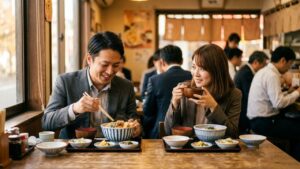
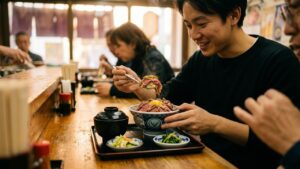
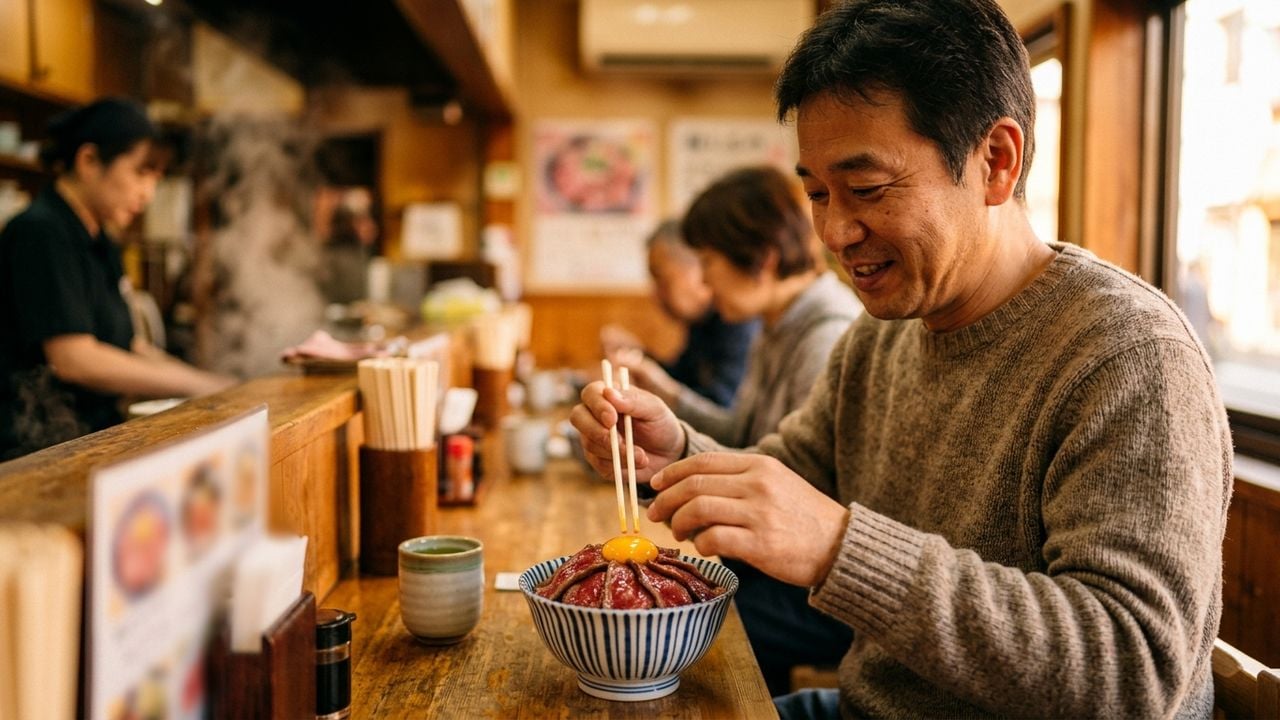
The bowl arrives as a composed arrangement: thinly sliced Horai Wagyu draped over rice made with Aichi-grown Aichi no Kaori, a raw Nagoya Cochin egg placed on top, shiso leaves from Toyohashi alongside traditional Atsumi Ichō-zuke pickles. The colors — deep crimson beef, golden yolk, vivid green shiso, white ceramic bowl — are visually striking without any artificial staging.
But what elevates it from "nice food photo" to "conversation-starting content" is the five-step eating guide that every guest receives. You begin by separating the egg — white into the miso soup, yolk atop the beef — then enjoy the wagyu in its purest form first. From there, you mix, you add condiments (pickled ginger, dried nori from Mikawa Bay, chirimen jako, Itadaki's original 8-spice blend), and you finish with wasabi. Each step creates a visibly different bowl, which means multiple moments worth capturing, not just one.
The setting is Osu, Nagoya's most atmospheric district — 400 years of history, Buddhist temples, and a labyrinth of shopping streets just outside the door. Many guests pair a visit with a stroll through Osu Kannon Temple or explore the area in kimono, making the surrounding neighborhood part of the story too.
If you're already drawn to Osu's layered culture — the kind explored in The Samurai City Rare Wagyu Discovery — Itadaki fits naturally into a full day of discovery in the area.
How do I visit, and how early should I plan?
Itadaki is open for lunch only — 11:00 to 15:00 (last order 14:30) — on Saturdays, Sundays, Mondays, and Tuesdays. On public holidays, doors open at 9:00. There is no dinner service, and the restaurant is closed Wednesday through Friday.
It's a four-minute walk from Yabacho Station Exit 4 on the Meijo Subway Line, and also reachable on foot from Sakae, Kamimaezu, and Osu Kannon stations. From Nagoya Station, the journey takes roughly 10 minutes by subway.
The Horai Wagyu option — limited to 10 bowls per day — does sell out during peak periods, especially now during the Asian Games season when Nagoya is welcoming visitors from across the region. Reservation via Tabelog is strongly recommended if you want to guarantee availability. For the monthly business calendar and any irregular closure notices, the official Instagram account (@itadaki_gyudon.08) is the most reliable source.
The restaurant seats 18 guests across counter seats and comfortable sofa tables. English, Simplified Chinese, and Korean menus are available, and the five-step eating guide is fully illustrated — designed so that the experience is genuinely stress-free for international visitors.
Why does Itadaki call itself "the Original"?
Because the concept didn't exist until Goto created it. Japan's broadcasting community — including NHK and Central Japan's major networks — has recognized Itadaki as the originator of "Rare Wagyu Gyudon." That's not a tagline. It's a documented fact, confirmed by eight TV features and three-plus years of operating the only restaurant of its kind.
The idea was born during the COVID-19 pandemic, when Goto watched small Aichi farmers — the same producers he'd built relationships with over years — struggle with unsold harvests. His response wasn't to find cheaper suppliers. It was to build a restaurant concept that would support those farms directly and permanently, by turning their extraordinary ingredients into an experience people would travel specifically to have.
That origin story — farmer relationships, pandemic-era resilience, a chef who asked why gyudon couldn't be exceptional — is woven into every bowl. It's the kind of background that makes a meal worth talking about long after the trip is over.
For our complete menu, access details, and store information, visit our official page at https://itadaki8.com/english/.
You came here asking what Itadaki is — now you have the full picture: the origin, the wagyu, the five-step experience, and the story your followers will actually ask about. The next step is straightforward: secure your bowl before the 10 daily Horai Wagyu portions are gone, especially during this busy Asian Games season in Nagoya.