Is Itadaki Really the World's First Rare Wagyu Gyudon Restaurant?
 gotowp
A guest once asked me — quite directly, in the best possible way — "Are you really the first? Or is that just marketing?" I appreciated the honesty. It's a fair question, and one I think every curious traveler deserves a straight answer to.
So let me answer it the same way I answered her: not with a sales pitch, but with the actual story of how this restaurant came to exist, and why the concept of "Rare Wagyu Gyudon" simply didn't exist before Itadaki opened in Osu, Nagoya in April 2022.
Who This Is For
- ✅ Travelers who want at least one meal in Japan that becomes a story worth telling for years
- ✅ Wagyu lovers who've already experienced Kobe or Matsusaka beef and want to discover what comes next
- ✅ Anyone skeptical of "world's first" restaurant claims — and who wants the honest facts before booking
- ✅ Visitors to Nagoya looking for a culinary experience that is genuinely impossible to replicate elsewhere
- ✅ Food enthusiasts who care about the provenance and narrative behind a dish, not just the taste
What Exactly Is "Rare Wagyu Gyudon" — and Why Didn't It Exist Before?
Before Itadaki, gyudon occupied a very specific place in the Japanese culinary imagination: fast, filling, and inexpensive. Chain restaurants had defined the category for decades. Nobody had ever reimagined it as a fine dining concept — even though Japan had already developed premium versions of katsudon, oyakodon, and kaisendon.
That gap was the puzzle I couldn't stop thinking about. Gyudon was the only donburi style that had never been elevated. My question was simple: why not use ultra-rare wagyu, a proprietary cooking technique, and a 100% Aichi Prefecture ingredient philosophy to create something the world had never seen?
The answer became Itadaki. The name comes from itadakimasu — the Japanese expression of gratitude spoken before a meal. It reflects the philosophy at the heart of everything we do: that food is a gift from farmers, land, and craft, and it deserves to be treated that way at every step.
"Rare Wagyu Gyudon" isn't just a description of the dish. It's a culinary category that didn't exist until we created it — and Itadaki is the restaurant where it was born. That's not marketing. It's simply what happened.
If the question of whether this concept is real or manufactured is still on your mind, the monthly business calendar is the most honest answer we can give. Because Itadaki operates only on scheduled days and limits Horai Wagyu to 10 bowls daily, the schedule itself reflects the reality of how this restaurant works. Our Instagram shows the actual days we're open each month — no guesswork needed.
What Makes the "Rare" Preparation Safe — and Unique?
The most common question we receive from first-time visitors is about safety. And it's a completely reasonable concern. Rare-style beef preparation is not something you expect in a beef bowl.
Here's what makes our approach different from anything else: Itadaki uses a proprietary two-stage cooking technique, developed specifically for this restaurant, that heats the beef to over 70°C at the core — fully meeting Japan's Ministry of Health, Labour and Welfare food safety standards — while preserving a texture that delivers the sensation of rare wagyu. The result is a mouthfeel that feels like a raw-style preparation, but is scientifically and legally compliant with Japan's strictest food safety regulations.
I hold a Certified Food Sanitation Supervisor qualification from Japan's Ministry of Health, Labour and Welfare, and Itadaki is a licensed restaurant operator under the Aichi Prefecture Public Health Center. The technique is our intellectual property — it took significant development time, and it's not something that can be simply copied and replicated. That's part of why the concept of Itadaki as the originator of Rare Wagyu Gyudon holds up to scrutiny.
Eight major Japanese television programs — including NHK, Japan's national public broadcaster — have recognized Itadaki as the originator of this culinary concept. That kind of acknowledgment doesn't come from a marketing claim. It comes from journalists and food critics doing their own verification.
✓ Key Takeaways
- "Rare Wagyu Gyudon" is a culinary category that did not exist before Itadaki opened in April 2022 — it was invented here.
- The rare-style texture is achieved through a proprietary two-stage cooking technique that fully meets Japan's food safety standards. Safety is built into the method, not compromised by it.
- Itadaki has been recognized as the originator of this concept by eight major Japanese TV programs, including NHK.
You now know why the 10-bowl daily limit on Horai Wagyu is not a gimmick — it reflects the actual scarcity of the ingredient and the standard of each service. That limit is also the reason walk-ins sometimes arrive to find the Horai Wagyu already sold out. Reserving in advance via Tabelog is the straightforward way to secure your bowl before the day begins.
Why Is Horai Wagyu the Ingredient That Makes This Truly Irreplaceable?
A concept can be original. But without an ingredient that matches its ambition, originality alone doesn't create a once-in-a-lifetime experience.
Horai Wagyu is that ingredient. It is a Japanese black wagyu raised in the Okumikawa mountains of Aichi Prefecture, produced by only 3 farms in Japan, with just 300 heads raised annually. To put that in perspective: there are approximately 500,000 wagyu cattle in Japan. Horai Wagyu accounts for 300 of them.
What makes Horai Wagyu extraordinary is not just its scarcity. These cattle are fed on sake lees from "Horaisen Sora" — a premium local sake from the same region — creating a beef with a flavor profile that is distinctively light in marbling yet intensely expressive in lean meat character. It's a rare combination in wagyu, which is usually celebrated for its fat content alone.
Itadaki is one of the very few restaurants in Nagoya with a direct sourcing partnership with Horai Wagyu farms. We limit the Horai Wagyu bowls to 10 per day — not as a gimmick, but because that is the volume we can serve at the quality standard this ingredient deserves. When those 10 bowls are gone, they're gone for the day.
If you're wondering whether the exclusivity of this experience is real or manufactured — here's a first-hand guest account from a wagyu enthusiast who came to find out for themselves.
"Instagram-worthy presentation and unforgettable taste. My followers keep asking about it."
— Guest review
That response — followers asking about a beef bowl — tells you something. The dish isn't memorable because of its price or its fame. It's memorable because there is genuinely nothing else to compare it to.
What Is the Experience Actually Like — and Why Does It Stay With You?
A once-in-a-lifetime culinary experience isn't created by the dish alone. It's created by the story you carry out of the restaurant.
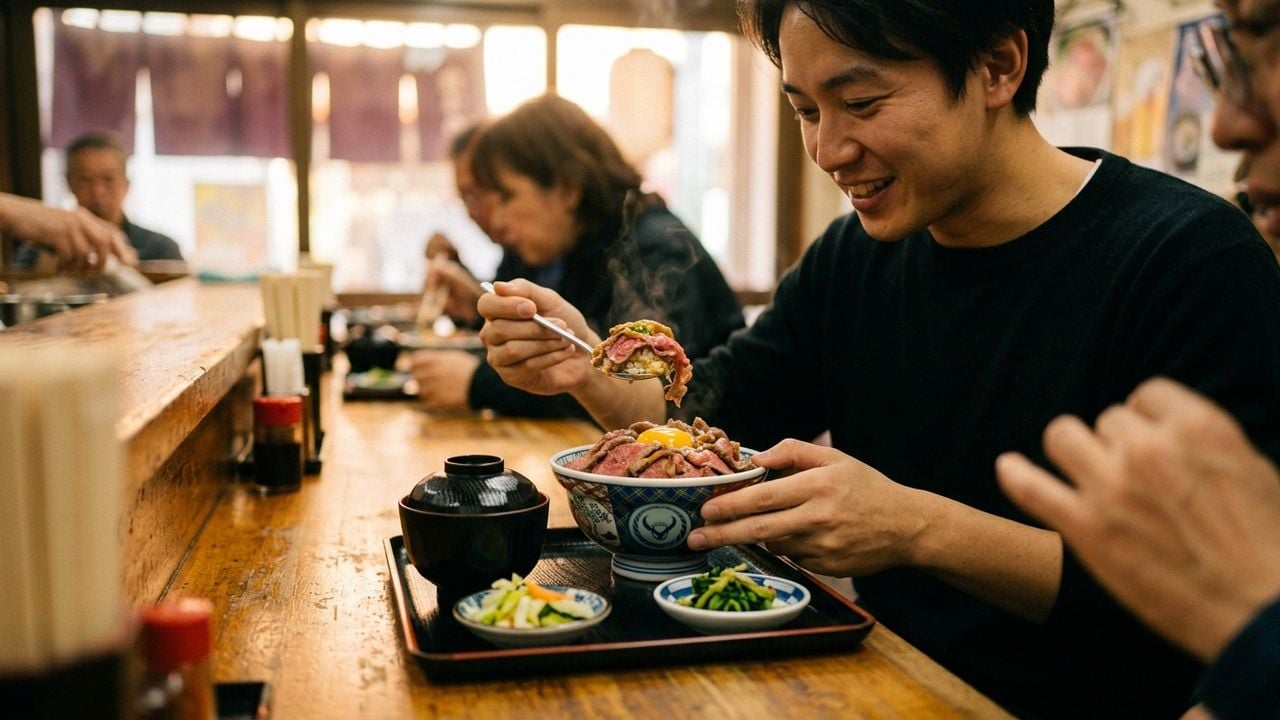
At Itadaki, every element of the meal is designed to give you something to talk about afterward. The five-step eating guide — separating the Nagoya Cochin egg, tasting the wagyu in its purest form first, then layering condiments and exploring new flavor combinations — transforms what could be a five-minute lunch into a deliberate, attentive experience. The complimentary condiments on the table are all from Aichi: pickled ginger from Inazawa City, chopped seaweed from Mikawa Bay, dried whitebait from Minamichita. Every detail traces back to a specific farm or fishing ground in Aichi Prefecture.
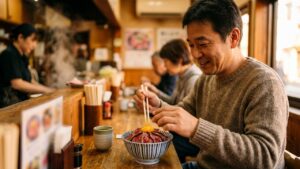
The visual presentation — rich wagyu draped over Aichi-grown rice, a golden Nagoya Cochin yolk resting at the center, vibrant shiso leaves from Toyohashi — is, by multiple guests' accounts, genuinely photogenic. The reason followers keep asking about it is because the bowl looks like it belongs to a different category of food entirely. And it does.
Everything is served à la carte, so there's no pressure to order more than you want. The Shinkoccho — our standard-size Horai Wagyu bowl with 100g of beef and 200g of rice, at ¥2,700 — is the natural entry point for first-time visitors. Larger sizes are available if you'd like more.
For the full story of what a visit actually looks like from the kitchen's perspective, this piece on a day of serving 10 bowls of Horai Wagyu gives you a sense of what goes into each service.
Is the "World's First" Claim Something You Should Trust?
Let me be honest about what I can and cannot verify.
I cannot claim to know every restaurant that has ever existed in Japan. What I can say is this: before Itadaki opened in April 2022, no restaurant had established a concept, a name, a cooking technique, or an ingredient identity around "Rare Wagyu Gyudon" as a distinct culinary category. We created the category from scratch — the name, the technique, the sourcing philosophy, the five-step eating ritual, and the storytelling framework that surrounds it.
Japan's leading national broadcaster and seven other major television networks recognized Itadaki as the originator of this concept after their own editorial research. That recognition is the most credible external validation we have — and it's enough for us.
What matters more than the claim, though, is this: there is nowhere else in the world where you can eat a bowl of Horai Wagyu — raised on sake lees from a single regional sake, produced by three farms at 300 heads per year — prepared with a two-stage cooking technique invented specifically for this dish, surrounded by ingredients sourced entirely from Aichi Prefecture. That specificity is what makes the experience genuinely irreplaceable.
A trip to Japan is a rare opportunity. Most of us get very few of them. The meals that stay with you are never the ones you could have had anywhere — they're the ones that could only have happened in that exact place, at that exact moment in time.
That's what we set out to create at Itadaki. And it's what we put on the table, 10 bowls at a time, every day we're open.
For our complete menu, access details, and store information, visit our official page at https://itadaki8.com/english/
You've read the story behind the concept, the ingredient, and the technique. The question now is whether you want this to be the meal you tell people about when they ask what was unforgettable about your Japan trip. Horai Wagyu is limited to 10 bowls each day we're open, and the bowl is yours only if it hasn't already been reserved.