Inside Look: A Day at Itadaki During Cosplay Summit Week
 gotowp
You've spent the morning in full cosplay, weaving through Osu's streets with hundreds of others dressed as beloved characters from around the world. Your phone camera is already full. Your feet are starting to feel it. And somewhere between the excitement and the sensory overload, you realize you're genuinely hungry — not just for food, but for a moment that means something. A moment that stands apart from the rest of your feed.
That's exactly where this article begins: the hours between costume check-in and the evening parade, when Nagoya's Cosplay Summit week is alive around you, and the question becomes — where do you go for a lunch that matches the energy of this trip?
Who This Is For
- ✅ World Cosplay Summit participants and anime enthusiasts exploring Osu district during summit week
- ✅ Travelers who want their Japan trip content to go beyond the obvious and genuinely surprise their followers
- ✅ Anyone looking for a visually stunning, story-rich lunch experience that photographs beautifully — even in cosplay
- ✅ Visitors to Osu Kannon Temple and the Osu Shopping Street who want to make the most of their time in the neighborhood
- ✅ Foodies who care about the backstory behind what they're eating, not just the taste
Why Cosplay Summit Week Makes Osu Feel Like a Different City
Every time the World Cosplay Summit comes to Nagoya, Osu transforms. The district — already one of Japan's most layered neighborhoods, blending a 400-year-old Buddhist temple with anime shops and international food stalls — takes on a kind of celebratory electricity. Characters from every imaginable universe spill out of the covered shopping arcade and into the streets. It's joyful, chaotic in the best way, and deeply photogenic.
What makes Osu special during summit week isn't just the costumes. It's the way the neighborhood absorbs all of it without losing itself. Osu Kannon Temple still rings its bell. The old covered arcade still hums with shoppers. And two flights of stairs up from the street, at 4-1-20 Osu on the second floor, Itadaki opens its doors to 18 guests at a time for a lunch that has nothing to do with trends — and everything to do with craft.
That contrast is part of what makes the visit memorable. You step away from the parade energy, climb those stairs, and enter a quiet, sofa-seated room where the focus shifts entirely to what's in the bowl in front of you.
You're planning which hours of summit week to spend where — and you know the Horai Wagyu bowls are limited to 10 per day. Itadaki's opening days shift month to month, and summit week is one of our busiest periods. The monthly business calendar is posted on Instagram so you can confirm before you go.
The Dish That Stops Scrolling — And Starts Conversations
Here's what arrives at the table: a traditional Japanese ceramic bowl, filled with premium wagyu arranged in delicate slices over Aichi-grown rice, topped with the golden yolk of a Nagoya Cochin egg. Beside it, a miso soup made with Hatcho miso from Okazaki City, floating with Atsumi aosa seaweed and black nori. A small dish of Atsumi Ichō-zuke pickles. A scattering of shiso leaves. Tabletop condiments: pickled ginger, dried Mikawa Bay seaweed, chirimen jako, wasabi, and Itadaki's own eight-spice blend.
Before you even pick up your chopsticks, you're reaching for your phone.
This is the Rare Wagyu Gyudon — Itadaki's founding dish, and a concept that didn't exist before founder Masayuki Goto opened this restaurant in April 2022. Goto's question, born during the pandemic when premium Aichi farmers were struggling with unsold harvests, was deceptively simple: every other Japanese donburi had a premium version — katsudon, oyakodon, kaisendon. Why not gyudon?
The answer he built is what sits in that bowl. And the story behind it is what your followers will keep asking about.
"Instagram-worthy presentation and unforgettable taste. My followers keep asking about it."
— Guest review
That reaction isn't accidental. The dish is designed to photograph the way great food photographs — with contrast, color, and a visual logic that makes sense even before you understand what you're looking at. But what turns a good photo into a great story is the detail beneath it.
✓ Key Takeaways
- Osu during Cosplay Summit week is one of Nagoya's most visually rich experiences — and Itadaki sits at its heart, just a short walk from the main event venues.
- The Rare Wagyu Gyudon is a visually striking dish with a genuine backstory, making it naturally shareable content with real substance behind it.
- Masayuki Goto invented this culinary category from scratch — it's not an adaptation of something else. That originality is part of the story.
The five-step eating guide and the Horai Wagyu backstory are the parts of this lunch that your followers will actually ask about — but only if you secure a bowl before the 10-per-day limit runs out. A Tabelog reservation locks in both your seat and your story before summit week fills the neighborhood.
The Story Behind the Bowl — What Makes It Actually Shareable
Visual appeal gets the first click. Story keeps people reading.
The wagyu used in Itadaki's most exclusive daily offering — limited to just 10 bowls — is Horai Wagyu, raised in Okumikawa, deep in Aichi Prefecture's mountainous interior. Only three farms in Japan produce it. Only 300 heads are raised annually, out of approximately 500,000 wagyu cattle across the country. These cattle are fed on sake lees from Horaisen Sora, one of Aichi's most respected breweries — a feeding method that gives the beef a distinctive quality: light marbling, lean meat character, and a flavor profile that's unlike anything you'll find under a more recognizable wagyu brand name.
When your followers ask "What is that?" — and they will — you'll have a real answer. Not just "wagyu in Japan" but: a 300-head-per-year breed, fed on sake lees from an award-winning sake, raised in a mountain region most people have never heard of, prepared using a two-stage cooking technique that achieves a rare mouthfeel while fully meeting Japan's Ministry of Health food safety standards.
That's not a caption. That's a story arc.
Goto, who holds a Certified Food Sanitation Supervisor qualification and operates under Aichi Prefecture Public Health Center licensing, developed the two-stage technique specifically to solve a puzzle: how do you serve wagyu with the sensory experience of rare-style preparation while meeting Japan's strictest food safety requirements? The answer took years of development and remains Itadaki's intellectual property. It's why the dish exists, and why it can be served safely to every guest who walks through the door — including international visitors unfamiliar with Japan's food safety culture.
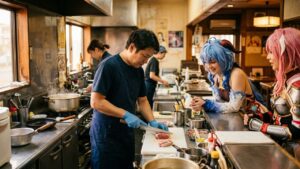
If you'd like a closer look at how a typical service day unfolds from the kitchen's perspective, this behind-the-scenes account of a day at Itadaki goes deeper into what happens before the bowl reaches the table.
Cosplay-Friendly, Sofa-Seated, and Surprisingly Calm
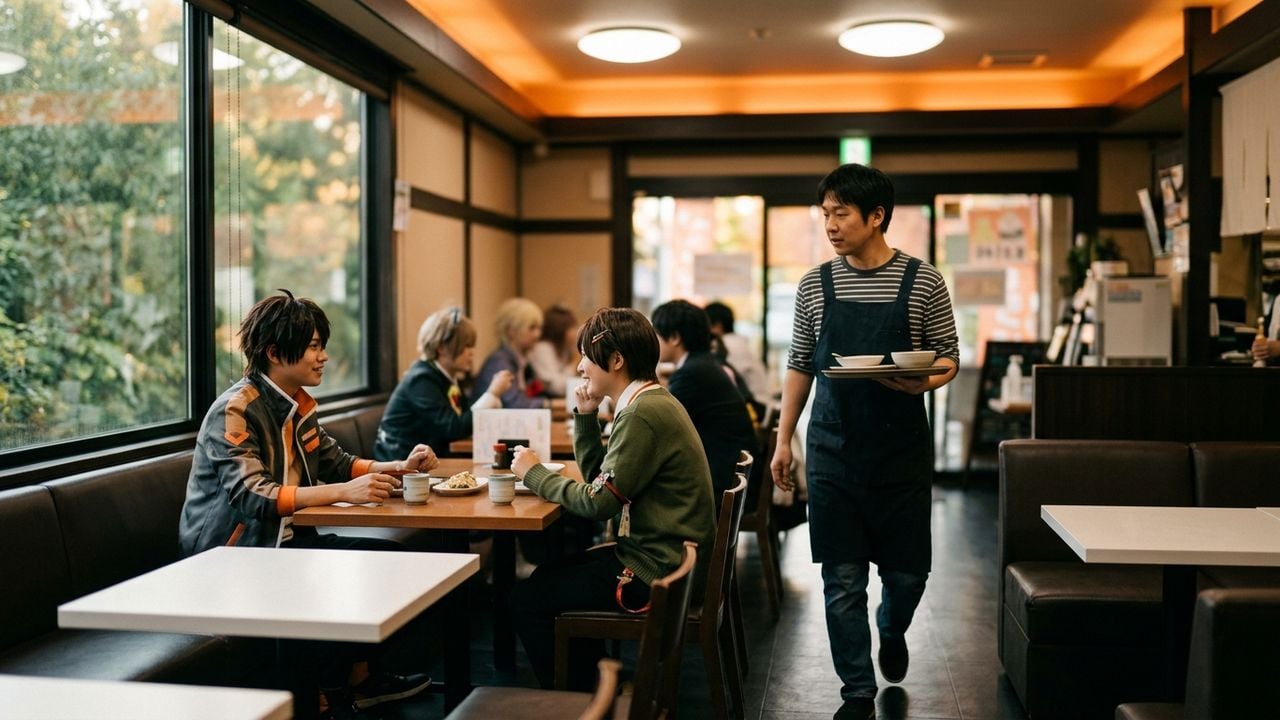
One question we hear during summit week: "Can I come in full cosplay?" The answer is yes, absolutely. Itadaki welcomes guests in cosplay, kimono, and everything in between. The atmosphere is warm and unhurried — 18 seats total, all sofa-style table seating, with natural light and a room designed for lingering rather than rushing.
For solo attendees, the five counter seats facing the room are a comfortable perch between event venues. For groups, the larger sofa tables seat up to five. There's no dress code beyond the one you've already committed to for the day.
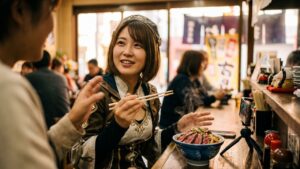
The five-step eating guide — printed in English and included with every order — also gives you something to document: separate the Nagoya Cochin egg yolk onto the beef, eat the wagyu first in its purest form, then mix, then layer condiments, then finish with wasabi. Each step changes the dish. Each step is a different photo. And if a previous guest's account of how summit participants spent their lunch break at Itadaki is any guide, the five-step sequence tends to become a group ritual — something to laugh about and narrate together.
A practical note for summit week planning: Itadaki is open on Sundays from 11:00 to 15:00, with last order at 14:30. The restaurant is a four-minute walk from Yabacho Station Exit 4 on the Meijo Subway Line — a straightforward connection from most of the summit's main venues in Osu and Sakae. The Horai Wagyu bowls (10 per day) can sell out during peak hours, so a reservation via Tabelog is the most reliable way to secure your seat and your bowl.
For step-by-step planning on fitting Itadaki into a full cosplay parade day schedule, this practical guide to timing your visit around summit events covers the logistics in detail.
A Lunch Worth the Caption — Because the Story Is Already Written
Cosplay Summit week in Nagoya gives you a week of extraordinary visual content. But the most memorable posts from any Japan trip tend not to be the biggest spectacles — they're the unexpected discoveries: the small room up the stairs, the bowl that made everyone stop scrolling, the story about 300 cattle and a sake brewery that nobody had heard of before.
That's what a lunch at Itadaki during summit week offers. Not a detour from the experience of the week, but a different kind of story running alongside it — quieter, richer, and entirely your own.
Every ingredient in the bowl comes from Aichi Prefecture. The rice, the egg, the pickles, the shiso, the condiments, the miso. Goto named the restaurant "Itadaki" — from itadakimasu, the expression of gratitude spoken before every Japanese meal — because he wanted every dish to carry the weight of that gratitude: to the farmers, to the land, to the craft. That philosophy doesn't disappear because you're eating between cosplay events. If anything, it makes the pause feel more intentional.
For our complete menu, access details, and store information, visit our official page at https://itadaki8.com/english/
You've read the story behind the bowl — 300 heads a year, sake-lees feeding, a two-stage cooking technique that nobody else offers, and a dish that photographs the way it tastes: unlike anything else on your feed. The next step is making sure that bowl has your name on it before the 10 daily portions are gone.