Guest Story: A Cosplayer's Instagrammable Osu Rare Wagyu Discovery
 gotowp
September in Nagoya has a certain energy to it. The summer heat hasn't quite released its grip, but something shifts in the air — a sense that the city is waking up for its busiest season yet. With the 2026 Asian Games on the horizon and Osu's streets humming with visitors in elaborate costumes, every Sunday morning at Itadaki feels a little charged with possibility.
I'm Masayuki Goto, founder and owner of Itadaki — The Original Rare Wagyu Gyudon. I want to take you through a recent Sunday with me: from the quiet before we open to the moment the last bowl leaves the kitchen. Because I think the story of a single day here says more about what we're trying to do than any menu description ever could.
Who This Is For
- ✅ Travelers who want at least one meal on their Japan trip that becomes a story worth telling for years
- ✅ Cosplayers and subculture enthusiasts visiting Osu who are curious about where to have a truly memorable lunch between events
- ✅ Anyone wondering what actually goes into preparing a rare wagyu gyudon before the restaurant opens its doors
- ✅ Visitors who have already tried Kobe or Matsusaka beef and are ready to discover something genuinely different
- ✅ Anyone curious about the person behind Itadaki and the philosophy that shapes every bowl we serve
Before the Doors Open: The Ritual Begins
I arrive before 9:30 on days like this. Not because the checklist demands it, but because this hour — with Osu still quiet, the shutters of the shopping street still down, the occasional cosplayer walking past in full armor on their way to an event — is when I think most clearly about what we're doing here.
The first thing I check is the Horai Wagyu. Ten bowls. That's all we can offer each day, and I take that number seriously. Horai Wagyu is produced by just three farms in Japan's Okumikawa region, with only 300 heads raised annually — out of roughly 500,000 wagyu cattle across the country. When you do that math, you understand why I count those portions by hand every morning. This isn't a manufactured story of scarcity. It's simply reality.
The rice cooker has already been set. We use Aichi no Kaori — a premium rice variety grown right here in Aichi Prefecture — and I adjust the settings depending on the season and the harvest year. It sounds like a small thing. It isn't. The rice is half the bowl.
Then comes what I call the sauce check. Our "magic sauce" is built on a base of white soy sauce from Hekinan City, blended with wine. I taste it every morning. Not because I distrust the recipe — I wrote it — but because consistency is a form of respect to the guest who's about to eat something they've never tasted before.
Itadaki is open only on scheduled days, and the Horai Wagyu sells out fast — especially on Sundays during busy seasons like this one. Our monthly business calendar on Instagram shows exact open days so you can plan around the right date. It takes thirty seconds to check before you finalize your Osu itinerary.
When Osu Wakes Up: A Cosplayer Walks In
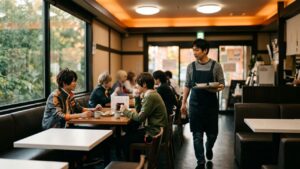
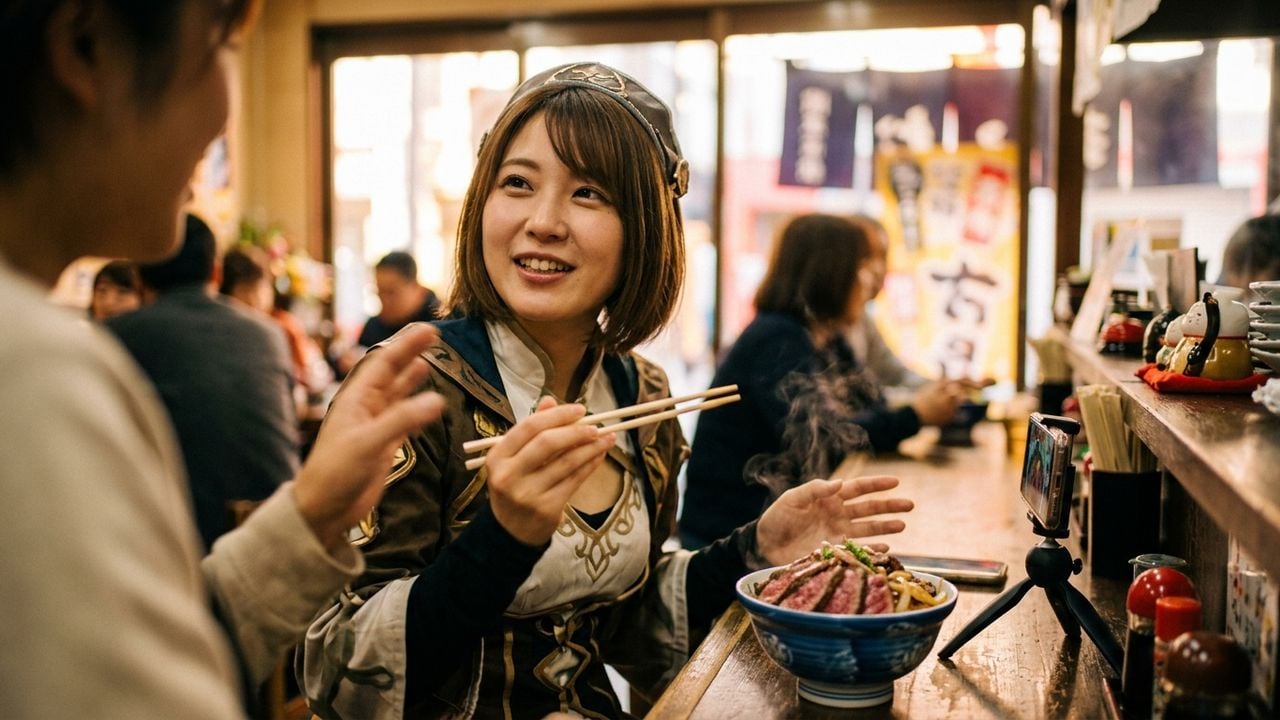
Around 11:15, about fifteen minutes after we open, a group of four walks through the door. Two of them are still in full cosplay — elaborate fantasy armor, carefully painted details, the kind of costumes that take months to build. They look slightly self-conscious stepping into a restaurant, as if they're wondering whether they'll be asked to change.
They won't be. Osu is that kind of neighborhood. In the sixteen years I've been running businesses here — MAX'S BAR opened in 2008, and Itadaki followed in April 2022 — I've come to believe that Osu's greatest quality is that it makes room for everyone. Cosplayers, temple visitors, vintage record hunters, elderly locals on their morning walk. The street holds all of them.
The group settles into our large sofa table. I hand them the English menu — we have printed menus in English, Simplified Chinese, and Korean — and one of them immediately spots the five-step eating guide. That guide matters to me more than most guests realize. The rare wagyu gyudon isn't meant to be eaten in a hurry. It unfolds: first the wagyu alone to appreciate the texture, then the egg yolk folded in, then the condiments one by one, then a final note of wasabi. The guide is my way of saying: slow down, this bowl has more to offer than the first bite.
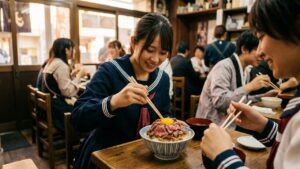
They order two Shinkoccho — our standard Horai Wagyu bowl — and two Mikawa Beef bowls. The Teppen beef plate goes to the table as a shared side. I watch from the counter as the bowls arrive and the camera comes out. The colors are genuinely striking: the blush-pink rare wagyu fanned across white rice, the golden Nagoya Cochin egg yolk at the center, the green shiso from Toyohashi, the pale pickled radish from the Atsumi Peninsula.
I don't rush them. A table in full cosplay photographing their lunch in Osu on a Sunday in September — that image is exactly where I hoped Itadaki would live when I conceived it during the pandemic.
✓ Key Takeaways
- Every morning begins with hands-on checks — the Horai Wagyu count, the rice setting, the magic sauce — because consistency at this level is not accidental.
- Itadaki's English menu and five-step eating guide are designed so that international guests — including first-time visitors — can experience the bowl exactly as intended, without needing to ask.
- Osu's welcoming character is part of the experience: whether you arrive in cosplay, kimono, or travel clothes, you belong here.
You've just read that the Horai Wagyu is limited to 10 bowls a day — and on a busy Sunday in Osu during Asian Games season, those ten go faster than you'd expect. Reserving your bowl via Tabelog secures your spot before the day even starts. The reservation form is in English and takes only a couple of minutes.
The Bowl That Made Someone Stop Talking
A little later in the service, I overhear something that stays with me. One of the cosplayers — the one who had been most animated, translating menu details for her friends — goes quiet after her first bite of the Horai Wagyu. Not the polite quiet of someone who doesn't know what to say. The real kind.
She looks up after a moment and says, in careful English: "I've had Kobe beef and Matsusaka beef, but this was on another level."
I've heard variations of that sentence more than once since we opened. And each time, I feel the same thing — not pride exactly, but something closer to relief. Relief that the idea worked. That what I set out to build during the hardest months of the pandemic, when the farmers I'd worked with for years had nowhere to sell their harvest, had become something that could genuinely move people.
What makes Horai Wagyu different is difficult to explain in words before you eat it. It has a lightness despite its richness — a quality that comes partly from the cattle being fed on sake lees from Horaisen Sora, a renowned local premium sake from Okumikawa. The marbling doesn't overwhelm the flavor of the meat itself. And our two-stage cooking technique — which brings the beef's core temperature above 70°C, fully meeting Japan's Ministry of Health food safety standards — delivers a rare-style texture that you genuinely cannot find anywhere else, because no other restaurant is doing exactly this.
That's not marketing language. That's just the result of spending years working out how to do something that had never been done before.
"I've had Kobe beef and Matsusaka beef, but Horai Wagyu at Itadaki was on another level."
Guest, Osu visit — September 2026
If you're curious how other guests have described their first encounter with the concept, this account of a wagyu enthusiast's first rare gyudon experience captures something I find hard to put into words myself.
The Last Orders and What They Mean
We close at 15:00, with last orders taken at 14:30. On a busy Sunday in Osu during this season, the Horai Wagyu is often gone well before that. Ten bowls sounds like a small number until you consider that every single one of those portions comes from a farm producing fewer than 300 cattle per year. We're not limiting it artificially to create a sense of drama. We're limiting it because that's all there is.
By early afternoon, the cosplay group has been replaced by a couple who arrived after visiting Osu Kannon Temple, and then by a solo traveler who found us through Google Maps and announced, slightly breathless, that she'd specifically planned her Sunday around this lunch. That's something that still surprises me — that someone would reroute a travel day for a bowl of beef and rice in a 2nd-floor restaurant on a back street in Osu.
But I think I understand it now. People who travel seriously — who've done Kobe, Matsusaka, the Golden Route — are looking for something they can't pre-package or anticipate. They want a meal that becomes a story. The experience becomes memorable not just through taste, but through the narrative you carry home: the scarcity of the ingredient, the craft of the preparation, the name of the farmer, the fact that this concept was invented in this specific kitchen and exists nowhere else in the world.
That's what Itadaki is. Not the most famous wagyu in Japan. Not the longest line or the highest price. Just a genuinely singular bowl, made every morning by people who care where every ingredient comes from.
And if you're planning a day in Osu — whether you're here for the World Cosplay Summit, or simply wandering the shopping street after Osu Kannon Temple — I'd love for this lunch to be part of your story. Here's how one visitor went from the Cosplay Summit parade straight to a rare wagyu bowl, if you want a sense of how naturally the two fit together.
Planning Your Visit: What You Need to Know
We're open Tuesday, Saturday, Sunday, and Monday — lunch service only, 11:00 to 15:00. On public holidays, we open at 9:00. Because September 7, 2026 is a public holiday, if you're reading this during the Asian Games period and planning a visit on a holiday Monday, please check our monthly business calendar on Instagram for the exact schedule, as irregular closures do sometimes apply.
We're a 4-minute walk from Yabacho Station Exit 4 on the Meijo Subway Line. From Nagoya Station, it's about 10 minutes total by subway — Higashiyama Line to Sakae, then transfer to the Meijo Line.
If you want to try the Horai Wagyu, I genuinely recommend reserving in advance via Tabelog. Ten bowls go quickly, especially on weekends. For the Mikawa Beef gyudon — which is equally carefully prepared, just always available — walk-ins are welcome.
For our complete menu, access details, and store information, visit our official page at https://itadaki8.com/english/
If you're curious what a day like this looks like from another guest's perspective — someone drawn to Osu's unique blend of history and subculture — this story of a history fan discovering rare wagyu in Osu offers a different but complementary view of the same neighborhood.
Whatever brings you to Osu — a cosplay event, a temple visit, the Asian Games, or simply the desire for one lunch that you'll still be talking about years from now — I'll see you on the 2nd floor.
— Masayuki Goto, Founder & Owner, Itadaki
If this bowl is going to be the meal you tell people about when you get home, the one step worth taking right now is locking in your reservation — because walk-in availability for Horai Wagyu cannot be guaranteed. Reserve your seat via Tabelog and make your Osu lunch the one part of your Japan trip you planned to be unforgettable.