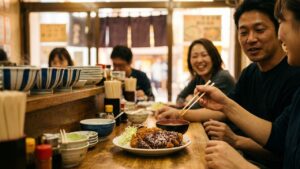
Inclusive Nagoya: Where Para Games Visitors Find Aichi's Best Lunch
 gotowp
A message came in through Instagram a few weeks ago that genuinely made me stop and think. A visitor — traveling to Nagoya specifically for the Aichi Para Games 2026 — wrote something I wasn't quite expecting: "I've been to Japan four times. I don't want the tourist lunch. I want the place where you actually eat."
It's a request I've been hearing more and more. And it's one that sits very close to the reason Itadaki exists in the first place.
This article is for visitors coming to Nagoya during the Aichi Para Games 2026 — held from September 13 to 25 — who want to use their time in the city to discover something genuinely local. Not a famous chain. Not a dish you could find replicated in Tokyo. Something that belongs here, in this city, in this neighborhood.
Who This Is For
- ✅ Repeat visitors to Japan who already know Kobe beef and Kyoto kaiseki — and want to find something no one back home has heard of
- ✅ Para Games spectators, supporters, and athletes' families looking for a real local lunch in Nagoya between events
- ✅ Travelers from Hong Kong, Taiwan, and other Asia-Pacific markets who seek personal discovery over guidebook recommendations
- ✅ Anyone who has ever wished their food story started with, "I found this place no one else knew about"
- ✅ Visitors curious about Osu district — one of Nagoya's most local neighborhoods — and what makes it worth exploring
The Numbers Behind Japan's Most Determined Repeat Visitors
There's a particular kind of traveler who arrives in Nagoya knowing exactly what they don't want. According to data published by the Japan Tourism Agency, the share of repeat visitors among inbound tourists has grown substantially in recent years — and markets like Hong Kong and Taiwan lead this trend. A survey conducted by the Japan National Tourism Organization (JNTO) found that 29.7% of Hong Kong visitors to Japan had made ten or more previous trips, with Taiwan following at 19.4%.
These travelers have already done the Golden Route. They've seen the famous wagyu cities. What they're looking for now is the story that only they can tell when they get home — the discovery that isn't on page one of any guidebook.
Nagoya, historically underrepresented in English-language travel media, has quietly become exactly that kind of destination. And within Nagoya, the Osu district is where that discovery most reliably happens.
Osu is not a tourist quarter. It's a working neighborhood — one of the city's oldest shopping districts, with over 400 years of history and more than 1,200 shops spanning Buddhist temple offerings, vintage electronics, anime subculture, and small specialty restaurants that have been doing one thing well for years. It is precisely the kind of place a Japanese foodie means when they say, "this is where I actually eat."
If the question of whether Itadaki is actually open during the Para Games period is already forming in your mind — it's a fair one. Our monthly business calendar, including any irregular closures during September, is posted in real time on our official Instagram. Takes about 30 seconds to check.
What "Inclusive" Means When You're Hungry and Looking for Something Real
The word "inclusive" gets used often around Para Games events — and rightly so, in terms of physical accessibility and welcoming environments. But when visitors write to me asking for "the place where locals really eat," they're asking for a different kind of inclusion: being let into a city's actual food culture, not directed to its performance of it.
Itadaki opened in Osu in April 2022 with a specific philosophy: that the gyudon — Japan's humble beef bowl — had never been given the same elevation as katsudon, oyakodon, or kaisendon. Every other donburi had a premium version. Gyudon had been left to the fast-food chains. We asked: why?
The answer became what we now call Rare Wagyu Gyudon. It is not a reinvention for reinvention's sake. It is a deliberate act of respect — for the beef, for the farmers who raise it, for Aichi Prefecture's ingredients, and for the act of sitting down to eat something that genuinely couldn't exist anywhere else.
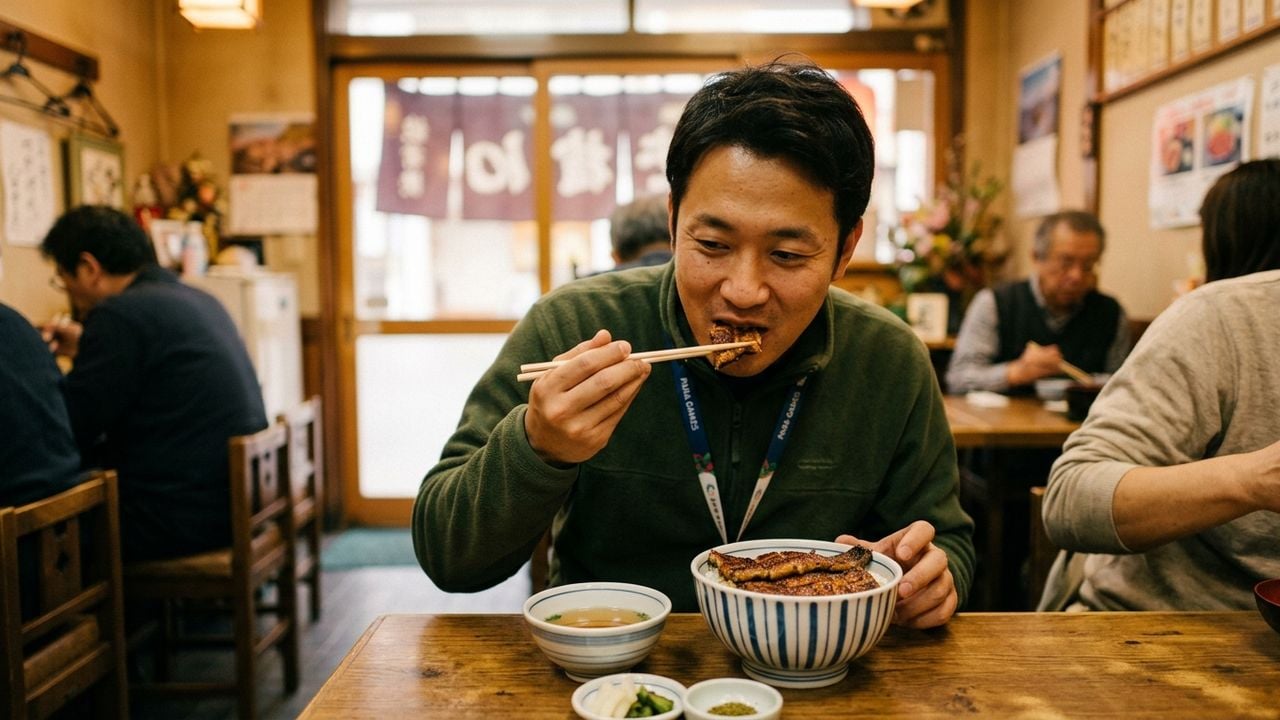
Every single ingredient comes from Aichi. The rice is Aichi no Kaori, grown here. The miso is Hatcho, from Okazaki. The pickles come from the Atsumi Peninsula. The egg is laid by Nagoya Cochin hens at Yamada Poultry Farm. And the beef — the Horai Wagyu that sits at the center of our most requested bowl — is raised across just three farms in Okumikawa, with only 300 heads produced annually across all of Japan.
That's 300, out of approximately 500,000 wagyu cattle raised in Japan each year.
✓ Key Takeaways
- Repeat visitors from Hong Kong (29.7% with 10+ Japan trips) and Taiwan (19.4%) are actively seeking local discoveries beyond the Golden Route — Nagoya and Osu fit exactly what they're looking for (JNTO data).
- Osu district is a genuine local neighborhood, not a tourist quarter — 400+ years of history, 1,200+ shops, and specialty restaurants that serve exactly the kind of food locals actually eat.
- Itadaki was founded on a single idea: elevate the gyudon using only Aichi ingredients — including Horai Wagyu, raised by just 3 farms with only 300 heads annually.
You've now read exactly why the Horai Wagyu bowl is limited to 10 servings a day — and why that number fills up faster during event periods like the Para Games. Reserving via Tabelog secures your bowl before you leave your hotel. The process is straightforward and takes just a few minutes.
The Five-Step Guide That Turns a Bowl Into a Moment
One of the things I'm most proud of at Itadaki is something very small: a printed guide in English (and simplified Chinese and Korean) that walks visitors through how to eat the dish in five steps.
It starts with separating the raw Nagoya Cochin egg — the white goes into the miso soup, the golden yolk sits atop the beef. From there, each step adds a new dimension: tasting the wagyu in its purest form first, mixing in the yolk for a richer bite, layering condiments from the tabletop, and finishing with wasabi for a clean, refreshing close.
The reason I mention this here, in an article about inclusion, is that this guide was designed precisely for visitors who have never encountered this dish before and might feel uncertain about what to do. There is no prior knowledge required. The dish welcomes you where you are.
A guest who visited recently put it simply:
"The five-step eating guide made the dish even more enjoyable and memorable."
That feedback means a great deal to me. The goal was never to be intimidating or exclusive. It was the opposite — to give every visitor, regardless of where they're from or how familiar they are with Japanese food culture, the full experience that the dish was designed to deliver.
The rare-style texture, by the way, is achieved through a proprietary two-stage cooking technique that heats the beef to over 70°C at the core — fully meeting Japan's Ministry of Health, Labour and Welfare food safety standards. The "rare" sensation is real. The safety is equally real. If you've ever hesitated at the phrase "rare wagyu," this is the answer to that hesitation.
For visitors arriving in Nagoya for the Para Games and wondering where the real local lunch is hiding, the Osu district is less than a 15-minute subway ride from most city-center hotels. Itadaki is a 4-minute walk from Yabacho Station (Meijo Subway Line, Exit 4). If you'd like a broader picture of how Para Games families have been discovering Osu as a dining destination, this story of a family's Para Games lunch discovery at Itadaki gives a warm and honest account of what that experience looks like in practice.
Practical Information for Para Games Visitors
Itadaki is open Tuesday, Saturday, Sunday, and Monday, from 11:00 to 15:00 (last order at 14:30). On public holidays, we open from 09:00. We do not serve dinner.
September 4, the day this article goes live, marks the final week before the Para Games opening ceremony on September 13. If you're arriving in Nagoya in the days just before or during the Games, please note: Horai Wagyu is limited to 10 bowls per day and can sell out during peak hours. Reservation via Tabelog is strongly recommended, particularly during event periods. Irregular closures can occasionally apply — our official Instagram calendar is the most reliable reference for confirmed business days each month.
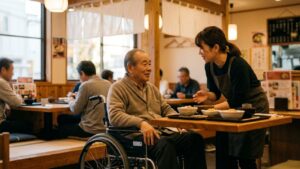
For visitors with accessibility considerations: Itadaki is located on the second floor and is accessed via a staircase. There is no elevator. Staff may be able to assist when available, but we cannot guarantee this in advance, so please plan accordingly. All seating inside features comfortable sofa-style chairs — once you're in, the experience is relaxed and unhurried.
Printed menus are available in English, simplified Chinese, and Korean. No Japanese is required to enjoy the meal. Many of our visitors arrive not speaking a word of Japanese, and that has never once been a problem.
If you're also planning to explore Osu's broader neighborhood during your Nagoya stay, we've written about why Osu is increasingly the choice for Para Games visitors who want real food, not just convenient food — it might give you some useful context for planning the rest of your afternoon.
The Lunch That Becomes the Story You Tell
Eighteen years in the food and hospitality industry have taught me one thing above all else: the meals people remember are rarely the most expensive ones. They're the ones with a story attached — the place they found by wandering, the dish that couldn't exist anywhere else, the ingredient with a history that surprised them.
The Aichi Para Games 2026 brings visitors to Nagoya from across the world. Many will arrive with a schedule full of competition venues, transportation logistics, and sightseeing checkboxes. But somewhere in the middle of all of that, there will be a lunch hour. And that hour, if spent in the right place, can become the part of the trip they talk about for years.
Osu is not on the map that most guidebooks hand you. That is not a flaw. It is precisely the point.
For our complete menu, access details, and store information, visit our official page at https://itadaki8.com/english/
The Para Games opening ceremony is September 13 — and the lunch hours around it will be among the busiest Osu has seen this year. If this bowl is the story you want to bring home, the time to secure your seat is now, not the morning you arrive.