My Aichi Para Games 2026 Story: A Family's Rare Wagyu Discovery
 gotowp
You've spent weeks planning the perfect Aichi Para Games 2026 trip — booking accommodation, mapping out venue access, packing for everyone. Then your partner spots a photo of a glistening bowl of rare wagyu gyudon somewhere online and says, "Can we try this?" And almost immediately, the doubt creeps in: "Wait — is that raw? Is it actually safe for us to eat?"
If that moment sounds familiar, this post is for you. September in Nagoya is electric right now, with Para Games athletes, families, and supporters from across the world filling the city. Between events, there's real time to explore — and Osu district, just a short subway ride from the main venues, is one of the most rewarding places to spend a lunch hour. This is the story of how food safety questions didn't stop one family from discovering something genuinely remarkable at Itadaki.
Who This Is For
- ✅ Families attending Aichi Para Games 2026 who want a memorable lunch between events
- ✅ Parents wondering whether rare-style wagyu is safe for the whole family to eat
- ✅ Travelers who've heard of Kobe or Matsusaka beef and want to go deeper into Japan's wagyu world
- ✅ Anyone cautious about undercooked beef but curious about Japan's food safety standards
- ✅ Visitors to Osu district looking for a sit-down lunch with comfortable seating for groups
The Question Every Western Traveler Asks First
Let's address it directly, because it deserves a real answer — not reassurance, but facts.
In the United States, the UK, Australia, and much of Western Europe, public health guidance strongly advises against consuming undercooked beef. The concerns are legitimate: E. coli, salmonella, and other bacterial risks are real. When people from those food cultures look at a bowl described as "rare wagyu," the alarm bells are understandable.
Here's what's actually happening at Itadaki, and why it's different.
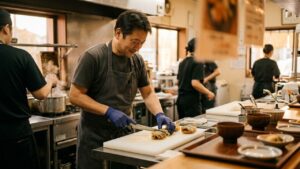
Founder Masayuki Goto — a Certified Food Sanitation Supervisor and licensed restaurant operator under Aichi Prefecture's Public Health Center — developed a proprietary two-stage cooking technique specifically to solve this problem. The beef is heated to over 70°C at the core during preparation. That threshold fully meets Japan's Ministry of Health, Labour and Welfare food safety standards for cooked beef. What you're experiencing when you eat it isn't raw meat — it's a precisely controlled texture achieved through careful temperature management, designed to feel tender and silky while being completely safe.
The wagyu itself adds another layer of confidence. Itadaki sources exclusively from Aichi Prefecture — Horai Wagyu from Okumikawa and Mikawa Beef from the Mikawa region — both raised under rigorous quality control by farms Goto works with directly. This isn't anonymous commodity beef. It's a traceable, trusted supply chain built over years of relationship farming.
No other gyudon restaurant in Japan offers this specific combination of culinary technique and farm traceability. It's genuinely a new category — and the food safety engineering behind it is as important as the flavor.
The food safety question is answered — but Itadaki's opening days and Horai Wagyu availability shift every month, and Para Games week is one of the busiest periods of the year. The monthly business calendar is posted on Instagram, where you can confirm whether your planned visit day is actually open before you build your lunch around it. No login or signup needed — just a quick check.
Choosing the Right Moment in a Para Games Day
Para Games schedules can be intense — morning sessions, afternoon finals, travel between venues. But Nagoya's subway network makes Osu district surprisingly accessible, and Itadaki's lunch-only model (open 11:00–15:00, with a last order 30 minutes before closing) fits naturally into the rhythm of a competition day.
From the main Para Games venues in Nagoya, Yabacho Station on the Meijo Line puts you four minutes from Itadaki's front door. The restaurant is on the second floor of a building in Osu — a neighborhood that rewards a short wander even on its own, with Osu Kannon Temple nearby and the long covered shopping street stretching in every direction.
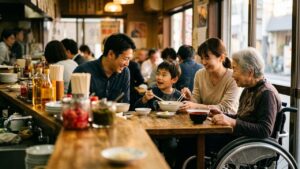
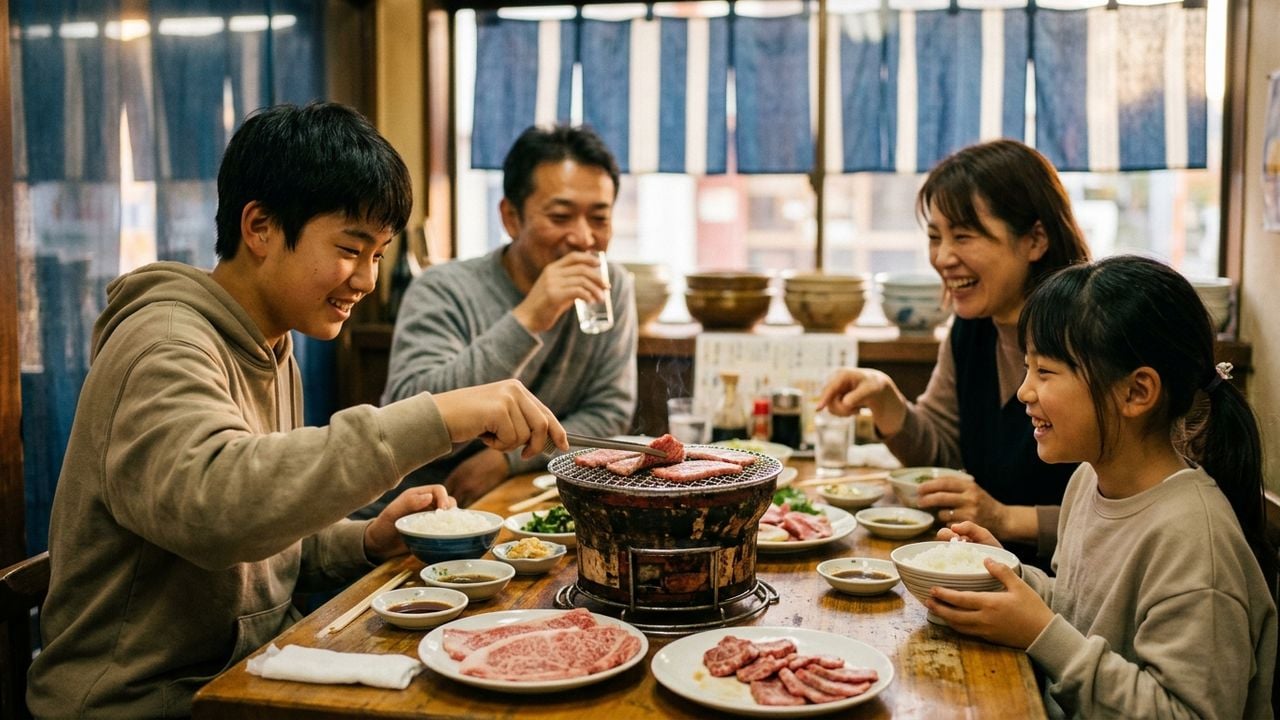
For families specifically, the seating at Itadaki was clearly thought through. All table seats are sofa-style — genuinely comfortable for an extended lunch, not the kind of rigid chairs that make young children restless. There's a table that seats five, which works well for larger family groups. Past guests have brought infants and found the sofa seating practical for bottle feeding. The atmosphere is calm and unhurried — a real contrast to the energy of competition venues, and a welcome one.
If your group includes someone with accessibility needs, it's worth noting that Itadaki is located on the second floor and requires a staircase for access. Staff may be able to assist depending on the situation at the time — please plan accordingly. For a fuller picture of dining accessibility in Nagoya during Para Games season, The Complete Accessibility Guide for Asian Para Games 2026 Dining covers this topic in detail.
✓ Key Takeaways
- Itadaki's rare wagyu is cooked to over 70°C at the core — fully compliant with Japan's Ministry of Health, Labour and Welfare standards. The "rare" experience is about texture, not temperature risk.
- The restaurant's sofa-style seating and calm atmosphere make it genuinely comfortable for families dining with young children.
- Yabacho Station (Meijo Line) is the closest access point — four minutes on foot, well connected to Para Games venues across Nagoya.
You now know the two-stage cooking technique meets Japan's Ministry of Health, Labour and Welfare standards — but Horai Wagyu is limited to 10 bowls a day, and Para Games September means those bowls go early. Reserving through Tabelog locks in your bowl before you make the trip to Osu. The reservation form is in Japanese, but the process is straightforward and takes just a few minutes.
What a Family Actually Encounters at the Bowl
Once you're seated and the menu arrives — available in English, with a photographic five-step guide to eating the dish — the experience becomes much less intimidating and much more engaging.
The five steps matter. They're not decorative instructions; they genuinely shape how the flavors unfold. You start by separating the Nagoya Cochin egg — white goes into the miso soup, yolk rests on top of the wagyu. Then you try the beef on its own first, appreciating the texture and the subtle, clean flavor of Horai Wagyu before anything else touches it. The yolk comes next, mixing into the beef for a richer, silkier bite. Then condiments — pickled ginger, dried nori from Mikawa Bay, chirimen jako, and Itadaki's original eight-spice blend. Finally, wasabi as a clean, refreshing finish.
For families with children, the Fumoto size (Mikawa Beef, 100g beef with 200g rice, ¥1,800) is often the most practical starting point — a complete bowl without being overwhelming. Parents ordering for themselves tend to gravitate toward the Horai Wagyu option, which is limited to 10 bowls per day and carries its own story: only 300 heads raised annually across three farms in all of Japan, fed on sake lees from the renowned Horaisen Sora brewery. That scarcity isn't a marketing line. It shapes the flavor in ways that are hard to describe until you've tasted it.
Every ingredient on the table comes from Aichi Prefecture — the rice, the miso soup base, the shiso leaves, the pickled radish, the egg. It's an intentional completeness that Goto has held to since the restaurant opened in 2022, and it gives the meal a coherence that you can actually feel.
"I traveled to Nagoya specifically to eat here — it was 100% worth it."
— Guest review
That kind of deliberate travel decision doesn't happen by accident. It happens when a restaurant answers the hard questions honestly — including the one about food safety — and then delivers something that earns the journey. If you're here for the Para Games and wondering whether a lunch detour to Osu is worth fitting in, this is one of those experiences that tends to become the story people tell when they get home.
For another perspective on what a family visit to Itadaki can look like during Nagoya's major sporting events, this guest story from an Asian Games family's Nagoya lunch offers a vivid firsthand account worth reading before you plan.
Practical Notes Before You Go
A few things that make a real difference in how smoothly your visit goes:
Horai Wagyu availability: Only 10 bowls are prepared each day, and they do sell out — particularly on busy Para Games days. Reservation via Tabelog is strongly recommended if the Horai Wagyu is on your list. The Mikawa Beef option is always available without reservation.
Opening hours: Itadaki is open for lunch only — 11:00 to 15:00 on Saturday, Sunday, Monday, and Tuesday. On public holidays, hours extend from 09:00. Wednesday, Thursday, and Friday are closed. The monthly business calendar is posted on the official Instagram account, and it's worth checking before you build your day around a visit.
Allergen notes for families: Soy (in the soy sauce and miso), wheat (in the soy sauce), and egg (Nagoya Cochin egg, which can be removed at -¥150) are present in the dish. The chirimen jako topping on the table contains sesame — guests with sesame allergies should skip this condiment. Staff can address specific concerns, and it helps to mention any severe allergies at the time of reservation.
Getting there: From Nagoya Station, take the Higashiyama Line to Sakae, transfer to the Meijo Line, and get off at Yabacho. The total journey is around 10 minutes. From Yabacho Station Exit 4, Itadaki is a four-minute walk.
For guests attending Aichi Para Games 2026 who want to understand what dining in Nagoya looks like during the event period more broadly, What Should I Know About Dining During Aichi Para Games 2026? covers the wider picture in one place.
A Lunch Worth Planning Around
The Aichi Para Games 2026 is a remarkable moment for Nagoya — and the city has a great deal to offer beyond the competition venues. Osu district sits at the intersection of old and new Nagoya: temples, covered shopping streets, and quiet corners that most Para Games visitors never find.
Itadaki is a few minutes' walk from that world. It opened in 2022 with a clear purpose — to take a category of Japanese food that had never been treated as something worthy of serious attention and reimagine it entirely, using ingredients that most visitors to Japan have never encountered. The food safety question that stops many Western travelers at the door is answerable, clearly and factually. The experience on the other side of that answer is one that tends to stay with people long after the Para Games medals have been decided.
For our complete menu, access details, and store information, visit our official page at https://itadaki8.com/english/
You've read how the rare preparation works, why the ingredients are traceable, and how the five-step experience unfolds for a family at the table. The one remaining step is making sure your bowl is waiting when you arrive — because 10 Horai Wagyu bowls per day, during Para Games week, will not last until walk-in hours. Secure your reservation now through Tabelog.