Guest Story: An Asian Games Family's Nagoya Lunch Discovery
 gotowp
You've just spent the morning watching your child cheer from the stands, the arena still buzzing in your memory. Now it's lunchtime in Nagoya — and your family is standing at a street corner in the Osu district, phones out, everyone scrolling through Google Maps at once. You want something real. Not a chain. Not another bowl of ramen from a restaurant with a laminated English menu taped to the window. You want the kind of meal that, when your relatives back home ask "what did you actually eat in Japan?", you'll have an answer that makes them wish they'd come with you.
That's exactly where this story begins.
Who This Is For
- ✅ Families attending the 2026 Asian Games or Para Games who want a memorable lunch, not just a convenient one
- ✅ Parents looking for a relaxed, comfortable restaurant where children are genuinely welcome
- ✅ Travelers who want their Japan food photos to tell a story — not just look nice
- ✅ Anyone in the Osu or Sakae area who wants to eat something they've never experienced anywhere else in the world
- ✅ Visitors who've already tried Kobe beef or Matsusaka beef and are curious what else Japan's wagyu landscape has to offer
A Family, a Free Morning, and a Walk Through Osu
The 2026 Asian Games bring tens of thousands of visitors to Nagoya — athletes' families, supporters, event staff, and curious travelers who timed their Japan trip around the games. For many of them, Osu is just a name on a subway map. But those who take the Meijo Line to Yabacho Station and walk four minutes to the district's heart tend to find something they weren't expecting: a neighborhood with four centuries of history, over 1,200 shops, and a food scene that feels genuinely alive.
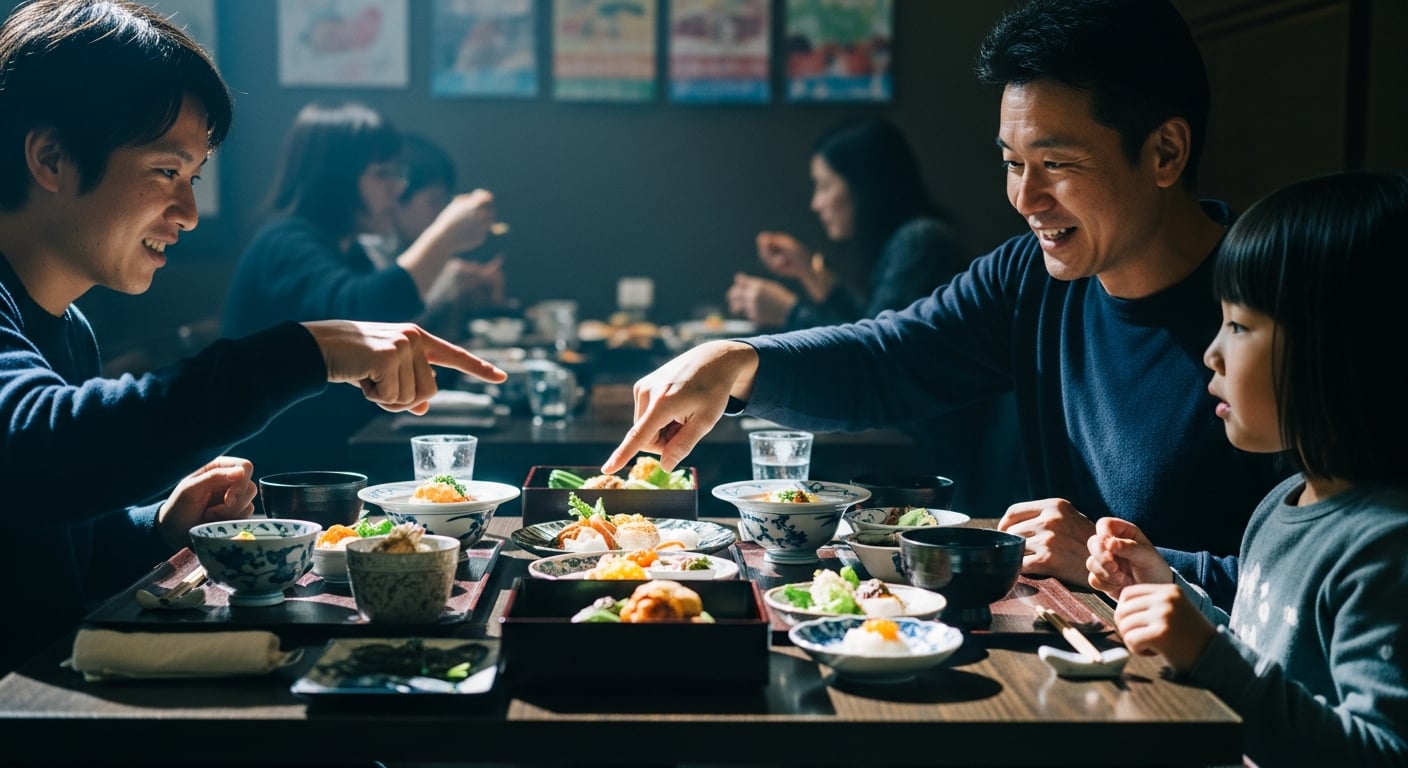
One family — parents and two teenagers — did exactly this on a free morning between events. They had planned to grab lunch quickly and return to the venue. But when they came across a second-floor restaurant with a sign reading 元祖レア牛丼 頂 ("Ganso Rea Gyudon Itadaki") and a menu display case showing what looked like beautifully plated wagyu on rice, they paused. The father pulled up the restaurant on his phone. Eight Japanese TV features, including NHK. The originator of something called "Rare Wagyu Gyudon." Horai Wagyu — a beef produced by only three farms in Japan, with just 300 heads raised annually.
They went upstairs.
You're planning your Nagoya days around the Asian Games schedule, and you're wondering whether Itadaki will even be open on the day you're free. The monthly business calendar — including any irregular closures during the Games period — is updated on the official Instagram account. Takes a few seconds to check before you finalize your plans.
The Moment a Meal Becomes a Story
What separates a meal you forget by Thursday from one you're still describing at dinner parties two years later? It's rarely about the price. It's about the moment you realize: nobody else I know has experienced this.
At Itadaki, that moment tends to arrive in stages — and that's by design.
Founder Masayuki Goto built the restaurant on a simple but radical question: why does every Japanese donburi have a premium version except gyudon? Katsudon, oyakodon, kaisendon — all have elevated forms. The humble beef bowl had always been left to fast-food chains. Goto decided to change that. Drawing on 18 years of food industry experience and direct relationships with Aichi Prefecture farms, he invented an entirely new culinary category: Rare Wagyu Gyudon.
The signature dish arrives at the table looking unlike anything labeled "gyudon" in the public imagination. Thinly sliced Horai Wagyu — rare in texture, thanks to Itadaki's proprietary two-stage cooking technique that heats the beef to over 70°C at the core — is arranged over Aichi no Kaori rice, accompanied by a raw Nagoya Cochin egg, pickled Atsumi Ichō-zuke radish, and fragrant Toyohashi-grown shiso leaves. Tabletop condiments include pickled ginger from Kimura Farm in Inazawa, chopped seaweed from Mikawa Bay, dried whitebait from Minamichita, and Itadaki's original 8-spice blend.
And then the menu provides something that surprises first-time visitors: a five-step visual guide, printed in English, explaining exactly how to experience the dish.
"The five-step eating guide made the dish even more enjoyable and memorable."
Guest review
Step one: separate the Nagoya Cochin egg — white into the miso soup, yolk on top of the beef. Step two: taste the wagyu first, on its own, to appreciate its natural character. Step three: mix the yolk through the beef for a richer, silkier texture. Step four: experiment with the condiments — each one shifts the flavor profile in a different direction. Step five: finish with wasabi, a clean and refreshing end to the bowl.
The teenagers at that family's table photographed every step. Their parents weren't even planning to post anything — but they did anyway, because the story was too good not to share.
✓ Key Takeaways
- Itadaki is the originator of "Rare Wagyu Gyudon" — a culinary concept invented here, unavailable anywhere else in the world
- Horai Wagyu is one of Japan's rarest beef breeds: 300 heads produced annually across just 3 farms, fed on sake lees from a renowned Aichi brewery
- The five-step visual guide in English transforms the meal into an experience — one your followers will actually want to ask about
Horai Wagyu is limited to 10 bowls a day — and Asian Games event days are exactly when walk-in guests arrive to find them gone. Reserving in advance via Tabelog Online locks in your bowl before you board the subway. Remember to include 鳳来牛希望 in the notes field to request the Horai Wagyu.
Why This Dish Photographs the Way It Does
There's a reason so many first-time visitors reach for their phones before they pick up their chopsticks.
The bowl arrives in a traditional Japanese ceramic dish. The pale pink of the rare-style wagyu, the deep gold of the egg yolk, the green of the shiso, the amber of the pickled radish — it's a composition that earns its photo before you've tasted a single bite. But what makes it genuinely shareable isn't the visual alone. It's the caption you can write underneath it.
"500,000 wagyu cattle in Japan. Only 300 of them are Horai Wagyu. I just ate one of 10 bowls available today."
That's not marketing language — it's the actual story behind every Horai Wagyu bowl at Itadaki. The beef is raised in the Okumikawa mountains of Aichi Prefecture, fed on sake lees from Horaisen Sora, a premium local sake brewery. It produces a distinctive flavor: the marbling and richness of a high-grade wagyu, combined with a leaner, cleaner finish that makes it unlike any other breed in Japan. All of it — the rice, the miso, the pickles, the egg, the sauce — comes from Aichi Prefecture. Every element has a provenance, and every provenance has a name.
When your followers ask "What is that?" — and they will — you won't just have a photo. You'll have a story that takes three minutes to tell and stays with the listener for years.
Practical Notes for Families Visiting During the Games
If you're planning to visit Itadaki as part of your Asian Games schedule, a few things worth knowing before you go:
Seating and comfort: Itadaki has 18 seats total, all featuring sofa-style seating — unusually comfortable for a specialty lunch restaurant, and genuinely relaxed for families. Past guests have settled in for an extended lunch with young children, including infants. The sofa tables seat up to five people, making the space well-suited to family groups of most sizes.
The Horai Wagyu is strictly limited to 10 bowls per day. During peak periods — including Asian Games event days — this will sell out. Advance reservation via Tabelog Online is strongly recommended. When making a reservation, include the note 鳳来牛希望 (pronounced "Hourai-gyu kibou") to request the Horai Wagyu bowl. If you prefer to walk in, arriving right at the 11:00 opening maximizes your chances, and the Mikawa Beef Rare Gyudon is always available as an equally exceptional alternative.
Getting there: Itadaki is a 4-minute walk from Yabacho Station Exit 4 on the Meijo Subway Line — the same line that serves much of central Nagoya. From Nagoya Station, the journey takes approximately 10 minutes (Higashiyama Line to Sakae, transfer to Meijo Line, alight at Yabacho). Look for the sign reading 元祖レア牛丼 頂 at street level, and take the stairs to the second floor.
Language support: The menu is printed in English, Simplified Chinese, and Korean, with photos, prices, and the five-step eating guide included. No Japanese is needed to order, navigate the dish, or enjoy the full experience.
Hours: Itadaki is open for lunch only (11:00–15:00) on Saturdays, Sundays, Mondays, and Tuesdays. Public holidays: 09:00–15:00. Irregular closures apply — the monthly business calendar is posted on the official Instagram account.
"Instagram-worthy presentation and unforgettable taste. My followers keep asking about it."
Guest review
The Lunch That Became the Story of the Trip
That family who walked up the stairs on a free morning? They had planned to be in and out in 45 minutes. They stayed for an hour and a half. The teenagers ordered the Teppen side dish — 50g of Horai Wagyu prepared with a different cutting and searing technique, delivering a noticeably distinct taste from the main bowl. Their parents tried the Chita Highball, made with whisky from Aichi's own Chita Distillery.
They posted during the meal, finished posting on the train back to the venue, and sent photos to family back home that evening. By the time they left Nagoya two days later, the lunch at Itadaki was the answer every family member gave when asked: "What was the best thing you ate?"
That's what a meal with a story behind it does. It doesn't just nourish you in the moment — it travels home with you.
For our complete menu, access details, and store information, visit our official page at https://itadaki8.com/english/
The five-step eating guide, the story of 300 heads a year, the bowl that photographs itself — you now have everything you need to know except the reservation. Secure your Horai Wagyu Gyudon for the day your family is free in Nagoya, before the 10 daily bowls are claimed.