Why Choose Itadaki for Lunch During Your Shirakawa-go Itinerary
 gotowp
Here's a number that might surprise you: according to data compiled from inbound tourism surveys, nearly 30% of visitors from Hong Kong and close to 20% from Taiwan have traveled to Japan ten or more times. For these repeat visitors, the question is no longer "Where should I go?" — it's "Where haven't I been yet, and where do locals actually eat?"
If your Shirakawa-go itinerary has you passing through Nagoya — as most do, since Nagoya is the natural transit point for both the JR and highway bus routes into Gifu Prefecture — you have a narrow window between checking out of your hotel and boarding your bus or train. Most travelers spend that window at a chain restaurant near Nagoya Station, or simply skip lunch altogether. But there's another option that repeat Japan visitors are quietly discovering: a short subway ride to Osu, and a bowl of something that doesn't exist anywhere else in the world.
Who This Is For
- ✅ Repeat visitors to Japan who have already covered the Golden Route and are looking for something genuinely off the tourist radar
- ✅ Travelers with a Shirakawa-go or Takayama day trip ahead, seeking a Nagoya lunch that feels like a local discovery, not a guidebook stop
- ✅ Food-curious visitors who want to understand the story behind a dish, not just taste it
- ✅ Anyone who has tried Kobe or Matsusaka beef and wonders what else Japan's wagyu world has to offer
- ✅ Travelers who want an Instagram-worthy, story-rich experience they can actually call their own find
What Repeat Visitors Already Know About Nagoya That First-Timers Miss
Nagoya rarely appears in the first draft of anyone's Japan itinerary. It tends to be added later — sometimes as an afterthought, sometimes on the recommendation of a friend who's been to Japan four or five times. That's precisely what makes it so rewarding for repeat visitors.
The Osu district, in particular, operates on a frequency that mainstream English travel guides haven't quite tuned into yet. A 400-year-old shopping street anchored by Osu Kannon Temple on one end and a warren of anime shops, vintage clothing stores, and maid cafés on the other — it's the kind of neighborhood that makes you feel like you've found something. Because you have.
And within Osu, on the second floor of a building a four-minute walk from Yabacho Station Exit 4, is Itadaki. The sign at street level reads 元祖レア牛丼 頂 — "Ganso Rea Gyudon Itadaki" — which translates roughly as "The Original Rare Wagyu Gyudon." It's not in the Lonely Planet. It's not on the first page of any major English travel aggregator. It was discovered by food-forward visitors long before it appeared in any guide — which is exactly the kind of restaurant repeat visitors come to Nagoya to find.
You're reading this because you want a Nagoya lunch that feels like a genuine discovery — not another stop that everyone else has already ticked off. Itadaki's monthly business calendar (including any irregular closures) is posted on our official Instagram, so you can confirm the exact schedule before finalizing your Shirakawa-go day. It takes less than a minute to check.
The Numbers Behind the Bowl: Why Horai Wagyu Is Different
Japan raises approximately 500,000 wagyu cattle at any given time. Horai Wagyu accounts for 300 of them — raised across just three farms in the Okumikawa region of Aichi Prefecture, fed on sake lees from Horaisen Sora, one of the area's finest local breweries. That's not a marketing number. That's a production ceiling imposed by geography, tradition, and the sheer difficulty of this particular raising method.
Founder Masayuki Goto — who has 18 years of experience in the food and beverage industry and holds a Certified Food Sanitation Supervisor qualification from Japan's Ministry of Health, Labour and Welfare — built a direct supply partnership with those farms from the beginning. When he conceived Itadaki in 2022, his starting point wasn't "what dish can I serve?" but "what ingredients from Aichi Prefecture deserve to be known, and aren't?" Horai Wagyu was the answer he kept coming back to.
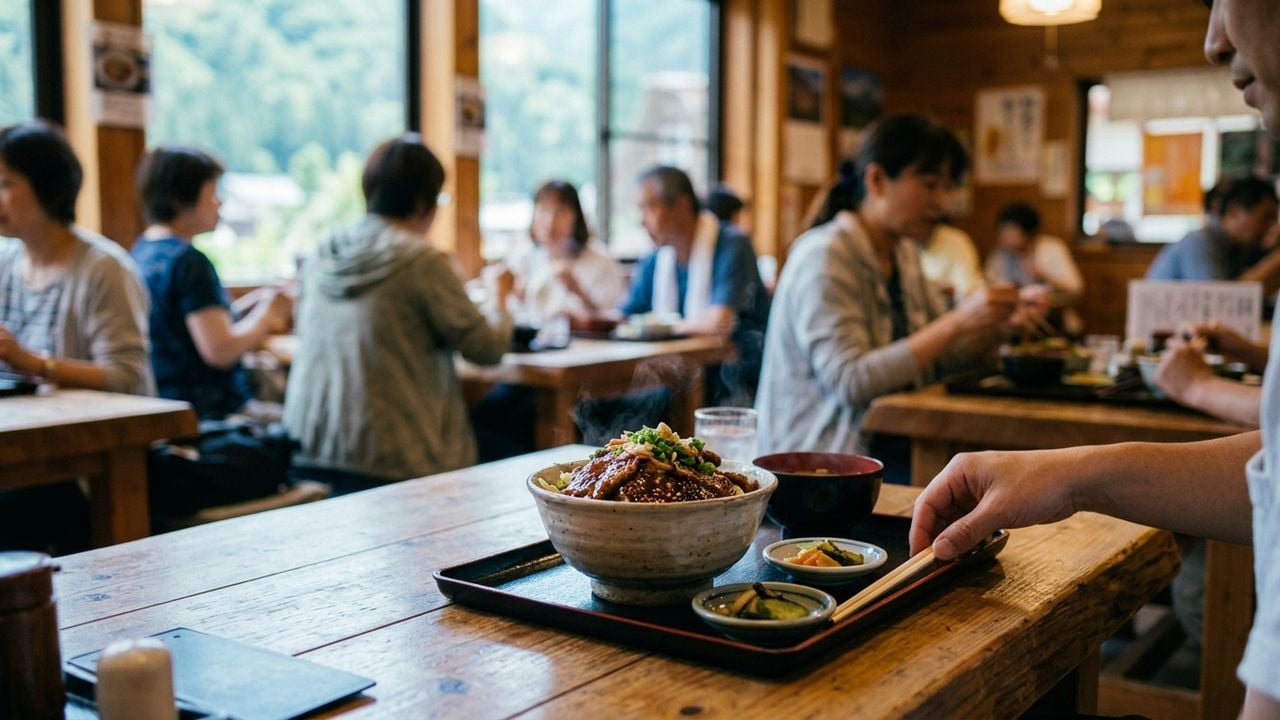
The result is a gyudon — Japan's classic beef bowl — reimagined entirely from the ground up. Every single component on the tray comes from Aichi: the "Aichi no Kaori" rice, the Hatcho miso for the soup, the Atsumi Ichō-zuke pickles, the Toyohashi-grown shiso, the Nagoya Cochin egg from Yamada Poultry Farm, and the white soy sauce from Hekinan City that forms the base of Itadaki's signature "magic sauce." It's not a fusion concept or a marketing angle — it's a genuine expression of what one prefecture tastes like when someone decides to take it seriously.
Because Horai Wagyu is strictly limited to 10 bowls per day, reservation via Tabelog Online is strongly recommended. When booking, paste 鳳来牛希望 into the notes field to request Horai Wagyu. For walk-in visitors, Mikawa Beef Rare Gyudon is always available and prepared with the same proprietary two-stage cooking technique.
✓ Key Takeaways
- Osu is Nagoya's best-kept neighborhood for local food discoveries — rarely covered in mainstream English guides, and exactly where repeat Japan visitors are now heading.
- Horai Wagyu is one of Japan's rarest wagyu brands: 300 heads per year, produced by 3 farms, available at Itadaki as one of the few direct-sourcing restaurants in Nagoya.
- Every ingredient in the bowl comes from Aichi Prefecture — making this a coherent "taste of Aichi" experience, not just a wagyu dish.
Horai Wagyu is limited to 10 bowls per day — and your Shirakawa-go departure time means you can't afford to arrive and find it sold out. Reserving your bowl through Tabelog Online is the straightforward way to lock in your spot before your travel day arrives. Remember to paste 鳳来牛希望 into the notes field when booking.
The Detail That Makes the Difference for International Visitors
One of the reasons Itadaki has resonated so strongly with foreign visitors isn't just the beef — it's a detail that sounds small until you've been lost in a Japanese restaurant without it.
"The English menu with clear serving instructions made the experience stress-free."
— Guest review
Itadaki offers a fully printed multilingual menu in English, Simplified Chinese, and Korean, with photos, prices, and ingredient explanations. Crucially, it also includes a five-step visual guide titled "How to Enjoy Rare Gyudon" — showing exactly how to separate the egg, when to add the yolk, and how to layer the condiments across your meal. For a dish this carefully constructed, that guide transforms eating from an uncertain experience into a deliberate one.
This matters especially for visitors whose Japan trip includes Shirakawa-go. The UNESCO World Heritage village is breathtaking, but its dining options are limited and often focused on set tourist menus. Having a genuinely memorable, locally specific lunch in Nagoya before you head north adds a layer to the day that the scenery alone can't provide. Several of our guests have described the combination of Itadaki for lunch and Shirakawa-go in the afternoon as one of the most satisfying day structures of their entire trip — the kind of day where every hour felt intentional.
For more on how Itadaki fits into a Shirakawa-go day, see how other visitors have structured their Shirakawa-go itinerary around a stop at Itadaki.
Finding Itadaki: The Practical Numbers
From Nagoya Station, Itadaki is approximately 10 minutes by subway: take the Higashiyama Line to Sakae, transfer to the Meijo Line, and exit at Yabacho Station Exit 4. The restaurant is a 4-minute walk from the exit. Look for the sign reading 元祖レア牛丼 頂 at street level and take the stairs to the second floor.
Itadaki is open for lunch only — 11:00 to 15:00 on Saturdays, Sundays, Mondays, and Tuesdays (last order 30 minutes before closing). On public holidays, hours extend from 09:00. The restaurant does not open for dinner. Given that most Shirakawa-go itineraries involve a late-morning departure from Nagoya, timing a visit to Itadaki between 11:00 and 12:30 works naturally before heading to the highway bus terminal or Meitetsu Bus Center.
The restaurant seats 18 guests across counter seats and sofa-style tables — a configuration that works equally well for solo diners, couples, and small groups. All seating is non-smoking.
Itadaki has been featured on eight major Japanese television programs, including NHK, and is recognized by Japan's broadcasting community as the originator of the "Rare Wagyu Gyudon" concept. That recognition came not from a publicist but from food journalists who found the restaurant the same way most visitors do: by following recommendations from people who had already been.
The Story You'll Carry Home
There's a particular kind of travel memory that outlasts photographs — the kind where you can explain exactly why something was different, and the person listening wishes they had been there. The fact that Horai Wagyu represents 300 out of 500,000 wagyu in Japan, raised on sake lees in a valley most travelers have never heard of, served in a bowl where every component was grown within the same prefecture — that's a story with enough detail to hold someone's attention at dinner back home.
Goto named the restaurant "Itadaki" — a reference to "itadakimasu," the Japanese expression of gratitude spoken before a meal. His philosophy is that food is a gift from farmers, land, and craft, and that a restaurant's job is to honor that at every step. For a visitor who has already seen Fushimi Inari and Arashiyama, who has eaten at Nishiki Market and wandered Dotonbori, that philosophy hits differently. It's not a tourist experience dressed up as a local one. It's the real thing, in a neighborhood that hasn't been polished for outsiders.
If your Shirakawa-go day has a free lunch hour in Nagoya — and it almost certainly does — this is how to spend it in a way you'll remember for the right reasons.
For our complete menu, access details, and store information, visit our official page at https://itadaki8.com/english/
You've spent time researching because you want this Nagoya lunch to be the kind of discovery you'll actually talk about — not something you stumbled into by default. The last step is straightforward: secure your Rare Wagyu Gyudon before the 10 daily bowls are gone, and your Shirakawa-go day already has its anchor moment planned.