Complete Guide to Nagoya Lunch for Gero Onsen Travelers
 gotowp
Let me be honest with you from the start: the single biggest reason travelers skip Itadaki isn't that they can't find us — it's that the words "rare wagyu" make them nervous. And that's completely understandable. If your instinct as a Western traveler is to pause when you see beef described as "rare-style," you're not being overcautious — you're being sensible. The good news is that the concern has a very clear answer, and once you have it, the only feeling left is anticipation.
This guide is written specifically for travelers making the Nagoya–Gero Onsen journey. Whether you're arriving in Nagoya first and heading to the hot springs afterward, or returning from Gero and catching a shinkansen home, there's a narrow window in your day for lunch — and we want to help you use it well. That starts with answering the food safety question honestly, so you can plan with confidence.
Who This Is For
- ✅ Travelers stopping in Nagoya on their way to or from Gero Onsen who want a memorable lunch, not just a quick bite
- ✅ Anyone who has heard "rare wagyu" and immediately wondered whether it's safe to eat
- ✅ Visitors who want to understand exactly what they're ordering before they sit down
- ✅ Gero-bound travelers looking for a Nagoya food experience that's genuinely different from anything in Tokyo or Kyoto
- ✅ Repeat Japan visitors who want to discover something authentic in Nagoya's Osu district, away from the usual tourist trail
The Concern I Hear Most — And Why It Almost Kept One Guest Away
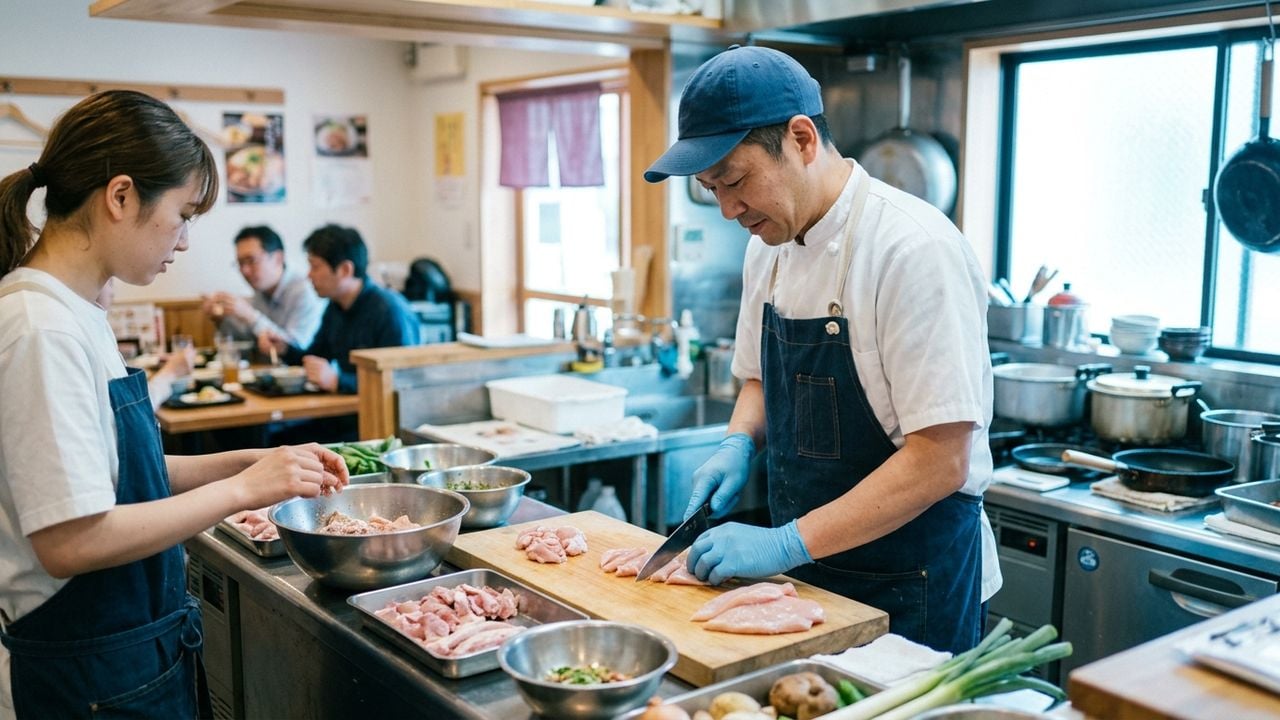
When we first opened in April 2022, a guest came in and sat down, looked at the menu, and said: "I want to order this. But I need to know — is it actually cooked?"
That question has stayed with me. Not because it was unusual, but because it was so reasonable. In the United States, the UK, Australia — most Western countries — public health advice has long been to avoid undercooked beef. The risks of E. coli, salmonella, and other pathogens from inadequately heated meat are well documented. That advice is grounded in real food science. So when a traveler arrives at a restaurant that uses the word "rare" in its name, the hesitation isn't irrational. It's informed.
Here's what I wish I had been able to hand that first guest on a card: a clear, honest explanation of what "rare" actually means at Itadaki, and why it is categorically different from what Western food safety warnings are designed to address.
The food safety question is answered — but your next practical question is probably whether we'll even be open on the day your Nagoya stopover lands. Our schedule runs on a fixed weekly pattern with occasional irregular closures, so the monthly calendar is the only reliable source. You can see the current month's confirmed business days there before you commit to any travel timing.
What "Rare" Means at Itadaki — And What It Doesn't
The phrase we use — Rare Wagyu Gyudon — refers to texture and mouthfeel, not to an absence of heat. Every bowl we serve is prepared using a proprietary two-stage cooking technique that heats the beef to over 70°C at its core. That temperature threshold is the exact standard set by Japan's Ministry of Health, Labour and Welfare for cooked beef. In other words: our wagyu is fully food-safe by the strictest official measure Japan applies.
What the two-stage technique achieves is something technically remarkable. By carefully controlling the temperature and timing of each stage, we preserve the soft, yielding texture that makes you feel as though the meat is melting — while the interior has already reached a temperature that eliminates harmful bacteria. The sensation is rare. The preparation is not.
This technique was developed by our founder Masayuki Goto, who holds a Certified Food Sanitation Supervisor qualification issued by Japan's Ministry of Health, Labour and Welfare and operates under a Licensed Restaurant Operator permit from the Aichi Prefecture Public Health Center. The method took considerable time and testing to perfect — it is, genuinely, the intellectual property of this restaurant. No other gyudon restaurant offers it.
The beef itself also matters here. We source exclusively from Aichi Prefecture: Horai Wagyu from Okumikawa (only 300 heads raised annually across three farms in Japan) and Mikawa Beef from the Mikawa region. Both are raised under rigorous quality control by local producers we know personally. The traceability of our supply chain is not a marketing line — it's the foundation of our food safety confidence.
✓ Key Takeaways
- Itadaki's rare wagyu is heated to over 70°C at the core — fully meeting Japan's Ministry of Health, Labour and Welfare food safety standards.
- The "rare" descriptor refers to texture achieved through a proprietary two-stage cooking technique, not undercooked beef.
- All beef is sourced exclusively from traceable, quality-controlled farms in Aichi Prefecture.
You now know the two-stage technique makes the rare preparation fully food-safe — but with Horai Wagyu capped at 10 bowls per day, knowing this and actually getting the bowl are two different things. Reserving in advance via Tabelog locks in your bowl before you board your train to Gero. Paste 鳳来牛希望 into the notes field when reserving to request Horai Wagyu.
Why This Matters More for Gero Onsen Travelers Specifically
If you're traveling to Gero Onsen — one of Japan's three great hot spring towns, about 90 minutes from Nagoya by express train — your Nagoya window is likely tight. You may have a few hours in the morning before your train, or a similar window on the return. That means you're choosing your one Nagoya meal carefully, and you cannot afford to arrive somewhere uncertain and leave disappointed.
That's exactly why the food safety question needs to be settled before you book, not after you sit down. Once it is, the experience itself becomes something to look forward to without reservation — in every sense of the word.
If you're planning a Shirakawa-go or Takayama trip alongside Gero, you might also find our guide covering what Shirakawa-go travelers often miss about Nagoya lunch useful for building your itinerary.
What the Experience Actually Looks Like
Once the food safety question is settled, what you're stepping into is one of Nagoya's most distinctive lunch experiences. Itadaki sits on the 2nd floor of a building in the Osu district — four minutes on foot from Yabacho Station Exit 4 on the Meijo Subway Line. From Nagoya Station, the journey takes roughly ten minutes: Higashiyama Line to Sakae, transfer to the Meijo Line, exit at Yabacho.
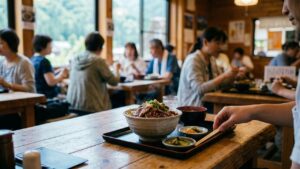
The restaurant seats 18 guests, all in sofa-style seating that makes the space feel unhurried. The menu is printed in English, Simplified Chinese, and Korean, with photos and a five-step visual guide that walks you through exactly how to enjoy the dish — how to separate the Nagoya Cochin egg, when to add the condiments, how to finish with wasabi. For Gero-bound travelers who want to understand what they're eating rather than guess, that guide removes every remaining layer of uncertainty.
Every ingredient on the table comes from Aichi Prefecture. The rice is Aichi no Kaori, grown locally. The miso soup is made with Hatcho miso from Okazaki. The pickles are traditional Atsumi Ichō-zuke from the Atsumi Peninsula. The shiso leaves are Aikei No.1 variety from Toyohashi. The complimentary condiments — pickled ginger, dried seaweed from Mikawa Bay, chirimen jako, and our original 8-spice blend — are there to explore freely.
One guest summed up what happens when all of this comes together in a way I haven't been able to improve on:
"Instagram-worthy presentation and unforgettable taste. My followers keep asking about it."
Guest review
That reaction — the surprise that a beef bowl could look and taste like this — is something we hear regularly. It's also, I think, what Goto-san had in mind when he asked the founding question of this restaurant: Why has no one ever made a premium version of gyudon?
Practical Planning: What Gero Onsen Travelers Need to Know
Itadaki is open for lunch only — 11:00 to 15:00 on Saturdays, Sundays, Mondays, and Tuesdays (last order 30 minutes before closing). Public holidays follow a 9:00 to 15:00 schedule. We are closed Wednesday through Friday. Irregular closures do occur, so please check our monthly business calendar on Instagram before you travel.
Our most-requested bowl — the Horai Wagyu Rare Gyudon — is strictly limited to 10 bowls per day. If you want to guarantee availability, advance reservation via Tabelog Online is the way to do it. When making your reservation, paste the following into the notes field: 鳳来牛希望 (this tells us you'd like Horai Wagyu). Tabelog's reservation interface is available in English.
If you're visiting without a reservation, Mikawa Beef Rare Gyudon is always available — prepared using the same two-stage cooking technique, and equally worthy of your lunch stop. Arriving right at 11:00 also gives you the best chance of enjoying Horai Wagyu on a walk-in basis.
The standard Horai Wagyu bowl (Shinkoccho) is 100g of wagyu with 200g of Aichi no Kaori rice at ¥2,700. The standard Mikawa Beef bowl (Fumoto) starts at ¥1,800. Both include miso soup, pickles, shiso, and a Nagoya Cochin egg. Average spend per person is around ¥3,000, ordering à la carte.
For a deeper look at what makes Itadaki's wagyu distinct from other Japanese beef brands — including how Horai Wagyu compares to the names you may already know — the complete guide to rare wagyu gyudon for beef connoisseurs goes into considerable detail on the sourcing and flavour differences worth knowing before you visit.
The Honest Summary
If the words "rare wagyu" gave you pause, I hope this guide has replaced that pause with clarity. The safety question has a factual answer — one grounded in Japanese food safety law, a certified food sanitation supervisor, and a cooking technique developed specifically to meet those standards without sacrificing the experience. There is nothing to guess at.
What remains is a lunch worth planning around: a bowl of wagyu that comes from farms most travelers will never hear of, prepared in a way no other restaurant replicates, served in a neighbourhood that still feels like a genuine discovery rather than a tourist destination. For travelers moving between Nagoya and Gero Onsen, it fits naturally into the day — close to the subway, quick to navigate, and unlikely to be forgotten.
For our complete menu, access details, and store information, visit our official page at https://itadaki8.com/english/
Your Gero Onsen itinerary has a Nagoya window, and the one question that was standing between you and this lunch now has a clear answer. The next step is simply securing your spot — especially if Horai Wagyu is on your list, since those 10 daily bowls go early. Reservations are made in English on Tabelog, and the whole process takes under five minutes.