5 Reasons Kimono Photographers Choose Osu Over Kyoto
 gotowp
You've rented your kimono. The obi is tied perfectly. Your phone is fully charged, and your ideal backdrop is somewhere between a stone-paved lane and a centuries-old temple gate. So why does everyone default to Kyoto?
Kyoto is stunning — no one disputes that. But it's also crowded, competitive, and exhaustingly familiar on social media. If you've spent any time scrolling through Japan travel photos, you've already seen the same red torii gate, the same bamboo grove, the same maiko district lantern shot reproduced thousands of times. For kimono photographers who genuinely want something memorable — and genuinely their own — Kyoto increasingly feels like the obvious choice, and obvious rarely means unforgettable.
There's a different story unfolding in Osu, Nagoya. And for photographers who care as much about the full experience as the final image, Osu offers something Kyoto simply cannot replicate: discovery without the script.
Who This Is For
- ✅ Travelers planning a kimono rental day and looking for a location beyond Kyoto's well-worn routes
- ✅ Kimono photographers who want backdrops that feel genuinely undiscovered rather than endlessly reproduced
- ✅ International visitors worried about language barriers at local Nagoya restaurants — especially when dressed for a special occasion
- ✅ Repeat Japan travelers already familiar with the Golden Route who want a deeper, more personal discovery
- ✅ Anyone who wants their lunch to be as memorable as their photos
1. Osu Is Visually Layered in a Way Kyoto's Tourist Corridors No Longer Are
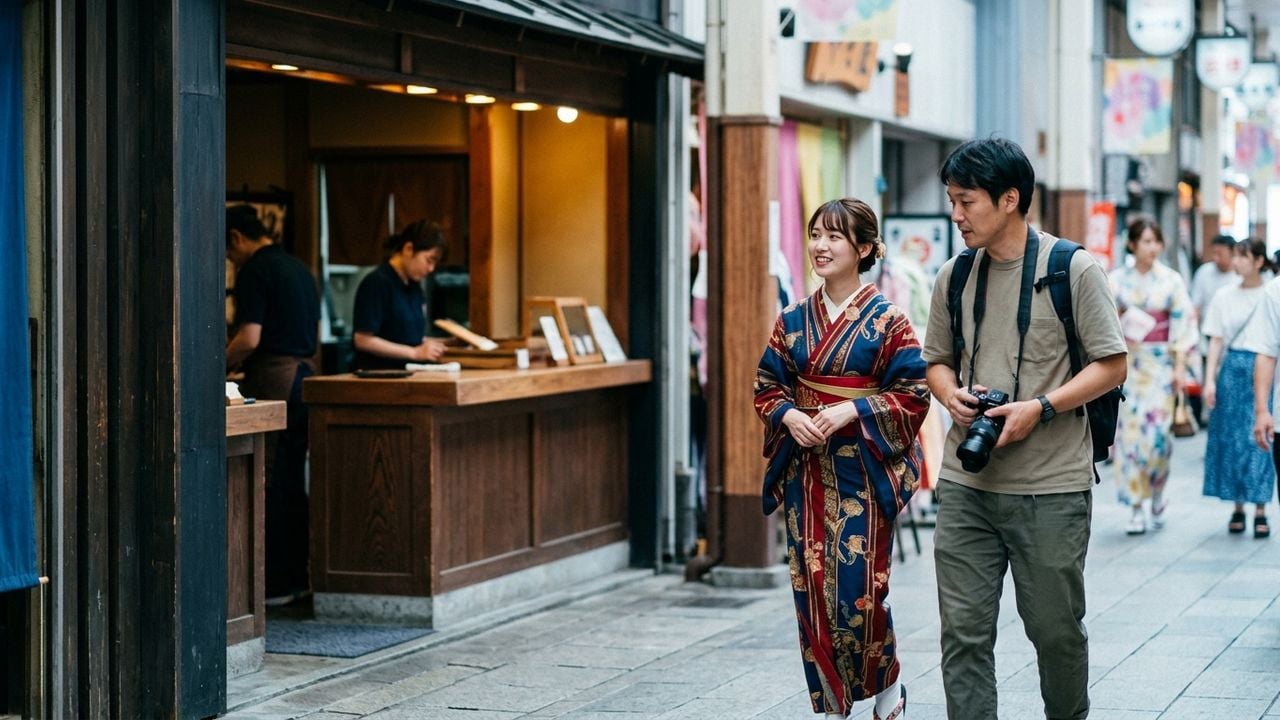
Osu doesn't try to be a theme park. That's its greatest visual strength. Within a ten-minute walk, you move from the incense-heavy calm of Osu Kannon Temple — one of Central Japan's most significant Buddhist sites — through a 1,200-shop shopping arcade that has been trading for over 400 years, past vintage electronics stalls, Taiwanese bakeries, maid cafés, and hand-painted shop signs that haven't changed in decades. A kimono against that layered backdrop creates something Kyoto's carefully curated tourist zones cannot: genuine contrast.
The light changes differently here too. Osu's arcade passages filter the afternoon sun in a way that flatters fabric texture. The temple approach in the early morning is nearly empty compared to Kyoto's perpetually-busy equivalents. And the neighborhood's acceptance of cosplay culture — Osu is Nagoya's home for the World Cosplay Summit — means that someone in a beautifully styled kimono is welcomed, admired, and never out of place.
If you're planning your Osu kimono day around the weekend, Itadaki's schedule isn't fixed every week — irregular closures do apply. The monthly business calendar is posted on Instagram, so you can confirm your date before committing to your kimono rental booking. A quick check takes less than a minute.
2. Osu Feels Like a Genuine Discovery, Not a Set
Here's the honest difference: Kyoto has been styled for the camera for so long that many of its most iconic spots now feel staged. The rickshaws are positioned. The lanterns are identical. The queues are real.
Osu has not been optimized for tourism in that way — and that's precisely what makes it compelling. The narrow lanes between Banshoji Temple and the covered arcade, the small shrines tucked between shops, the unexpected Portuguese-tile wall or Edo-era roof detail visible above a modern storefront: these are genuinely there because Osu grew organically, not because a tourism board placed them. For a photographer, that authenticity shows in the image.
Repeat visitors to Japan — particularly from Hong Kong and Taiwan, where a significant portion of travelers have visited Japan ten or more times — are increasingly choosing Nagoya for exactly this reason. The story they bring home isn't one everyone already knows.
3. After the Photos, You Need a Lunch That Matches the Day
This is where most kimono photography guides go quiet. You've had a remarkable morning. Your camera roll is full. And now you're standing in Osu in full kimono, hungry, and not entirely sure where to eat without a long walk, a difficult menu, or an awkward experience trying to communicate in Japanese while wearing something beautiful and slightly impractical.
This anxiety is real, and it's one of the reasons international visitors sometimes retreat to familiar international chains on days like this — which is a shame, because Osu has exactly the kind of restaurant that makes a kimono lunch unforgettable rather than stressful.
At Itadaki, a specialty rare wagyu gyudon restaurant a four-minute walk from Yabacho Station Exit 4, the answer to the language barrier concern is built directly into the experience.
4. Itadaki's Multilingual Menu Means You Can Fully Enjoy the Meal — No Japanese Required
One of the most common worries foreign visitors have when considering an authentic Japanese specialty restaurant is the menu itself. Not just the translation — but the texture of uncertainty: not knowing what to order, how to eat it, whether you'll accidentally skip something important, or whether you'll be able to ask about ingredients.
Itadaki addresses this before you even sit down. The menu is printed in full in English, Simplified Chinese, and Korean, with photographs, prices, and ingredient notes for every item. There's no guessing, no pointing at a kanji you can't read, no apologetic pantomime at the counter.
More importantly, the menu includes a step-by-step visual guide: How to Enjoy Rare Gyudon. In five clear steps, it walks you through the entire experience — from separating the raw Nagoya Cochin egg (the white goes into the miso soup, the yolk rests on the beef) through to adding wasabi as a final, refreshing note. The guide exists because the dish genuinely has a sequence that makes it more enjoyable when followed deliberately. Itadaki's team designed it specifically so that international guests could arrive without any prior knowledge of rare wagyu gyudon and still experience the dish exactly as intended.
For someone in a kimono — already navigating an unfamiliar experience with care — this kind of thoughtful preparation makes a remarkable difference. You can focus entirely on the moment rather than the logistics of ordering.
"I've had Kobe beef and Matsusaka beef, but Horai Wagyu at Itadaki was on another level."
Guest review
That reaction comes from guests who were able to taste the dish fully — because they understood what they were eating and how to eat it. The multilingual guide isn't a convenience feature. It's what allows the flavor to actually land.
✓ Key Takeaways
- Osu offers authentic, visually layered backdrops that feel genuinely undiscovered — particularly valuable for kimono photographers tired of Kyoto's over-photographed landmarks
- Language barriers at local Nagoya restaurants are a real concern for international visitors, but Itadaki's printed multilingual menu (English, Chinese, Korean) with a five-step visual guide removes that barrier entirely
- The rare wagyu gyudon experience at Itadaki is designed to be fully accessible to guests with no prior knowledge of the dish — no Japanese required
The Horai Wagyu bowl — limited to 10 per day — is the dish most guests come specifically for, and it does sell out during peak lunch hours on weekend kimono days in Osu. Reservations are accepted in English on Tabelog; add 鳳来牛希望 in the notes to request the Horai Wagyu. No walk-in guarantee exists for this one.
5. The Sofa Seating Makes It Comfortable Even in a Kimono
This detail matters more than it might seem. Obi-wrapped kimono sitting is not the same as sitting in a standard chair. The structured layers around your waist and lower back require room, support, and ideally a seat with some give. Counter stools, hard chairs, and cramped bench seating can genuinely be uncomfortable when you're dressed in full kimono.
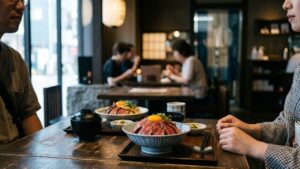
Itadaki's 18 seats are all sofa-style table seating — low, cushioned, and generously spaced. Whether you're at one of the two-person tables or the larger group sofa, you'll be seated comfortably without adjusting your outfit or worrying about the fabric. It's a small detail that makes a meaningful difference on a day when you want everything to feel easy.
The restaurant's commitment to welcoming international guests authentically extends beyond the menu translation. Staff are accustomed to guests arriving from all backgrounds and in all kinds of attire — including cosplay, which is entirely normal in Osu. A beautifully styled kimono will fit right in.
Itadaki is open for lunch on Saturdays, Sundays, Mondays, and Tuesdays (11:00–15:00), with last order at 14:30. If you're planning a kimono day in Osu on a weekend, it fits naturally into the afternoon after your morning photography. The Horai Wagyu bowl — the restaurant's signature, produced by only 3 farms in Japan with just 300 heads raised annually — is limited to 10 bowls per day, so if that's what you're aiming for, a reservation via Tabelog is recommended. To request Horai Wagyu specifically, copy and paste this phrase into the notes field when booking: 鳳来牛希望
If you're curious about how Osu compares for other kinds of special-day dining, this piece on why Osu draws samurai history enthusiasts for lunch captures the neighborhood's broader appeal for visitors who want a destination that holds up on its own terms.
Putting It Together: A Kimono Day in Osu
The shape of a great Osu kimono day isn't complicated. Rent your kimono from one of the studios in or near the shopping district. Spend the morning working through the temple approach at Osu Kannon, the arcade passages, and the quieter lanes between Banshoji and the covered street — the light is best before noon. Then walk four minutes from Yabacho Station Exit 4 to Itadaki for lunch.
You'll sit down in a comfortable sofa seat, open an English menu that tells you exactly what everything is, follow a five-step guide that makes the rare wagyu experience genuinely enjoyable rather than confusing, and leave with a meal that matches the quality of the morning's photographs.
Kyoto will always be there. But the version of Japan you haven't yet photographed — the one that will actually surprise you — is waiting in Osu.
For our complete menu, access details, and store information, visit our official page at https://itadaki8.com/english/
You've put thought into every part of this day — the kimono, the route, the backdrops. The lunch should be just as deliberate. Securing your Horai Wagyu bowl in advance means you arrive at Itadaki knowing exactly what's waiting, with nothing left to chance. Reservation takes a few minutes on Tabelog, in English.
Reserve Your Seat at Itadaki — Rare Wagyu Gyudon, Osu Nagoya