Inside Look: How Osu District Serves Asian Para Games Visitors
 gotowp
Here's a number that might surprise you: according to a 2023 survey by the Japan Tourism Agency, nearly 40% of foreign visitors to Japan say that language barriers at restaurants are the single biggest source of anxiety during their trip — ranking higher than transportation confusion or price uncertainty. For Para Games spectators and athletes' families arriving in Nagoya in 2026, that anxiety doesn't disappear just because you're excited about the event. If anything, it becomes more pressing when you're navigating an unfamiliar city on a tight schedule, trying to find a lunch that works for your group.
The Osu district — Itadaki's home neighborhood, just a 4-minute walk from Yabacho Station — is one of the most internationally layered parts of Nagoya. But even here, where multilingual signage is more common than most Nagoya streets, the gap between "I can read the street sign" and "I can confidently order a specialty dish I've never seen before" remains very real. This article looks specifically at how Osu handles that gap for Para Games visitors — and what it actually feels like to walk into a specialty restaurant here without a word of Japanese.
Who This Is For
- ✅ Asian Para Games spectators, volunteers, or athletes' families planning to eat lunch in the Osu area during their Nagoya visit
- ✅ Travelers who feel anxious about ordering at authentic Japanese specialty restaurants without Japanese language skills
- ✅ Visitors who want to know exactly what multilingual support looks like inside an Osu restaurant — before they walk through the door
- ✅ Anyone traveling with dietary needs or allergen concerns who needs to communicate clearly with restaurant staff
- ✅ Groups or families who want a relaxed, stress-free lunch experience in an unfamiliar city
Why Language Anxiety Keeps Visitors Away from the Best Restaurants
The frustrating truth is that the restaurants most likely to give you a genuinely memorable meal in Japan are often the ones that feel the most intimidating to enter. A handwritten menu with no photos. A counter where the staff is focused and efficient. A dish you've never encountered before, with no obvious parallel in your home cuisine.
For Para Games visitors especially, there's an added layer: many will be in Nagoya for only a few days, and no one wants to spend their one free lunch afternoon staring at an untranslated menu, unsure whether what they're about to order contains something they can't eat. The safer-feeling choice — a chain restaurant with English on the signage — becomes the default. And that's exactly how so many travelers leave Japan having eaten very well, but not having eaten here.
Osu, to its credit, has always drawn a more internationally curious crowd than most Nagoya neighborhoods. Its 400-year-old shopping street, anime shops, and Osu Kannon Temple bring in visitors from across Asia and beyond. But "internationally curious" doesn't automatically mean "fully equipped to host a first-time visitor through a complex culinary experience." That requires deliberate preparation on the restaurant's part.
You now know that Itadaki's multilingual menu removes much of the ordering anxiety — but business days in Osu can shift, and arriving on a closed day is the one thing no amount of menu preparation can fix. The official Instagram posts the monthly business calendar so you can confirm your exact visit date before making plans. A quick check takes under a minute.
What a Truly Multilingual Restaurant Experience Looks Like in Practice
At Itadaki, the approach to language support wasn't designed as an afterthought. It was built into the concept from the beginning — because founder Masayuki Goto understood early on that if the dish required explanation even in Japanese, it absolutely required clear, thoughtful communication in other languages too.
The Rare Wagyu Gyudon is not a dish you can intuit from a photo alone. The rare-style preparation using Itadaki's proprietary two-stage cooking technique, the role of the Nagoya Cochin egg, the five-step sequence for enjoying the bowl — these details aren't optional extras. They're the difference between eating a good beef bowl and understanding what makes this dish unlike anything else.
So the printed menu at Itadaki comes in English, Simplified Chinese, and Korean — with clear photographs, prices, and ingredient explanations. More importantly, it includes a visual step-by-step guide: "How to Enjoy Rare Gyudon." The guide walks you through separating the raw egg (white into the miso soup, yolk atop the beef), appreciating the wagyu in its initial rare form, mixing the yolk through for a richer bite, adding condiments from the tabletop, and finishing with wasabi. It's a genuine eating guide, not a decoration.
One guest described it simply: "The English menu with clear serving instructions made the experience stress-free." That phrase — stress-free — matters enormously when you're in a foreign city, jet-lagged, and trying to make the most of a limited window.
"The English menu with clear serving instructions made the experience stress-free."
Guest review, Itadaki
For visitors with allergen concerns, the menu also outlines the key ingredients: soy and wheat are present in the soy sauce and miso; the Nagoya Cochin egg can be omitted at a small reduction in price; the complimentary chirimen jako (dried whitebait) on the tabletop contains sesame and can simply be left aside. Staff are welcoming to guests who use translation apps at the table — the restaurant's compact, focused format makes that kind of quiet, self-directed communication entirely comfortable.
✓ Key Takeaways
- Language anxiety is a real barrier for foreign visitors at Japanese specialty restaurants — even in internationally-minded neighborhoods like Osu
- Itadaki's multilingual printed menu (English, Simplified Chinese, Korean) includes photos, prices, allergen notes, and a five-step visual guide to enjoying the dish
- Translation apps work comfortably in the restaurant, and staff are genuinely welcoming to international guests regardless of language proficiency
Knowing the five-step guide exists is one thing — but the Horai Wagyu that makes the experience genuinely rare is limited to 10 bowls a day, and Para Games schedules don't leave much room for a second attempt if it sells out. Reserving in advance via Tabelog locks in your bowl and lets you paste 鳳来牛希望 in the notes to request it specifically. The booking interface supports English.
The Osu District Beyond the Language Question: What Para Games Visitors Will Find
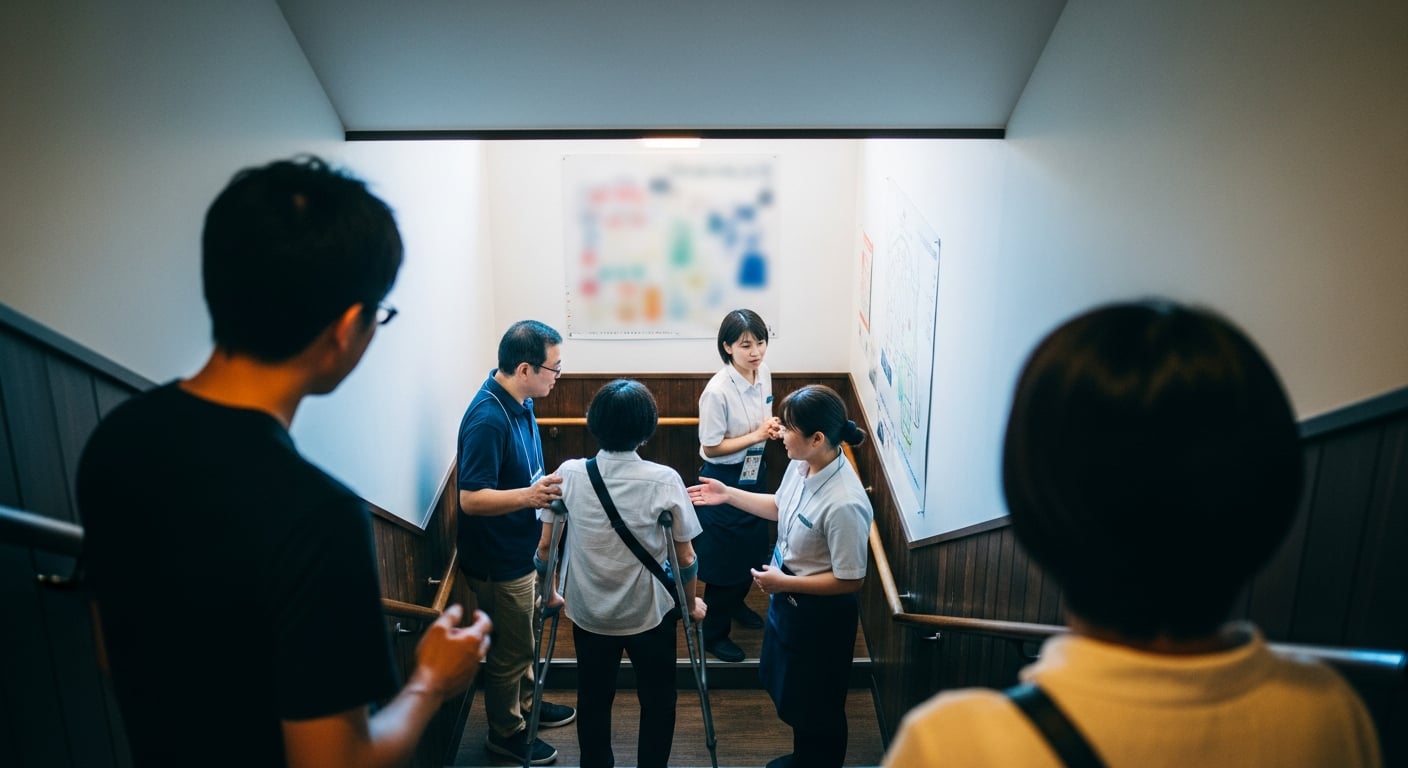
Even if the language barrier were fully resolved tomorrow, Osu would still require a little orientation for first-time visitors. The shopping street is enormous — over 1,200 shops across a network of covered arcades — and Itadaki itself is on the 2nd floor of a building on Osu's main street, with a sign in Japanese that reads 元祖レア牛丼 頂 ("Ganso Rea Gyudon Itadaki"). The staircase entrance is easy to walk past if you don't know to look for it.
The practical advice: arrive at Yabacho Station Exit 4 (Meijo Subway Line), walk four minutes in the direction of Osu Kannon Temple, and look for that sign at street level. From Nagoya Station, the journey takes approximately 10 minutes — Higashiyama Line to Sakae, transfer to the Meijo Line, off at Yabacho. It's simpler than the Osu street layout might suggest.
For Para Games visitors who want more detail on navigating the neighborhood's dining scene, this guide to Osu restaurants for Para Games visitors covers ten practical facts worth knowing before you arrive. And if accessibility is a consideration for your group, this article on accessible restaurants near Asian Para Games venues addresses the specifics of barrier-free dining options in the Nagoya area.
Itadaki operates on a lunch-only basis: open Monday, Tuesday, Saturday, and Sunday from 11:00 to 15:00, with extended hours from 9:00 on public holidays. Wednesday, Thursday, and Friday are closed. Because the schedule can shift, the most reliable way to confirm business days is to check the monthly calendar posted on the official Instagram before your visit.
One additional note for Para Games visitors planning as a group: Itadaki's full restaurant — 18 seats across counter spots, sofa tables for two, four, and five people — is available for full buyout for special occasions or group lunches. Inquiring via Instagram DM in advance is the way to coordinate that kind of visit.
Reserving Without Japanese: A Step-by-Step for International Guests
One of the practical concerns for any international visitor is how to actually make a reservation at an authentic Japanese restaurant when the booking platform assumes Japanese fluency. Itadaki accepts reservations through Tabelog Online, which supports English-language bookings. The interface is navigable for English speakers, and the confirmation process is straightforward.
If your goal is to try the Horai Wagyu — the ultra-rare wagyu produced by only 3 farms in Japan, with just 300 heads raised annually — it's worth noting that this is limited to 10 bowls per day. To request it specifically when booking, copy and paste the following into the notes field: 鳳来牛希望. That phrase communicates your request in Japanese to the kitchen team. No additional translation is needed on your part.
Walk-in guests are always welcome, and the Mikawa Beef Rare Gyudon is available without reservation. Arriving right at 11:00 opening gives walk-in visitors the best chance of experiencing Horai Wagyu on the day.
"The staff were welcoming and made us feel at home even without perfect Japanese."
Guest review, Itadaki
A Lunch Worth Planning Around
The 2026 Asian Para Games will bring thousands of visitors to Nagoya — many of them on tight itineraries, many navigating Japanese dining for the first time, and many looking for something more than a safe, familiar option. The Osu district, with its layered history and genuine local character, offers that something more. But it requires restaurants that have done the work to make that experience accessible — not just physically, but linguistically and culturally.
At Itadaki, that work is visible the moment the menu arrives at your table: photographs, clear pricing, allergen information, and a guide that walks you through the dish in your own language. The rare wagyu experience — featuring Aichi Prefecture ingredients from the beef to the rice to the miso — doesn't require Japanese to appreciate. It requires a restaurant that has thought carefully about how to share it.
For our complete menu, access details, and store information, visit our official page at https://itadaki8.com/english/
You've read through the multilingual menu, the five-step guide, the reservation phrase — now the only step left is actually securing your seat. With only 10 bowls of Horai Wagyu available each day and a Para Games schedule that won't wait, reserving now is the straightforward move. Tabelog Online handles it in English, no Japanese required.