If You're a MICE Attendee in Nagoya, Add Itadaki to Your Schedule
 gotowp
Here's a fact that might surprise you: Nagoya hosts more international MICE events — conventions, trade shows, incentive trips, and corporate conferences — than any other city in Japan outside of Tokyo and Osaka. And yet, when business travelers are asked what they actually did in Nagoya, the most common answer is still "I stayed near the convention center and grabbed something at the hotel."
That's a missed opportunity. Because tucked into one of Nagoya's most atmospheric districts — just 10 minutes by subway from Nagoya Station — is a specialty restaurant that has been reimagining Japan's humble beef bowl since 2022. If your schedule has a lunch window, Itadaki belongs in it.
Who This Is For
- ✅ MICE attendees staying in Nagoya with a free lunch slot to fill meaningfully
- ✅ Business travelers who want an authentic local experience without a long detour
- ✅ Anyone wondering how to actually get from Nagoya Station or a central hotel to the Osu district
- ✅ First-time visitors to Osu who feel unsure about navigating its winding streets
- ✅ Professionals looking for a memorable, story-worthy meal to take home from Nagoya
The Ingredient Story Behind Every Bowl
Before we talk logistics — and we will, in detail — it helps to understand what makes Itadaki worth the trip in the first place. Because this isn't a restaurant that simply serves good beef. It's a restaurant built on a very specific philosophy: everything on your table comes from Aichi Prefecture.
Founder Masayuki Goto, who has spent 18 years in the food and hospitality industry and holds a Certified Food Sanitation Supervisor credential from Japan's Ministry of Health, Labour and Welfare, designed Itadaki as a direct-supply operation from the ground up. Every ingredient was chosen not for convenience, but for provenance and craft.
Let's walk through what's actually in the bowl:
Horai Wagyu — the rarest beef in the lineup. Produced in Okumikawa, deep in Aichi's mountain interior, by just 3 farms with a combined annual output of 300 heads. To put that in context: Japan raises roughly 500,000 wagyu cattle per year. Horai Wagyu accounts for 300 of them. What makes it distinctive isn't just scarcity — it's diet. These cattle are fed on sake lees from Horaisen Sora, one of Aichi's most respected breweries. The result is a marbling profile that's lighter and more nuanced than the fat-forward wagyu most travelers encounter at tourist-oriented steakhouses.
Mikawa Beef — the always-available alternative. Also from Aichi, raised on okara (soy pulp) feed with lactic acid bacteria management for gut health. The uchimomo (inner thigh) lean cut is used exclusively — a deliberate choice that delivers cleaner, more pronounced beef flavor rather than the richness that comes from heavily marbled cuts.
Aichi no Kaori rice. A premium rice variety grown in Aichi Prefecture, cooked in high-tech rice cookers that Goto's team adjusts annually based on that year's harvest quality. Yes — the rice settings change each year. That's the level of attention this kitchen operates at.
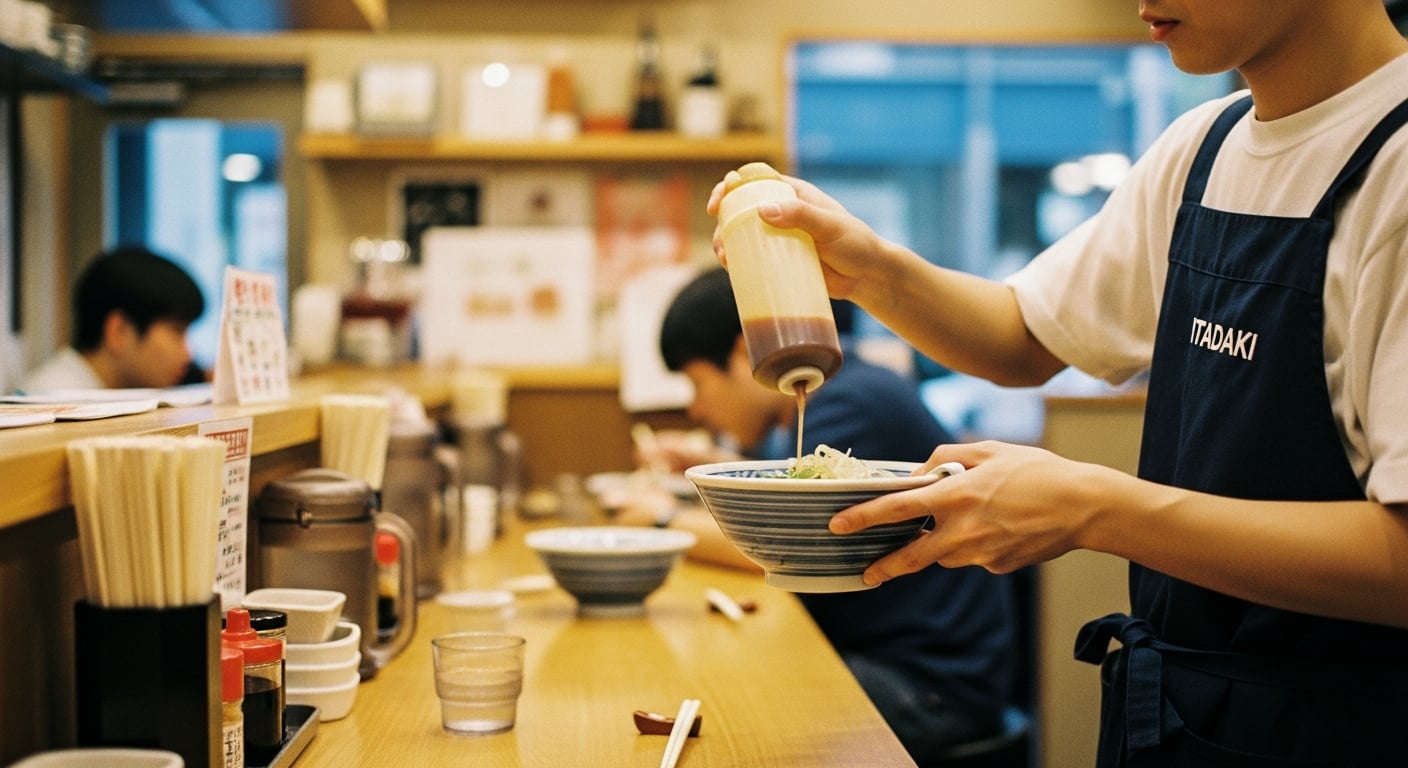
The "magic sauce." Built on white soy sauce from Hekinan City — a variety far lighter in color and more delicate in flavor than the dark soy sauce most international visitors know — and blended with wine and carefully selected seasonings. It's used twice: as a brief dip for the beef and as the base for simmering the onions.
Nagoya Cochin egg from Yamada Poultry Farm. Rich in yolk, with a depth of flavor that separates it from standard eggs. The egg white goes into the miso soup; the yolk is placed on top of the beef — and the five-step guide on the menu tells you exactly what to do next.
Complimentary tabletop condiments. Pickled ginger from Kimura Farm in Inazawa City, chopped seaweed from Himakajima island in Mikawa Bay, chirimen jako (dried whitebait) from Minamichita, Itadaki's original 8-spice blend, and house wasabi. Every single one from Aichi.
✓ Key Takeaways
- Itadaki sources 100% of its ingredients from Aichi Prefecture — from the beef to the rice to the condiments — creating a fully cohesive taste-of-Aichi experience in a single bowl.
- Horai Wagyu, limited to 10 bowls per day, is one of Japan's rarest wagyu breeds: 300 heads annually across 3 farms. Mikawa Beef is available as a walk-in option at all times.
The Two-Stage Cooking Technique — and Why It Matters for You
If you've attended international food safety briefings, you may already know that rare or undercooked beef raises legitimate concerns in many regulatory environments. Japan's approach is different — and Goto developed a proprietary two-stage cooking technique specifically to make rare-style wagyu safe under Japan's strict Ministry of Health, Labour and Welfare standards.
The technique heats the beef to over 70°C at the core. Fully. Every time. What you experience as "rare" is a texture sensation created through precise temperature management — not through serving undercooked meat. It is a genuine technical innovation, recognized as such by the eight major Japanese television programs (including NHK, Japan's national public broadcaster) that have featured Itadaki since it opened in 2022.
For MICE attendees and business travelers: this is a restaurant that has done its homework. The food safety documentation is sound, the sourcing is traceable, and the culinary concept was developed by someone with formal credentials and nearly two decades of professional experience. You can share this meal with confidence — and with a story worth telling at the next conference dinner.
"The lunch was the highlight of my Nagoya trip — I'm telling all my friends about it."
— Guest review
Getting There from Nagoya Station or Your Hotel — Step by Step
This is where many visitors hesitate. Osu has a reputation for being a maze — and honestly, it earns that reputation. The shopping district is a network of covered arcades, side streets, and temple grounds that can feel disorienting even with a phone in hand. Google Maps is useful but occasionally imprecise in this part of the city. And Itadaki is on the 2nd floor, which means it's easy to walk right past the entrance at street level.
Here's the route that actually works:
From Nagoya Station: Take the Higashiyama Line (yellow line) from Nagoya Station toward Fujigaoka. Ride two stops to Sakae Station. At Sakae, transfer to the Meijo Line (purple line) and ride one stop to Yabacho Station. Total transit time: approximately 10 minutes. Exit at Exit 4 and walk straight — Itadaki is a 4-minute walk from that exit.
From central Nagoya hotels (Fushimi, Marunouchi, Sakae area): If you're already in the Sakae district, you're effectively at the doorstep. Walk to Yabacho Station on the Meijo Line, or simply navigate on foot — it's roughly 10–15 minutes from most Sakae hotel properties.
Alternative access points: Itadaki is also within walking distance of Osu Kannon Station (Tsurumai Line), Kamimaezu Station (Meijo/Tsurumai Lines), and Sakae Station itself. If you're already exploring Osu Kannon Temple or the Osu Shopping Street, you're close.
Finding the entrance: At street level, look for the sign that reads 元祖レア牛丼 頂 (pronounced: "Ganso Rea Gyudon Itadaki"). This is the sign you're looking for. Once you see it, take the staircase up to the 2nd floor. The restaurant is at 4-1-20 Osu, 2F, Naka-ku, Nagoya.
A landmark to orient yourself: Osu Kannon Temple is one of the most recognizable landmarks in the district — if you can see or navigate to the temple, you're within easy walking distance of Itadaki. The main Osu Shopping Street entrance is also a useful reference point.
For direct navigation, a Google Maps link is available on our official page at itadaki8.com/en/ — we recommend saving it to your phone before you head out.
Practical Notes for a Smooth Visit
Hours: Itadaki is open for lunch only — 11:00 to 15:00 on Saturdays, Sundays, Mondays, and Tuesdays (last order 30 minutes before closing). On public holidays, we open at 9:00. The restaurant is closed Wednesday through Friday. Please check the monthly business calendar on Instagram before your visit, as irregular closures may apply.
Horai Wagyu availability: Strictly limited to 10 bowls per day. During peak lunch hours — especially on weekends — these sell out before noon. If Horai Wagyu is your target, advance reservation via Tabelog Online is the reliable path. When booking, paste the following into the notes field: 鳳来牛希望 (this tells us you'd like to reserve Horai Wagyu). Tabelog reservations can be made in English. Mikawa Beef Rare Gyudon is always available for walk-in guests.
Language support: A fully multilingual printed menu in English, Simplified Chinese, and Korean is available, with photos, prices, and a five-step visual guide for enjoying the dish. No Japanese required.
Seating: 18 seats total, all sofa-style table seating — comfortable for working lunches, small group gatherings, or a quiet solo meal. Five counter seats are ideal for solo diners. A table for five makes it a practical option for a small team outing. No private rooms are available, but the intimate scale of the space creates a relaxed atmosphere rather than a formal one.
Payment: Credit cards accepted. The restaurant operates on an à la carte basis — order your gyudon, add a side dish, add a Chita Highball or Kinshachi craft beer if the afternoon allows it. Average spend is around ¥3,000 per person.
Why It Fits a MICE Schedule
MICE schedules are built around precision. Sessions start on time, networking slots fill fast, and genuine free time is rare. That's exactly why Itadaki works: the walk from Yabacho Station Exit 4 takes four minutes. The meal, enjoyed at its own pace, fits comfortably into a 60-to-90-minute lunch window. And you leave with the kind of experience that actually gives you something to talk about at the next session — not just a hotel restaurant meal that disappears from memory by Tuesday.
Masayuki Goto built Itadaki on a belief that a bowl of rice and beef could carry a story worth telling. That the ingredients deserved to be named, traced, and understood. That "itadakimasu" — the Japanese expression of gratitude spoken before every meal — means something. For anyone traveling to Nagoya on business, that philosophy translates into a lunch that is genuinely different from anything you'll find in a hotel lobby or convention center food court.
For our complete menu, access details, and store information, visit our official page at itadaki8.com/en/.
If Horai Wagyu is on your list, reserve early — those 10 bowls move quickly. We'd be glad to have you at the table.
Reserve Your Rare Wagyu Experience
And to confirm which days we're open during your stay, the monthly business calendar is always up to date:
Check Our Monthly Schedule on Instagram