Business Traveler's Hidden Gem: Osu Rare Wagyu Bowl Near Sakae
 gotowp
You've wrapped up your meetings near Sakae, you have exactly ninety minutes before your next call, and somewhere between your hotel and the subway you remember: that wagyu place — the one your colleague mentioned, the one you bookmarked three weeks ago. You pull up the map, confirm it's a four-minute walk from Yabacho Station, and then the doubt creeps in. It's already 12:30. Will the Horai Wagyu still be available?
If that scene sounds familiar, this article is written for you. Not a first-timer overwhelmed by Nagoya's food scene — but a business traveler who knows what they want, has limited time to get it, and cannot afford to arrive and find the dish already gone.
Who This Is For
- ✅ Business travelers visiting Nagoya for corporate meetings, factory tours, or MICE events who want a remarkable lunch within striking distance of Sakae
- ✅ Anyone who has heard about Horai Wagyu at Itadaki and needs a clear, step-by-step plan to actually secure it
- ✅ Visitors unfamiliar with Tabelog who want to know exactly how to make a reservation in English
- ✅ Walk-in guests who arrive without a reservation and want to know their best options
- ✅ Travelers with a tight midday window who need to know what to realistically expect before they walk through the door
Why Horai Wagyu Sells Out — and Why It Matters to You
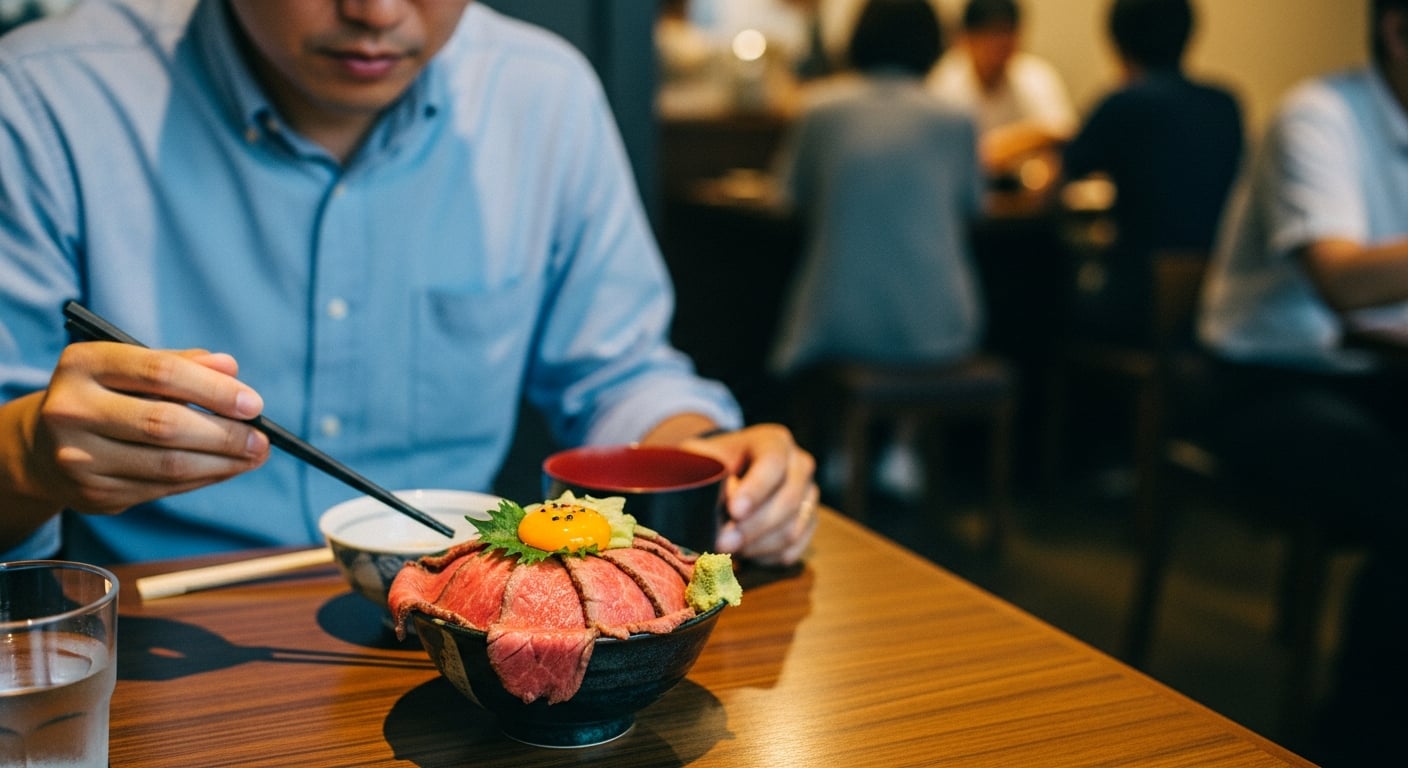
Here's the honest number: ten bowls per day. That's the absolute limit for Horai Wagyu at Itadaki, and it isn't a marketing decision. It reflects a simple agricultural reality. Horai Wagyu is a Kuroge Wagyu breed raised in the Okumikawa region of Aichi Prefecture — a mountainous inland area where only three farms produce this cattle, with just 300 heads raised annually across all of Japan. For context, Japan raises roughly 500,000 wagyu cattle in total. Horai Wagyu represents 300 of them.
The cattle are fed on sake lees from Horaisen Sora, a premium local brewery, which gives the beef a distinctive quality: genuine marbling alongside lean, flavorful cuts — a combination rarely found in wagyu, where ultra-rich fat content tends to dominate. Itadaki founder Masayuki Goto spent years building a direct-supply partnership with these farms to bring this ingredient to the table. The ten-bowl daily limit exists because supply is genuinely that constrained.
On a weekday lunch service, those ten portions are typically claimed well before 1:00 PM. During Golden Week, cherry blossom season, or any period when Nagoya sees elevated visitor numbers, they can disappear within the first hour of opening. For a business traveler who can only do lunch between 12:00 and 13:30, that window is precarious.
The Reservation Path: Tabelog in English, One Key Phrase
Tabelog is Japan's most trusted restaurant reservation platform — the equivalent of OpenTable for the domestic market. Most foreign visitors haven't used it before, which is exactly why we want to walk you through it clearly.
The good news: Tabelog's reservation interface works in English. You can set your date, select your time slot, choose the number of guests, and confirm everything without needing Japanese language skills. The platform accepts standard international payment cards for confirmation purposes.
There is one step that requires your attention. When making a reservation for Horai Wagyu, please copy and paste the following phrase into the notes or special requests field:
鳳来牛希望
This tells our team that you specifically want Horai Wagyu reserved for your visit. Without this note, your table is secured but your Horai Wagyu portion is not. Staff cannot automatically assume every reservation is for the premium Horai option — the note is what locks it in.
For Itadaki's business hours: lunch service runs 11:00–15:00 on Saturdays, Sundays, Mondays, and Tuesdays (last order at 14:30). On public holidays, doors open at 9:00 AM. Wednesday through Friday, the restaurant is closed. Before you plan your lunch, verify the current monthly schedule — irregular closures do apply.
Check Our Monthly Schedule on Instagram — the official calendar is published here each month.
✓ Key Takeaways
- Horai Wagyu is limited to 10 bowls per day and typically sells out before 1:00 PM on busy days — advance reservation is the only reliable guarantee
- Tabelog reservations work in English; add 鳳来牛希望 in the notes field to specifically request Horai Wagyu
- Business days are Saturday, Sunday, Monday, and Tuesday only — check the Instagram calendar before planning your visit
The Walk-In Strategy: How to Maximize Your Chances Without a Reservation
Sometimes the calendar doesn't cooperate. A Monday meeting runs long, a Tuesday layover appears at short notice, and suddenly you're standing near Yabacho Station with an hour to spare and no reservation made. Here's your best path forward.
Arrive at 11:00 AM sharp. This is the single most effective walk-in strategy. The restaurant opens at 11:00 AM, and Horai Wagyu allocation is not pre-distributed across the day — it's available on a first-come basis until the ten portions are gone. Guests who arrive at opening have the highest probability of securing Horai Wagyu without a reservation. If you can shape your morning schedule around an 11:00 AM arrival, do it.
If Horai Wagyu is gone, Mikawa Beef is not a consolation prize. Our second signature option — the Mikawa Beef Rare Gyudon, starting at ¥1,800 for the Fumoto (standard size) — is prepared using the exact same proprietary two-stage cooking technique. Mikawa Beef comes from Aichi's Mikawa region, raised on okara feed with a lactic acid bacteria gut management program that produces a lean, clean-flavored beef with remarkable texture. It's always available for walk-in guests, it's never second-tier, and it remains one of the most distinctive wagyu dishes in Nagoya.
The route from Sakae is straightforward: take the Meijo Subway Line one stop to Yabacho, use Exit 4, and walk four minutes. Look for the Japanese signage reading 元祖レア牛丼 頂 at street level and take the stairs to the second floor. Total transit time from most Sakae hotels or conference venues: under fifteen minutes.
What Happens Once You Sit Down
Itadaki runs on an à la carte format — no set menus, no fixed courses. For a working lunch, the rhythm is relaxed but efficient. The restaurant seats 18 guests across a mix of counter seats (ideal for solo diners) and sofa-style table seats. The sofa seating is genuinely comfortable for business lunches — you're not perched on a wooden stool between phone calls, you're settled in.
The menu is printed in English, Simplified Chinese, and Korean, with clear photos and ingredient descriptions. You won't need to navigate Japanese to order. One of the things our guests consistently mention is how the multilingual five-step visual guide transforms the experience of eating the dish itself:
"The five-step eating guide made the dish even more enjoyable and memorable."
Guest review
The five steps — separating the Nagoya Cochin egg, appreciating the wagyu's texture first, mixing the yolk through, adding the complimentary condiments (pickled ginger, dried nori, chirimen jako, Itadaki's original eight-spice blend), and finishing with wasabi — turn what could be a quick meal into something more deliberate. Even with ninety minutes between meetings, the experience doesn't feel rushed. It feels intentional.
Every element on the table is sourced from Aichi Prefecture. The white soy sauce base for the magic sauce comes from Hekinan City. The rice is Aichi no Kaori, a premium Aichi-grown variety. The miso soup uses Hatcho miso from Okazaki. The egg is Nagoya Cochin from Yamada Poultry Farm. This isn't a wagyu restaurant that happens to be in Nagoya — it's a restaurant built entirely around Aichi's ingredients, told through a bowl of rice and beef.
Planning Your Visit: The Practical Checklist
For business travelers who think in checklists, here's what you need before you go:
- Confirm the restaurant is open your day: Open Saturday, Sunday, Monday, Tuesday. Closed Wednesday–Friday. Public holidays: 9:00 AM open. Check Instagram for irregular closures.
- Reserve via Tabelog if you want Horai Wagyu: Add 鳳来牛希望 in the notes field. Reservations work in English.
- No reservation? Aim for 11:00 AM arrival. Walk-in guests have the best Horai Wagyu chances at opening.
- Backup option: Mikawa Beef Rare Gyudon (from ¥1,800) is always available and always exceptional.
- Getting there from Sakae: Meijo Line to Yabacho, Exit 4, four-minute walk. Look for 元祖レア牛丼 頂 at street level, stairs to 2F.
- Average spend: Approximately ¥3,000 per person, à la carte.
- No dinner service: Lunch only, last order 30 minutes before closing.
A Note on Timing for the Business Traveler's Year
Nagoya's business calendar creates natural windows for this kind of discovery. Autumn — particularly October and November — tends to bring higher MICE activity alongside the foliage season, making the midday window between morning and afternoon meetings especially valuable. The lead-up to the 2026 Asian Games (scheduled for Aichi-Nagoya in September–October 2026) will bring a significant increase in international visitors and event participants to the city, and with that, greater pressure on Nagoya's most distinctive lunch destinations.
If you're planning a Nagoya business trip in 2026, particularly around the Asian Games period, reserving Horai Wagyu well in advance isn't overcaution — it's the only reliable way to secure those ten bowls on a day when the entire city is at peak capacity.
Itadaki is located four minutes from Yabacho Station in Osu — a district that most business travelers walk past on the Meijo Line without stopping. That's part of what makes it worth stopping for.
For our complete menu, access details, and store information, visit our official page at https://itadaki8.com/english/
When you're ready to lock in your Horai Wagyu for your next Nagoya visit, we're ready for you. Reserve Your Rare Wagyu Experience — and don't forget to add 鳳来牛希望 in the notes.