Where Can I Eat Lunch During Asian Games 2026 in Nagoya?
 gotowp
You've got a free afternoon between events at the 2026 Asian Games in Nagoya — maybe a morning session just wrapped up, or your next venue doesn't open until evening. You open Google Maps, type "lunch near me," and get flooded with chain restaurants, hotel buffets, and the same handful of tourist spots every travel blog already mentions. Sound familiar?
Here's what most Asian Games visitors won't find in the official event guide: Nagoya has a lunch destination that regulars quietly protect, that Japanese food media has featured on national TV, and that repeat visitors from Hong Kong, Taiwan, and beyond have started flying in specifically to experience. It's in the Osu district — ten minutes from the main event corridors — and it serves something no other restaurant in the world offers.
Who This Is For
- ✅ Asian Games 2026 spectators, athletes' families, and event participants looking for a memorable lunch during their Nagoya stay
- ✅ Repeat visitors to Japan who've already done Tokyo, Kyoto, and Osaka — and want something genuinely new
- ✅ Wagyu enthusiasts curious about rare Japanese beef beyond Kobe and Matsusaka
- ✅ Travelers who value discovery over guidebook familiarity and want a story to bring home
- ✅ Anyone who wants to eat where Nagoya locals actually eat — not where tourists are pointed
Why Is Nagoya's Osu District the Best-Kept Lunch Secret During the Asian Games?
The 2026 Asian Games and Asian Para Games bring athletes, officials, and spectators from across Asia into a city that most international visitors have only ever passed through on the Shinkansen. That's actually what makes Nagoya so exciting right now: it has the infrastructure of a global city and the authenticity of a place that hasn't been reshaped by mass tourism.
The Osu district sits at the center of that authenticity. Easily reached from the main Asian Games venues by subway, Osu has been Nagoya's living, breathing neighborhood for over 400 years — a place where a Buddhist temple (Osu Kannon) stands shoulder-to-shoulder with anime shops, vintage clothing stalls, and specialty food restaurants that have been doing one thing perfectly for years. It's not a tourist district pretending to be local. It's simply local.
Among the food spots here, one stands out for a reason that's hard to explain until you've experienced it yourself: Itadaki, the originator of Rare Wagyu Gyudon, a culinary concept that didn't exist before founder Masayuki Goto invented it in 2022. Four years later, it's been featured on eight major Japanese TV programs — including NHK — and visitors who find it for the first time tend to say some version of the same thing: "I can't believe more people don't know about this place."
What Exactly Is Rare Wagyu Gyudon — and Why Haven't I Heard of It Before?
That's precisely the point. When Goto opened Itadaki, he asked a question that no one in Japanese food culture had thought to ask seriously: why is there no premium version of gyudon?
Katsudon has its high-end iterations. Kaisendon has been elevated to fine dining. But gyudon — the humble beef bowl — had never left the fast-food lane. Goto decided to change that, and he built the concept entirely on ingredients from Aichi Prefecture: local farms, local rice, local seasonings, and at the heart of it, Horai Wagyu.
Horai Wagyu is produced by just three farms in Japan, with approximately 300 heads raised annually — out of roughly 500,000 wagyu cattle across the entire country. These cattle are raised in the Okumikawa mountains of Aichi and fed on sake lees from Horaisen Sora, one of the region's most respected breweries. The result is a beef with a flavor profile unlike anything most wagyu lovers have encountered: lean, delicate, and complex, rather than simply rich with fat.
The "rare" preparation is achieved through a proprietary two-stage cooking technique developed under Goto's direction — one that heats the beef to over 70°C at the core, fully meeting Japan's Ministry of Health, Labour and Welfare food safety standards, while preserving a texture that feels unlike fully cooked beef. It is, in every meaningful sense, a technical achievement as much as a culinary one.
Because of the extreme scarcity of Horai Wagyu, Itadaki serves only 10 bowls of it each day. Mikawa Beef Rare Gyudon — equally crafted, always available — is the alternative for walk-in guests.
✓ Key Takeaways
- Osu is Nagoya's most authentic food neighborhood — easy to reach from Asian Games venues, rarely featured in standard tourist guides
- Itadaki invented the Rare Wagyu Gyudon concept in 2022 and remains the only restaurant in the world that specializes in it
- Horai Wagyu is limited to 10 bowls per day — reserving in advance is strongly recommended for Asian Games visitors with tight schedules
What Will I Actually Experience When I Sit Down at Itadaki?
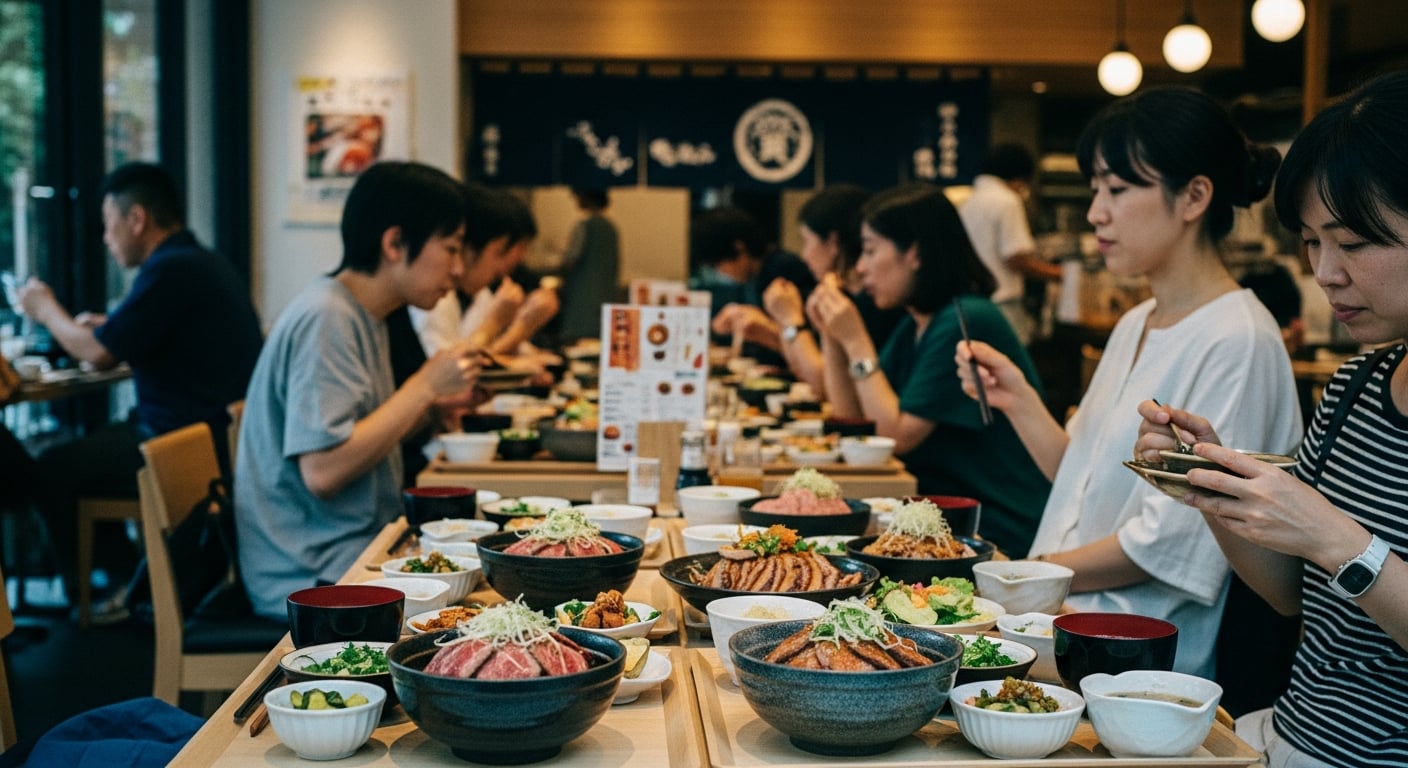
The restaurant seats 18 guests across comfortable sofa-style tables and a counter — an intimate scale that feels deliberate. There's no background rush, no conveyor belt, no laminated picture menu from a decade ago. The printed menu is available in English, Simplified Chinese, and Korean, with clear photos, prices, and a five-step visual guide to enjoying the dish exactly as it was meant to be enjoyed.
That five-step guide is worth mentioning, because Rare Wagyu Gyudon isn't meant to be eaten the way you'd eat a chain beef bowl. You start by separating the Nagoya Cochin egg — the white goes into the miso soup, the yolk sits atop the beef. You taste the wagyu first on its own, without mixing, to appreciate the texture and the flavor that 300 heads of carefully raised cattle have produced. Then the yolk is worked in. Then the complimentary condiments — pickled ginger from Inazawa City, dried nori seaweed from Mikawa Bay, chirimen jako, Itadaki's original eight-spice blend — are layered in to shift the flavor. Finally, a touch of wasabi to close. It's a meal designed to evolve as you eat it.
Every ingredient on the table comes from Aichi Prefecture. The rice is Aichi no Kaori, a premium Aichi-grown variety. The miso soup is made with Hatcho miso from Okazaki. The pickles are traditional Atsumi Ichō-zuke from the Atsumi Peninsula. The shiso leaves are Aikei No.1 from Toyohashi. It's not a list of local ingredients assembled for marketing — it's a coherent expression of what this prefecture tastes like, built one careful sourcing decision at a time.
"The rare wagyu was unlike anything I've ever tasted — a life-changing culinary experience."
Guest review
How Do I Get to Itadaki From the Asian Games Venues?
Itadaki is located at 4-1-20 Osu, 2nd floor, Naka-ku — a four-minute walk from Yabacho Station Exit 4 on the Meijo Subway Line. The Meijo Line connects directly to Nagoya Station and several of the key venues and transport hubs you'll be moving through during the Asian Games. From Nagoya Station, the journey takes approximately ten minutes: Higashiyama Line to Sakae, transfer to Meijo Line, exit at Yabacho.
On street level, look for the sign reading 元祖レア牛丼 頂 ("Ganso Rea Gyudon Itadaki") and take the stairs to the second floor. Osu Kannon Temple is nearby and makes for an easy orienting landmark if you're navigating on foot from the shopping street side.
Itadaki is open for lunch only: 11:00–15:00 on Saturdays, Sundays, Mondays, and Tuesdays. On public holidays, hours extend from 09:00–15:00. The restaurant is closed Wednesdays, Thursdays, and Fridays. Last orders are taken 30 minutes before closing. Because schedules can vary, checking the monthly business calendar on Instagram before your visit is always wise — especially during a major event period like the Asian Games.
For guaranteed access to Horai Wagyu, booking ahead via Tabelog Online is highly recommended. When making your reservation, paste the following phrase into the notes field to request it specifically: 鳳来牛希望. Reservations can be made in English on the Tabelog website. If you're planning to walk in, arriving right at the 11:00 opening gives you the best chance at the limited daily allocation.
Is Itadaki Right for My Group — or Just for Solo Diners?
Itadaki works well across different group configurations. The sofa-style table seating makes it genuinely comfortable for families with young children — past guests have brought infants and used the sofa seats for bottle feeding. There's a table for up to five guests, making it suitable for small travel groups or families. Counter seats are available for solo diners. Full restaurant buyout for groups of up to 18 is also available for those coming with athletic delegations, corporate groups, or event parties — inquire via Instagram DM in advance.
The printed multilingual menu means you don't need Japanese to order or understand what's in front of you. And the five-step eating guide means the dish explains itself in a way that feels engaging rather than confusing. Many guests who arrive uncertain about what to expect leave with a clear story they're ready to tell.
That story — of Nagoya, of Aichi, of a chef who asked why gyudon had never been taken seriously and then spent years answering that question — is the part that outlasts the meal itself. During the Asian Games, when Nagoya fills with visitors from across Asia, Itadaki is the kind of place that becomes someone's permanent answer to the question: "What was the best thing you ate in Japan?"
For our complete menu, access details, and store information, visit our official page at https://itadaki8.com/english/.
Ready to reserve your seat? Horai Wagyu is limited to 10 bowls a day, and the Asian Games period will be busy. We'd love to welcome you — secure your table now:
Reserve Your Rare Wagyu Experience
Want to check our schedule before the Games begin? Our monthly business calendar is posted regularly:
Check Our Monthly Schedule on Instagram