7 Facts About Nagoya Lunch That Shirakawa-go Travelers Miss
 gotowp
You've planned your Shirakawa-go day trip down to the minute. The bus is booked, the gassho-zukuri farmhouses are on your camera roll before you've even arrived, and your itinerary looks tight but doable. But here's the moment many travelers describe afterward: standing in Nagoya at 11:30am, hungry, slightly rushed, and realizing they hadn't thought once about where to eat lunch.
It happens more often than you'd think. Nagoya sits at the center of some of Japan's most breathtaking day-trip destinations — Shirakawa-go, Takayama, Gifu — and for many travelers, the city itself becomes a functional layover rather than a destination. That's a missed opportunity. Especially when it comes to lunch.
Here are 7 facts about Nagoya lunch that Shirakawa-go travelers frequently overlook — and one discovery that a growing number of repeat Japan visitors say changed how they thought about the city entirely.
This article is for you if:
- ✅ You're staying in Nagoya before or after a Shirakawa-go or Takayama day trip
- ✅ You want to make the most of your Nagoya lunch stop without spending hours deciding
- ✅ You're a wagyu enthusiast curious about lesser-known Japanese beef beyond Kobe and Matsusaka
- ✅ You're a repeat Japan visitor looking for an authentic local discovery rather than a guidebook staple
- ✅ You want a lunch experience with a story — something worth telling when you get home
Fact 1: Nagoya Has a Lunch Culture All Its Own
Many travelers assume Nagoya is a stopover city — a place to change trains, not linger. But locals know differently. Nagoya has one of Japan's most distinctive regional food cultures, built around ingredients and preparations that rarely travel beyond Aichi Prefecture. Hatcho miso from Okazaki. White soy sauce from Hekinan. Nagoya Cochin eggs from specialty farms. These aren't export products you'll find in Tokyo restaurants. You find them here, at lunchtime, in places that have been quietly perfecting them for years.
Fact 2: The Osu District Is a 10-Minute Detour That Most Travelers Skip
Shirakawa-go-bound travelers typically stage themselves near Nagoya Station, which makes sense logistically. But the Osu district — just 10 minutes from Nagoya Station by subway — is where the city's most interesting independent restaurants are concentrated. With over 400 years of history as a merchant district and a reputation among locals as the place to find specialty food, Osu rewards the traveler willing to take that short detour.
One visitor described their experience this way: "We almost didn't go. We had a noon bus to Shirakawa-go and thought Osu would be too far. It was 10 minutes on the subway. We had lunch, walked through the shopping street, saw Osu Kannon Temple, and still made our bus. It became the part of the trip we talk about most."
Fact 3: There's a Wagyu Category in Japan That Most Travelers Have Never Heard Of
Ask most international visitors to name a Japanese wagyu brand and you'll hear Kobe, Matsusaka, or perhaps Omi. These are excellent answers. But in Aichi Prefecture, a wagyu category exists that even many Japanese food enthusiasts don't know about: Horai Wagyu.
Produced by just three farms in Japan's Okumikawa region with only 300 heads raised annually — against a national wagyu population of approximately 500,000 — Horai Wagyu is rarity defined by practice rather than marketing. These cattle are raised on a feed that incorporates sake lees from Horaisen Sora, one of Aichi's most respected breweries. The result is a beef with a flavor profile that sits somewhere distinct from the typical heavy marbling of Kobe: a cleaner, more nuanced taste that lets both the fat and the lean speak at the same time.
Most travelers heading through Nagoya will never encounter it. Not because it isn't extraordinary, but because so few restaurants serve it, and even fewer have made it the center of their entire concept.
Fact 4: Someone in Nagoya Invented an Entirely New Way to Eat Wagyu
In 2022, Masayuki Goto — founder of MAX'S BAR and a veteran of Japan's food and beverage industry for nearly two decades — opened Itadaki in Osu with a question that had been nagging at him: why didn't gyudon have a premium version?
Every major Japanese donburi had one. Katsudon, oyakodon, kaisendon — all had elevated interpretations. Only gyudon, Japan's iconic beef bowl, remained in the domain of fast food chains. Goto decided to change that. The result was what he called "Rare Wagyu Gyudon" — a completely new culinary category that prepares wagyu in a rare style while fully meeting Japan's Ministry of Health, Labour and Welfare food safety standards through a proprietary two-stage cooking technique.
The name Itadaki comes from "itadakimasu," the Japanese expression of gratitude spoken before meals. That philosophy — of honoring the farmers, the land, and the craft behind every ingredient — runs through every bowl served here.
The restaurant has since been featured on 8 major Japanese TV programs, including NHK, and is recognized as the originator of the "Rare Wagyu Gyudon" concept. But you won't find it in most mainstream English travel guides. That, for many repeat Japan visitors, is exactly the point.
✓ ここまでのポイント
- Nagoya's lunch culture is built around Aichi-specific ingredients that you genuinely cannot find elsewhere in Japan
- The Osu district is a 10-minute subway ride from Nagoya Station — close enough to visit comfortably before a Shirakawa-go departure
- Horai Wagyu (300 heads/year, 3 farms) is one of Japan's rarest wagyu varieties, and it's centered in Aichi Prefecture
Fact 5: "Rare" Wagyu Is Safe to Eat — But Only If the Kitchen Knows What It's Doing
This is the concern that stops many Western travelers before they even look at the menu. In the United States and Europe, rare beef carries real food safety warnings. The anxiety is understandable and legitimate.
At Itadaki, Goto's two-stage cooking technique heats the beef to over 70°C at the core — fully compliant with Japan's official food safety standards — while preserving the texture and mouthfeel of rare preparation. This is not a marketing claim. It is a technical achievement that required sustained development to execute correctly, and it is the reason Goto holds both a Certified Food Sanitation Supervisor qualification from Japan's Ministry of Health, Labour and Welfare and a Licensed Restaurant Operator certification from Aichi Prefecture's Public Health Center.
"The rare wagyu was unlike anything I've ever tasted," one guest wrote. Another added: "I've had Kobe beef and Matsusaka beef, but Horai Wagyu at Itadaki was on another level." These aren't reactions to novelty — they're responses to something genuinely different in both concept and execution.
"The English menu with clear serving instructions made the experience stress-free. I never felt lost or uncertain about what I was eating."
International visitor, discovered via Google Maps
"Perfect lunch during our Nagoya stay before our Shirakawa-go trip the following day. It set the tone for the whole trip."
Traveler on a Nagoya–Shirakawa-go itinerary
Fact 6: Horai Wagyu Is Strictly Limited — and Sell-Outs Are Real
Because Horai Wagyu is so scarce at the source, Itadaki limits it to just 10 bowls per day. This is not a manufactured scarcity tactic. It reflects the reality of direct-farm sourcing from three small producers raising 300 animals annually.
For Shirakawa-go travelers, the timing challenge is real. If your bus departs at noon or 1pm, your lunch window is narrow, and arriving at Itadaki to find Horai Wagyu sold out is a frustration that's easy to avoid with a small amount of planning. Advance reservation through Tabelog Online is available in English — and adding "Horai Wagyu request" (鳳来牛希望) in the notes field when booking means your bowl is waiting when you arrive.
For walk-in guests, or anyone whose plans don't allow for advance booking, the Mikawa Beef Rare Gyudon is always available. Sourced from Aichi's Mikawa region and prepared with the same two-stage technique, it is a genuinely excellent dish in its own right — not a fallback, but a different expression of the same craft.
Fact 7: A Meal Here Becomes Part of the Story You Tell About Japan
Travel stories often compress into a handful of moments. The castle that took your breath away. The ramen place down the stairs. The lunch you had the morning before Shirakawa-go that you didn't expect to remember as clearly as the farmhouses themselves.
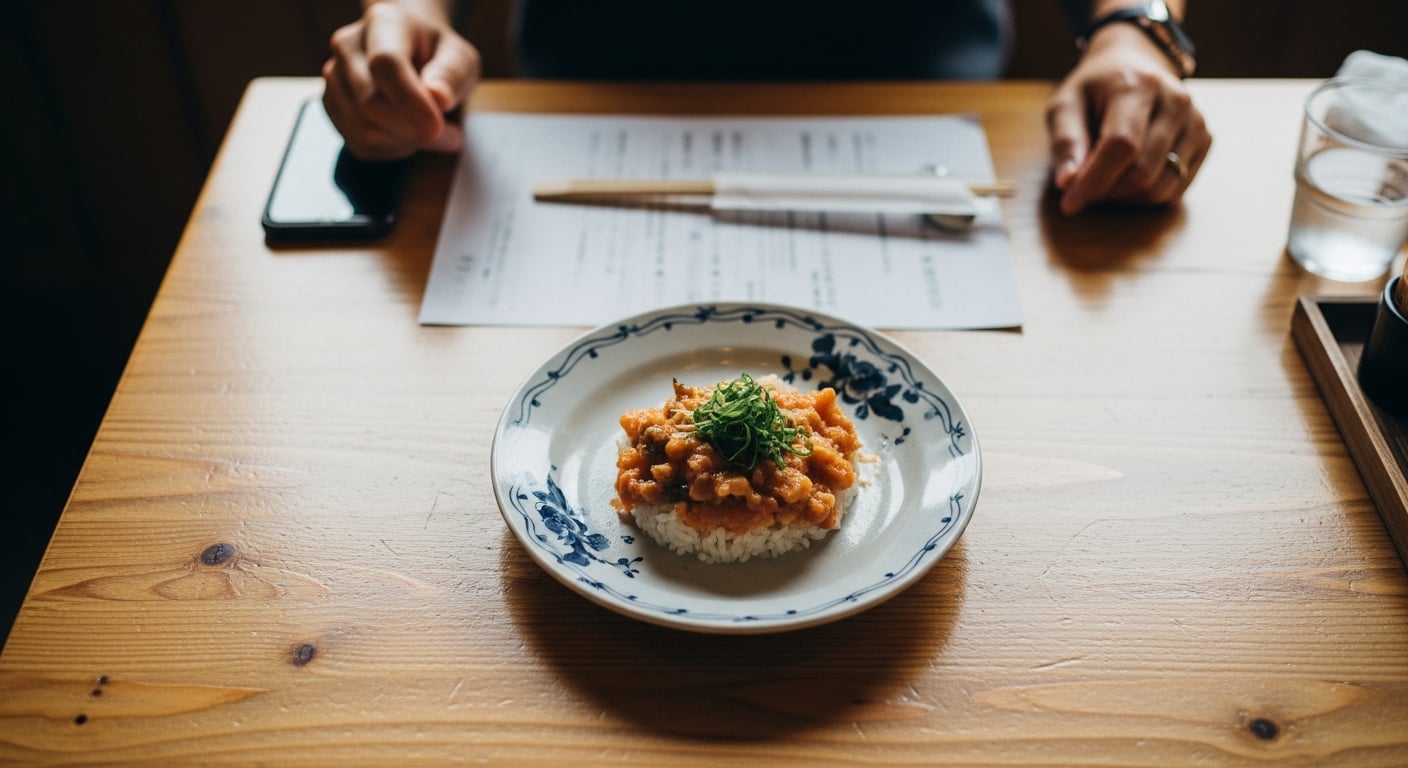
Itadaki is the kind of place that earns that kind of memory — not through spectacle, but through the precision of a single dish done with deep intention. The five-step eating guide (separate the Nagoya Cochin egg, place the yolk over the beef, taste the wagyu pure, then layer in the condiments, finish with wasabi) turns a bowl of food into a deliberate experience. Every ingredient on the table — the pickled ginger from Inazawa, the shiso from Toyohashi, the dried whitebait from Minamichita — carries a specific Aichi address.
Goto's vision, rooted in gratitude to the farmers he sources from, is present in every detail. When you sit down at Itadaki, you're not just eating lunch before a day trip. You're tasting a very specific version of Aichi Prefecture — one that took four years, 18 years of industry experience, and one question nobody had asked before to put in a bowl.
Planning Your Nagoya Lunch Before Shirakawa-go
If you're traveling from Nagoya to Shirakawa-go, the most common departure point is Nagoya Station (Meitetsu Bus Center). Itadaki is a 10-minute subway ride away at Yabacho Station (Meijo Line, Exit 4, 4-minute walk). Opening is at 11:00am, and last order is 14:30. That window fits comfortably before most afternoon Shirakawa-go departures.
Itadaki is open Saturday, Sunday, Monday, and Tuesday, with occasional irregular closures. Business hours on public holidays shift to 9:00am–3:00pm. Because schedules can vary, it's worth checking the monthly calendar before you finalize your Nagoya day.
For full menu details, access information, and everything you need to plan your visit, you're welcome to explore the official English page at https://itadaki8.com/english/.
To secure your Horai Wagyu bowl — especially if your Nagoya stay is short — we'd encourage you to book ahead: Reserve Your Rare Wagyu Experience. And if you'd like to confirm we're open on the specific day you're visiting, our monthly schedule is always posted on Instagram: Check Our Monthly Schedule on Instagram.
Shirakawa-go will be extraordinary. But the meal you have in Nagoya the morning before — that might be the part of the trip you didn't see coming.