Why Osu Beats Sakae for International Travelers
 gotowp
A guest stopped by recently — a couple from Hong Kong on their seventh trip to Japan — and said something that stuck with me. "We've done Kyoto three times. Tokyo four times. This time we told ourselves: no guidebooks." They had spent the morning wandering through Osu with no plan, stumbled in through our door, and ended up staying for nearly an hour. Before they left, one of them turned to me and said, "This is exactly the kind of place we were looking for."
That conversation made me think about the choice that more and more international visitors are quietly making: Osu over Sakae. And I wanted to write about why.
Who This Is For
- ✅ Repeat visitors to Japan who have already explored Tokyo, Kyoto, and Osaka and want something genuinely new
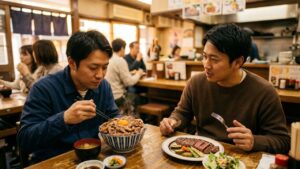
- ✅ Travelers staying in Nagoya — even just for one or two nights — who want to eat where locals actually eat
- ✅ Visitors planning day trips to Shirakawa-go or Takayama the following day and looking for a meaningful Nagoya lunch beforehand
- ✅ Anyone who feels that guidebook recommendations all start to look the same after a while
- ✅ Foodies who value the story behind a dish as much as the dish itself
The Sakae Experience — and Why Repeat Visitors Start to Feel Its Limits
Let me be clear: Sakae is a great district. Wide avenues, landmark department stores, international hotel chains, stylish restaurants with English signage. For a first-time visitor arriving in Nagoya with limited time, Sakae is safe and convenient.
But here is the pattern I notice with repeat visitors — particularly those from Hong Kong, Taiwan, Singapore, and South Korea who have been to Japan five, seven, ten times. Sakae starts to feel familiar in a way that is not entirely satisfying. The restaurants are polished. The menus often have English translations on a screen at the door. The food is good. But the feeling of discovery — the feeling of finding something that your friends back home haven't found yet — that part is harder to come by.
According to data that often circulates in Japan's travel industry, 29.7% of Hong Kong visitors to Japan have been here ten or more times. For Taiwanese visitors, that figure is 19.4%. These are not first-timers following a printed itinerary. They are people actively hunting for the experience that doesn't appear in any English-language guidebook.
Sakae, for all its appeal, is thoroughly mapped. Osu is not.
You're reading about Osu as the kind of neighborhood that rewards spontaneous discovery — but Itadaki's monthly business calendar and any irregular closures are only announced in one place. Our Instagram shows the exact days we're open each month, so you can plan your Osu visit around a confirmed lunch stop rather than arriving to a closed door. No account needed to view the schedule.
What Makes Osu Different: A Neighborhood That Hasn't Been Packaged Yet
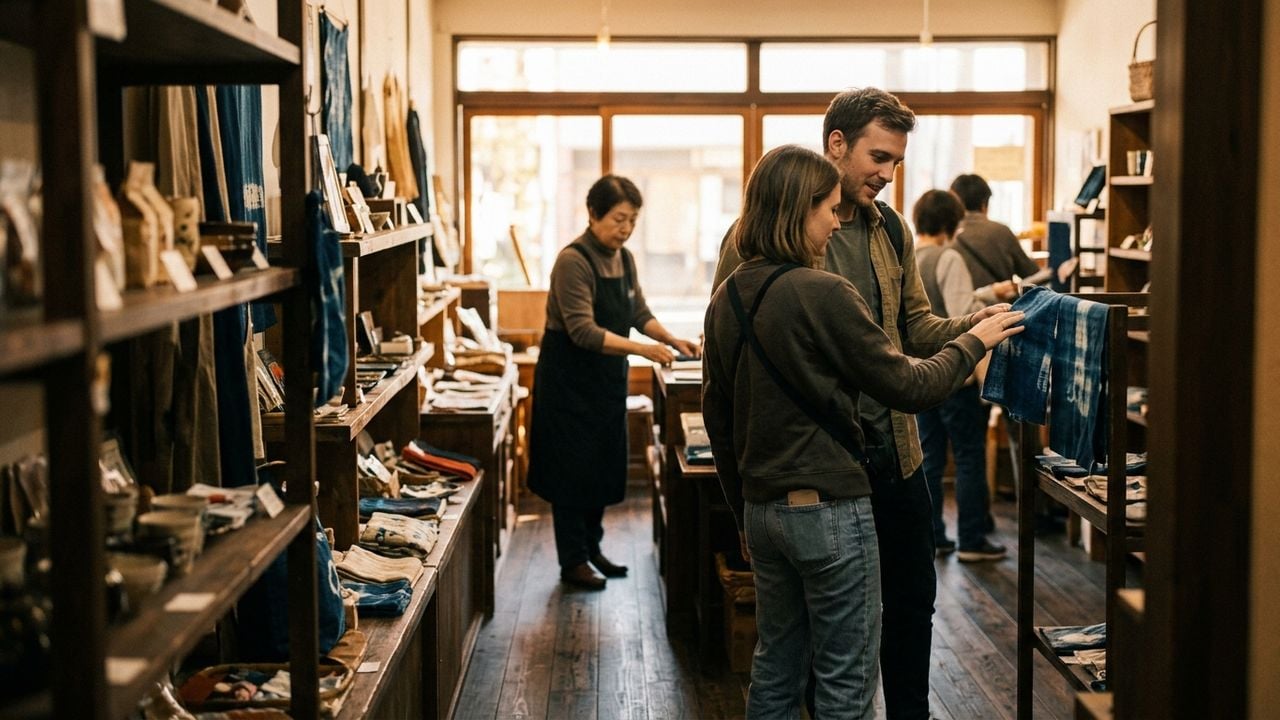
Osu has over 400 years of history as a merchant district, anchored by Osu Kannon Temple — one of Central Japan's most important Buddhist sites. But walk deeper into the covered arcade streets and you find something that defies easy categorization: vintage electronics shops next to maid cafés, century-old confectionery stores beside cosplay costume dealers, Taiwanese restaurants that have been here for decades, and quiet specialty food spots that focus on doing one single thing with extraordinary care.
That last category is the one that matters most to the kind of traveler I'm describing. In Osu, you still find restaurants where the owner decided to master one dish — and only one — and open a tiny space dedicated entirely to that pursuit. These are the places that Japanese food enthusiasts seek out and talk about quietly among themselves. The kind of place where someone would say, in Japanese, "ここが本当に食べるところだよ" — "This is where I actually eat."
This is precisely why kimono rental customers exploring Osu discover a very different Nagoya than the one on most tourist maps — the district rewards slow, curious walking in a way that Sakae's grid simply doesn't.
For international visitors arriving from Shirakawa-go or headed there the next morning, Osu also sits at a natural geographical and emotional midpoint. It is close to the subway, easy to reach, and offers a kind of energetic warmth that pairs naturally with the quiet, rural beauty of the Hida region. The contrast sharpens both experiences.
A Specific Case: The Couple with the Shirakawa-go Plan
We receive guests with many different itineraries, but one pattern comes up more than any other this time of year: travelers who are spending one night in Nagoya before an early departure to Shirakawa-go or Takayama the following day. They want to make the most of their Nagoya afternoon — but they don't want to commit to a long, elaborate dinner reservation. They want something memorable, manageable, and genuinely local.
One guest captured this perfectly in a review that I still think about:
"Perfect lunch during our Nagoya stay before our Shirakawa-go trip the following day."
Guest review
That sentence says everything. It wasn't just a meal — it was the right meal at the right moment in a journey that was still unfolding. Osu gave them something to carry with them into the mountains the next day: a story, a flavor, a discovery that was entirely theirs.
This is the kind of experience that Sakae — with its international hotel restaurants and department store food halls — rarely delivers. Not because those places are inferior, but because they aren't built for discovery. They're built for reliability.
✓ Key Takeaways
- Sakae offers polish and convenience; Osu offers the feeling of genuine discovery that repeat Japan visitors actively seek.
- Osu's specialty restaurant culture — one chef, one dish, done perfectly — is exactly what distinguishes it from Nagoya's more commercial dining districts.
- For travelers with a Shirakawa-go or Takayama itinerary, an Osu lunch creates a meaningful Nagoya memory without overcomplicating the day.
The Horai Wagyu bowls — strictly 10 per day — are exactly the kind of thing that sells out quietly, without announcement, before the lunch crowd thins. If your Nagoya stay includes the day before Shirakawa-go or Takayama, locking in the bowl in advance is the one step that turns "I hope it's available" into a confirmed part of the itinerary. Reservation takes a few minutes on Tabelog.
The Hidden Gem Logic: Why "Nobody Knows About This Place" Is the Point
There is a specific kind of satisfaction that comes from telling people back home about a restaurant that doesn't appear in any English travel guide. It's not about exclusivity for its own sake — it's about the authenticity of the find. When a dish has a real story behind it, sourced from real farms, cooked with a technique that took years to develop, served in a small room by people who genuinely care about what they're putting in front of you — that story travels with you.
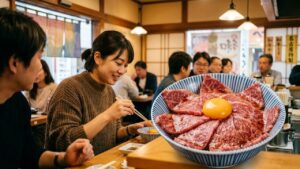
At Itadaki, we invented an entirely new category of Japanese cuisine: the Rare Wagyu Gyudon. The gyudon — Japan's classic beef bowl — had never had a premium, craft-driven version before. Every other donburi had one. Katsudon, oyakodon, kaisendon — all have elevated interpretations. Only gyudon had been left exclusively to fast-food chains. That struck me as a gap worth closing.
We source every ingredient from Aichi Prefecture. The Horai Wagyu we use — strictly limited to 10 bowls per day — comes from just three farms in all of Japan, with only 300 heads raised annually. These cattle are fed on sake lees from Horaisen Sora, a premium local sake from Okumikawa. The flavor profile is unlike any wagyu you will find under a recognizable brand name, because the brand doesn't exist yet in the international consciousness. That's precisely what makes it worth seeking out.
For visitors who have already tried Kobe beef or Matsusaka beef and are wondering what comes next, this breakdown of Nagoya's rare wagyu for Hida region travelers goes into more detail on what makes Horai Wagyu genuinely different — not as marketing, but as agricultural fact.
Practical Reality: Getting to Osu Is Easier Than Most Visitors Expect
One reason Sakae wins by default for many visitors is simple: they know how to get there. The Sakae Station exit signs are everywhere. Osu feels slightly further, slightly less legible.
In practice, Osu is four minutes on foot from Yabacho Station (Exit 4, Meijo Subway Line). From Nagoya Station, the journey is roughly ten minutes total: Higashiyama Line to Sakae, transfer to the Meijo Line, one stop to Yabacho. That's it. You surface from the stairs and Osu Kannon Temple is ahead of you, the covered shopping street begins to your left, and within a short walk you're in the part of Nagoya that most tourists — and most English guidebooks — have not yet fully mapped.
Itadaki is open for lunch Tuesday, Monday, Saturday, and Sunday (11:00–15:00), and on public holidays from 9:00. We are closed Wednesday through Friday. The Horai Wagyu — limited to 10 bowls per day — can sell out during peak hours, so a reservation via Tabelog is the most reliable way to secure your bowl before you arrive. Our monthly business calendar is posted on Instagram, and irregular closures do occasionally happen, so it's worth a quick check before your visit.
We have printed menus in English, Simplified Chinese, and Korean, and a five-step photographic guide to enjoying the dish — so language is not a barrier. Come as you are, whether that means fresh from Osu Kannon, still in your kimono rental, or carrying a backpack bound for Takayama the next morning.
The Story You'll Tell When You Get Home
I've traveled enough to understand that the meals that stay with you are almost never the ones you planned the most carefully. They're the ones where something unexpected happened — a neighborhood you almost skipped, a dish that didn't fit any category you already knew, a conversation with a chef or a fellow traveler that opened a door you hadn't seen before.
Osu is built for that kind of moment. Sakae is built for a different, equally valid kind of trip. But if you're a repeat visitor to Japan who has decided, this time, to go without the guidebook — Osu is where that decision pays off.
The Hong Kong couple I mentioned at the start of this piece? They sent a message through Instagram a few days after their visit. They had made it to Shirakawa-go. The snow had already started on the upper slopes. They said the lunch at Itadaki was still the thing they were talking about most.
That's the story Osu gives you.
For our complete menu, access details, and store information, visit our official page at https://itadaki8.com/english/
The discovery you've been reading about — the 300-head wagyu, the dish no one else invented, the neighborhood most tourists skip — is available for lunch on Monday, Tuesday, Saturday, Sunday, and public holidays. The only thing that makes it unavailable is not reserving before the 10 daily Horai Wagyu bowls run out. Secure your seat now via Tabelog and make the Osu lunch the moment your Nagoya trip is built around.