Asian Games Football at Toyota Stadium: Post-Match Nagoya Osu Dining
 gotowp
A guest messaged me on Instagram a few weeks ago — she had attended a football match at Toyota Stadium during a tournament event and wanted to make her way to Osu afterward for lunch. "I checked Google Maps," she wrote, "but the streets around Osu looked so complicated. I was afraid I'd get lost and miss my train back to Nagoya Station." Her message stayed with me, because I hear a version of it regularly. People travel across Japan — sometimes fly from overseas — to experience something specific in this city, and then hesitate at the final step because the streets look unfamiliar on a phone screen.
That conversation is the reason I'm writing this piece. If you've just come from Toyota Stadium, or you're planning to combine a football match day with lunch in Osu, I want to walk you through it clearly — not just how to navigate here, but what to do once you arrive, and in what order. Think of this as a ranked post-match dining guide, built specifically for the Asian Games football crowd making their way into central Nagoya.
Who This Is For
- ✅ Asian Games football spectators traveling from Toyota Stadium to Nagoya's Osu district for lunch
- ✅ First-time visitors to Osu who find the shopping district's layout confusing or hard to navigate
- ✅ Anyone worried about missing their train or spending too long wandering before they find the restaurant
- ✅ Wagyu enthusiasts who want to add a rare, meaningful meal to their match-day itinerary
- ✅ Travelers who've heard about Itadaki but aren't sure exactly how to get there from major transit hubs
#1 Priority: Plan the Journey Before the Final Whistle
This is the single most important thing I can tell you: the journey from Toyota Stadium to Osu works best when you plan it before the match ends — not while everyone is rushing out of the stadium at once.
From Toyota Stadium, take the Meitetsu Toyota Line to Kanayama Station (approximately 35–40 minutes, with a transfer at Shin-Toyota or Mikawa-Toyota depending on your service). At Kanayama, connect to the Meijo Subway Line heading toward Nagoya. Get off at Yabacho Station — and use Exit 4. From Exit 4, Itadaki is a four-minute walk. That's the whole route. Write it down, screenshot it, or use the Google Maps link on our website before you leave your hotel in the morning.
Alternatively, if you're coming from Nagoya Station first (for luggage storage or hotel check-in), the route is simpler: take the Higashiyama Line to Sakae, transfer to the Meijo Line, and get off at Yabacho. Door to door from Nagoya Station: approximately 10 minutes. Same exit — Exit 4.
What confuses most visitors is not the subway. It's the final four minutes on foot. Osu's shopping district is a layered maze of covered arcades, small alleys, and branching streets that don't follow a grid. Google Maps is not always precise at this scale, and Japanese-language signage at street level can feel disorienting. So here's what to look for instead of relying entirely on your phone:
When you come out of Yabacho Exit 4, walk straight ahead (south). After roughly four minutes, look for a sign at street level that reads 「元祖レア牛丼 頂」 (read: Ganso Rea Gyudon Itadaki). That's us. We are on the 2nd floor — take the stairs up from street level. A lot of first-time visitors walk straight past the entrance because they're looking for a ground-floor restaurant. Don't overlook the staircase.
Nearby landmarks to orient yourself: Osu Kannon Temple and the main entrance to Osu Shopping Street are both within a few minutes' walk. If you can see the temple's gate, you're in the right neighborhood.
You now know the route — Yabacho Exit 4, four minutes, stairs to the 2nd floor — but Itadaki's open days follow a monthly schedule that can change around event periods. Our Instagram carries the live business calendar so you can confirm before you leave Toyota Stadium. Takes ten seconds to check.
#2: Time Your Arrival — Especially If You Want Horai Wagyu
Football matches at Toyota Stadium often finish mid-afternoon, but Asian Games group-stage and knockout matches can start and end at various hours. If your match ends before 1:00 PM and you can arrive in Osu by 12:30–13:00, you're in good shape for our full lunch service.
Here's what matters: we serve lunch only, with last order 30 minutes before our 15:00 close. And our signature Horai Wagyu Gyudon — the ultra-rare wagyu produced by only 3 farms in Japan, with just 300 heads raised annually — is limited to 10 bowls each day. On busy match days and weekends, those bowls can be gone well before noon.
If Horai Wagyu is the reason you're coming, I strongly recommend reserving in advance via Tabelog. It takes less than a few minutes and guarantees your bowl is waiting. Our standard Mikawa Beef Rare Gyudon is available without reservation and is always prepared to the same quality standard — but if you've traveled this far and you want to try Japan's rarest wagyu, secure it beforehand.
Also worth noting for match-day planning: we are open on Saturdays, Sundays, Mondays, and Tuesdays, as well as public holidays (with earlier opening at 9:00 AM on holidays). We are closed Wednesday through Friday. Please check our official Instagram for our monthly business calendar, as irregular closures may apply during event periods.
✓ Key Takeaways
- From Yabacho Station Exit 4, Itadaki is a 4-minute walk — look for the sign reading 「元祖レア牛丼 頂」 and take the stairs to the 2nd floor. Don't rely solely on Google Maps at street level in Osu.
- Horai Wagyu is limited to 10 bowls per day and sells out on busy days. Reserve via Tabelog if this is your priority bowl.
- Itadaki is open lunch-only (11:00–15:00), with last order at 14:30. Public holidays open at 9:00 AM. Closed Wednesday through Friday.
The Horai Wagyu — 10 bowls a day, from just 300 heads raised annually across 3 farms — is the bowl most visitors come specifically to try, and on Asian Games match days the seats fill quickly. Reserving via Tabelog locks in your bowl before you even board the train from Toyota. The booking process is straightforward and takes only a couple of minutes.
#3: How to Actually Eat the Bowl — The Five-Step Guide Is There for a Reason
One of the most consistent pieces of feedback we receive from international guests is that the five-step eating guide we provide at the table transformed their experience. One guest put it simply:
"The five-step eating guide made the dish even more enjoyable and memorable."
— Guest review
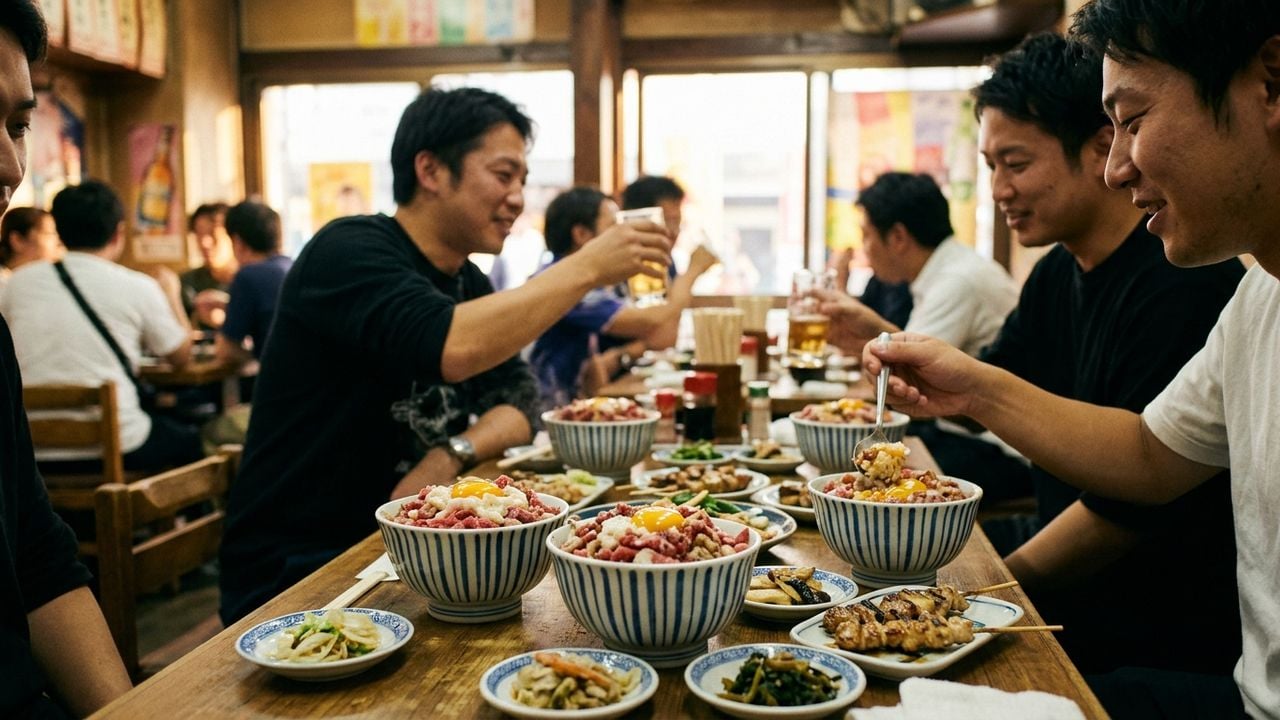
I mention this because a surprising number of guests, when the bowl arrives, feel unsure of where to begin. The dish is layered — visually striking, with the raw Nagoya Cochin egg resting on top of the rare-style wagyu, surrounded by shiso leaves, pickled radish, and complimentary condiments across the table. It doesn't look like anything you've encountered before, and that's intentional.
The guide walks you through five deliberate steps: first, separating the egg — white into the miso soup, yolk onto the beef — and enjoying the wagyu in its purest form. Then mixing the golden yolk in for a richer bite. Then exploring the condiments: pickled ginger, dried seaweed from Mikawa Bay, chirimen jako, and Itadaki's original 8-spice blend. And finally, finishing with wasabi for a clean, refreshing close. Each step changes the flavor profile, and together they make the bowl feel like a journey rather than a single note.
Every ingredient on the table — the shiso from Toyohashi, the pickles from the Atsumi Peninsula, the egg from Yamada Poultry Farm in Nagoya — comes from Aichi Prefecture. That's not a marketing angle; it's the foundation the restaurant was built on. If you want to understand more about why Itadaki sources this way, our guide to Aichi's local beef and what makes it different from other wagyu regions goes into more depth than I can fit here.
#4: After Lunch — Osu Is Worth an Hour of Your Time
If your match schedule allows it, the streets around Itadaki reward a slow walk. Osu Kannon Temple is a five-minute stroll from the restaurant — one of Central Japan's most significant Buddhist sites, and a quiet contrast to the bustle of the shopping arcade. The main Osu Shopping Street itself stretches for blocks in multiple directions, with everything from traditional craft shops to the kind of subculture stores that make Osu famous among international visitors.
If you're staying near the Sakae or Yabacho area during the Games, Hisaya-odori Garden Flarie is a three-minute walk from Yabacho Station — a free-admission urban garden featured in major English travel guides, and a genuinely pleasant place to sit and decompress after a busy match day.
For those planning their full Asian Games schedule around Nagoya's dining scene, this overview of what Osu offers spectators across multiple match days may help you plan more than just this one lunch stop.
#5: The Practical Checklist Before You Go
Because post-match travel tends to be quick and reactive, here's a condensed version of what you need before you leave Toyota Stadium:
- Route: Meitetsu Toyota Line → Kanayama → Meijo Subway Line → Yabacho Station, Exit 4. Or from Nagoya Station: Higashiyama Line → Sakae → Meijo Line → Yabacho, Exit 4.
- Street-level landmark: Look for the sign 「元祖レア牛丼 頂」. We are on the 2nd floor — take the stairs.
- Reservation: Tabelog booking is recommended if you want Horai Wagyu (10 bowls daily). Walk-ins welcome for Mikawa Beef Gyudon.
- Hours: 11:00–15:00 (last order 14:30) on Sat, Sun, Mon, Tue, and public holidays. Closed Wed–Fri.
- Seating: 18 seats total, with comfortable sofa-style table seating — well suited for groups heading over from the stadium together.
- Menus: Available in English, Simplified Chinese, and Korean. The five-step eating guide is printed and on the table when your bowl arrives.
If you're part of a group of up to 18 and want to reserve the full restaurant for your party, please reach out via Instagram DM in advance. We can coordinate for special occasions and group bookings tied to Games events.
A Match Day Worth Remembering — From the First Goal to the Last Bite
There's something I genuinely enjoy about the idea that someone's match-day memory of the 2026 Asian Games includes a bowl of Horai Wagyu in a second-floor restaurant in Osu. Not because it makes for a good story (though it does), but because that's exactly the kind of meal that stays with you — the one you didn't plan perfectly, that required a subway transfer and four minutes of navigating an unfamiliar street, and that turned out to be the moment you remember most clearly from the entire trip.
The hard part isn't finding us once you know where to look. The hard part was not knowing where to look. Now you do.
For our complete menu, access details, and store information, visit our official page at https://itadaki8.com/english/
You've got the route, the timing, and the five-step eating guide in your head — the only thing left is making sure your bowl is actually there when you arrive. Tabelog reservations for Horai Wagyu take only a few minutes and mean you won't arrive after the 10 bowls are gone.