After Paloma Mizuho Stadium Athletics: Central Nagoya's Best Rare Wagyu
 gotowp
Here's something that surprises many visitors to Japan: nearly 30% of travelers from Hong Kong have visited Japan ten times or more — and a growing share of them say their most memorable meals were not in Tokyo, Kyoto, or Osaka. They happened in places no guidebook told them to go.
If you've just come from a morning at Paloma Mizuho Stadium watching athletics — one of the marquee venues for the 2026 Asian Games — and you're standing in central Nagoya wondering where to have lunch, you're about to face a choice. You could follow the crowd to somewhere familiar. Or you could do what repeat Japan travelers do: step off the well-worn path and find the place where locals actually eat.
This article is the story of that second choice — and what it looks like before and after you make it.
Who This Is For
- ✅ Repeat visitors to Japan looking for a discovery beyond the standard tourist trail
- ✅ Athletics spectators or Asian Games 2026 attendees spending time in central Nagoya between events
- ✅ Wagyu enthusiasts who've already tried the famous brands and want to find something genuinely rare
- ✅ Travelers who want a story — and a photo — that their friends back home will keep asking about
- ✅ Anyone who's wondered: "Is there a hidden gem in Nagoya that most tourists walk right past?"
Before: Leaving the Stadium with No Plan
Paloma Mizuho Stadium sits in the southern part of Nagoya's city center, and after a morning of athletics, most visitors find themselves at a crossroads. The international food chains near the stadium are predictable. The larger tourist spots — Nagoya Castle, Osu Kannon — are on the map, but lunch near those landmarks often means crowds, long queues, and menus designed for passing tourists rather than people who care deeply about what they eat.
This is the "before" state that many of our guests describe. They had a few hours in Nagoya. They wanted something real. They scrolled through Google Maps, unsure which restaurants were genuinely worth the detour and which were just well-reviewed tourist traps. They didn't want a meal they'd forget by the next morning.
Sound familiar? That feeling — of a city full of options, none of which feel quite right — is exactly where the best discoveries begin.
You're planning a lunch stop after athletics at Paloma Mizuho Stadium, and the Horai Wagyu — limited to 10 bowls a day — is the kind of detail that makes or breaks the timing. Itadaki's monthly business calendar is posted on Instagram so you can confirm open days before you build your schedule around it. Takes about 30 seconds to check.
The Detour That Changes the Narrative
From Paloma Mizuho Stadium, a short subway ride on the Meijo Line brings you to Yabacho Station. From Exit 4, it's a four-minute walk to Osu — and to a restaurant that most tourists walk straight past without noticing.
Itadaki occupies a second-floor space on a street that mixes 400-year-old Buddhist temple culture with anime shops and vintage clothing stores. It doesn't announce itself loudly. There's no queue stretching out onto the pavement. The sign is understated. And that, for the kind of traveler this article is for, is exactly the point.
Itadaki is the originator of Rare Wagyu Gyudon — a culinary concept that didn't exist before founder Masayuki Goto created it here in Osu in April 2022. Goto spent 18 years in the food and beverage industry before conceiving this restaurant, and the question that drove him was deceptively simple: every Japanese rice bowl dish — katsudon, oyakodon, kaisendon — has a premium high-end version. Why not gyudon?
The answer he built is Itadaki. And the beef at the center of it is Horai Wagyu — a Japanese black wagyu raised in Okumikawa, Aichi Prefecture, by only three farms, producing just 300 heads annually. To put that in perspective: there are approximately 500,000 wagyu cattle in Japan. Horai Wagyu accounts for 300 of them.
If you've already experienced Kobe beef or Matsusaka beef, Horai Wagyu is the chapter of the story that comes next — the one most visitors never reach.
For visitors curious about how this fits into a broader day of discovery in Nagoya, our piece on finding Nagoya's best-kept wagyu secret explores how travelers stumble upon Itadaki and what they find when they do.
✓ Key Takeaways
- Itadaki is a 4-minute walk from Yabacho Station (Meijo Line) — an easy detour from central Nagoya after athletics at Paloma Mizuho Stadium
- Horai Wagyu is produced by only 3 farms in Japan, with just 300 heads raised annually — a genuine rarity, not a marketing claim
- Itadaki invented the Rare Wagyu Gyudon category — no other restaurant offers this specific experience
The 10-bowl daily limit on Horai Wagyu is real — and on days when central Nagoya is busy with Asian Games events, those bowls move faster than usual. Securing your bowl in advance means you arrive knowing your lunch is waiting, not hoping. Reservation is handled online through Tabelog.
After: What Changes When You Sit Down
Guests who find Itadaki often describe a shift that happens somewhere between the first bite and the moment they reach for their phone.
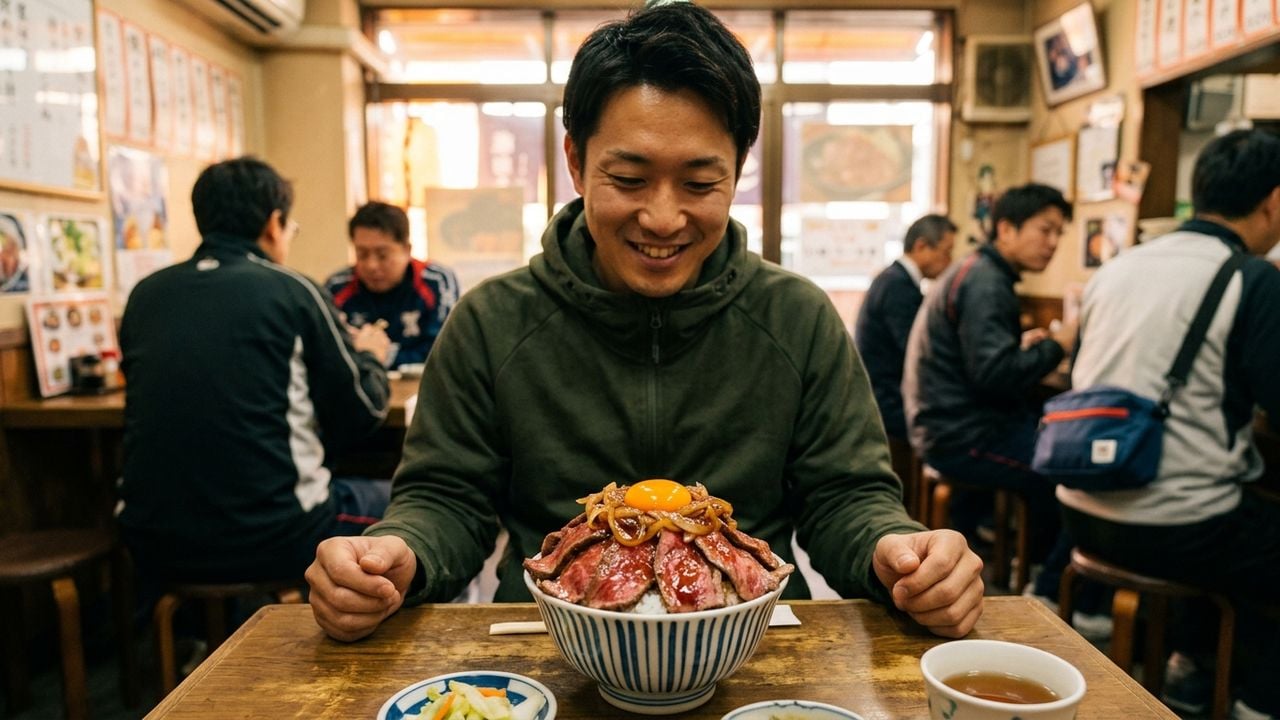
The dish itself is called Shinkoccho — Itadaki's signature bowl featuring 100g of Horai Wagyu, cooked using a proprietary two-stage technique that brings the beef to over 70°C at the core (fully meeting Japan's Ministry of Health, Labour and Welfare food safety standards) while preserving a rare-style mouthfeel. Every ingredient comes from Aichi Prefecture: rice grown in Aichi, miso from Okazaki, pickles from the Atsumi Peninsula, shiso leaves from Toyohashi, a Nagoya Cochin egg from Yamada Poultry Farm.
Goto designed the eating experience in five deliberate steps — separating the egg yolk to place atop the beef, tasting the wagyu first in its purest form, then layering condiments from the table (pickled ginger from Inazawa, dried seaweed from Mikawa Bay, Itadaki's own 8-spice blend) — each stage revealing a different dimension of the same bowl.
The result is a bowl that looks unlike anything most visitors have photographed before — and tastes like nothing they expected a gyudon to be.
"Instagram-worthy presentation and unforgettable taste. My followers keep asking about it."
— Guest review
That response — the followers asking about it — captures something important. The "after" at Itadaki isn't just a satisfying lunch. It's a story you carry home. The kind of discovery that repeat Japan travelers wait years to find.
Itadaki has been featured on eight major Japanese television programs, including NHK, not because it chased media coverage, but because the concept was genuinely new. Goto is the founder of a culinary category, and that recognition comes through in how the restaurant is run: with precision, with care for every ingredient's provenance, and with menus available in English, Simplified Chinese, and Korean so that international guests can navigate the experience without friction.
Planning Your Visit After the Stadium
Itadaki is open for lunch service only — Tuesday, Monday, Saturday, and Sunday from 11:00 to 15:00, with last order 30 minutes before closing. On public holidays, doors open at 09:00. There is no dinner service.
The Horai Wagyu option — Shinkoccho (¥2,700, tax included) and its larger sizes — is strictly limited to 10 bowls per day. On event days when central Nagoya is busy with Asian Games visitors, those bowls can sell out earlier than usual. Reservation via Tabelog is strongly recommended if you want to be certain of securing one.
If Horai Wagyu has sold out by the time you arrive, the Mikawa Beef Rare Gyudon (starting from ¥1,800) is always available — another Aichi Prefecture wagyu with its own distinct character, raised on okara feed with lactic acid bacteria gut management for a clean, lean flavor profile.
The restaurant has 18 seats, all with sofa-style table seating — comfortable for a relaxed post-event lunch, whether you're visiting solo, as a couple, or with a small group. Counter seats work well for solo diners; the larger sofa tables are ideal for groups of four or five.
Getting there from Paloma Mizuho Stadium: take the Meijo Line to Yabacho Station and use Exit 4. Itadaki is a four-minute walk from there, located on the 2nd floor at 4-1-20 Osu, Naka-ku.
The surrounding Osu district is worth some time before or after your meal. Osu Kannon Temple is a five-minute walk. Hisaya-odori Garden Flarie — a free-admission urban garden with six themed sections, featured in major English travel guides — is three minutes from Yabacho Station. For visitors who appreciate finding their own way through a city, this corner of Nagoya rewards exploration. Our guide to the best lunch spot near Yabacho Station during the Asian Games has practical timing advice for combining stadium visits with a meal at Itadaki.
One more detail worth knowing: the restaurant posts its monthly business calendar on Instagram, since irregular closures can apply. Checking before you travel saves frustration — especially when you're working around an event schedule.
The Story Worth Telling
Repeat visitors to Japan often say that the trips that matter most are the ones where they found something unexpected — a restaurant not in the guidebook, a dish they couldn't have anticipated, a memory that belongs only to them.
A morning of world-class athletics followed by a lunch of ultra-rare Horai Wagyu gyudon, eaten in a quiet second-floor restaurant in the heart of Osu while the rest of the tourist crowd looks elsewhere — that's exactly the kind of day that becomes the story you keep telling.
Itadaki didn't set out to be a hidden gem. It set out to do one thing with complete integrity: honor Aichi's farmers, reimagine an everyday dish, and welcome every guest — from wherever they've come — with genuine warmth. The discovery part happens naturally, because the restaurant simply isn't designed for people who aren't paying attention.
You've been paying attention. That's why you're here.
For our complete menu, access details, and store information, visit our official page at https://itadaki8.com/english/
You've read what changes between walking out of Paloma Mizuho Stadium without a plan and sitting down to a bowl of Horai Wagyu in Osu — the story, the taste, the photo your followers will keep asking about. The next step is straightforward: lock in your spot before the 10 daily bowls are gone. Reservation takes just a few minutes on Tabelog.