Family Story: A Nabana no Sato Trip Made Special by Rare Wagyu
 gotowp
A guest messaged me recently through Instagram — a parent traveling with two young children, planning a full day that included Nabana no Sato and a lunch stop somewhere in Nagoya. They'd already found Itadaki through Google Maps and were excited about trying the rare wagyu gyudon. But then came the question that I hear more often than you might expect:
"We're staying near Nagoya Station. How do we actually get to you? Osu looks like a complete maze."
I completely understand that feeling. I'm Masayuki Goto, the founder of Itadaki. I've lived in Nagoya for years, and even I know that Osu — as wonderful and energetic as it is — can feel genuinely disorienting the first time you walk into it. Small alleys branch off in unexpected directions, Google Maps sometimes points you at a wall, and if you're not sure what you're looking for, a restaurant tucked on a second floor can disappear entirely from view.
So today, instead of talking about the food first, I want to talk about the journey. Because arriving relaxed is half the experience.
Who This Is For
- ✅ Families visiting Nabana no Sato or other Aichi attractions and looking for a memorable lunch in Nagoya
- ✅ First-time visitors to Osu district who are nervous about navigating unfamiliar streets
- ✅ Travelers arriving from Nagoya Station who want clear, step-by-step directions to Itadaki
- ✅ Parents with young children who want to know if the restaurant works for family dining
- ✅ Anyone who's found Itadaki on Google Maps but isn't sure they'll actually find the door
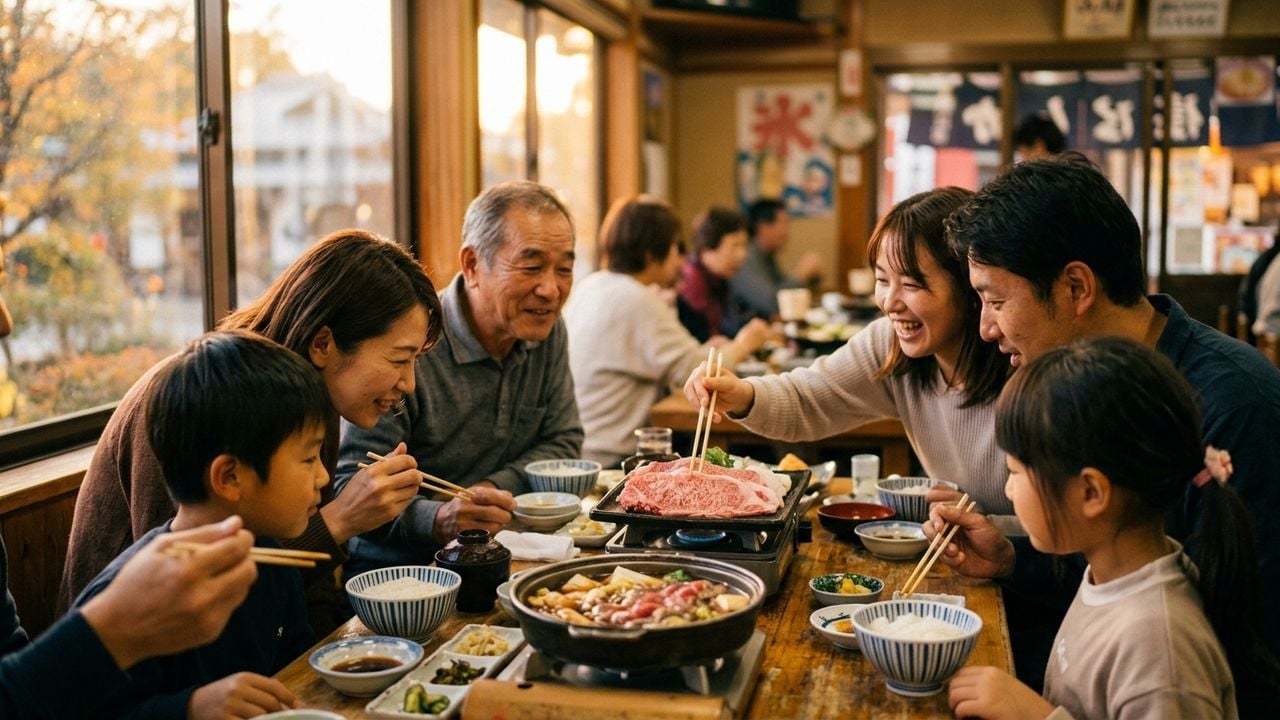
The Honest Truth About Getting Lost in Osu
Osu is one of my favorite neighborhoods in Nagoya — and I say that as someone who has spent 18 years working in the city's food and bar scene. It has that rare quality of feeling both ancient and completely alive at the same time: Buddhist temple incense drifting past anime shops, vintage electronics next to Taiwanese noodle stalls. I love walking through it on my days off.
But I also know that for a visitor arriving with luggage, young kids, and a time constraint — Osu can quickly turn from exciting to exhausting. The shopping street is over 1,200 shops long, signage is mostly in Japanese, and the side passages all start to look the same. Add the fact that Itadaki is on the 2nd floor of a building (not at street level), and it's genuinely easy to walk right past us without realizing it.
This isn't a small problem. I've had guests tell me they circled the block twice before finding the stairs. I've seen people give up and eat somewhere else, only to leave a comment saying "I couldn't find the entrance." That always stings a little — not because of the lost reservation, but because they missed the experience they'd been looking forward to.
So here is exactly how to get here, in plain language.
You've got the subway route and the landmark to look for — but Itadaki operates on scheduled business days that shift month to month, and irregular closures do happen. Our monthly business calendar, including any schedule changes for September, is posted to Instagram. A quick check before you finalize your Nabana no Sato day-trip plan takes less than a minute.
Step-by-Step from Nagoya Station to Itadaki's Door
The simplest route from Nagoya Station takes about 10 minutes total and requires one transfer:
Step 1: At Nagoya Station, take the Higashiyama Subway Line (the yellow line) toward Fujigaoka. Ride two stops to Sakae Station.
Step 2: At Sakae, transfer to the Meijo Subway Line (the purple/violet line). Ride one stop to Yabacho Station.
Step 3: Exit from Exit 4. From the moment you step out of Exit 4, Itadaki is a 4-minute walk.
What to look for at street level: Look for the sign that reads 「元祖レア牛丼 頂」 (pronounced "Ganso Rea Gyudon Itadaki"). Once you see that sign, take the staircase up to the 2nd floor. That's us.
If you're coming from elsewhere in the city — Sakae Station, Kamimaezu Station, or Osu Kannon Station — all are within walking distance as well. The Google Maps link on our official website will take you directly to the right spot, which I strongly recommend setting as a saved destination before you leave your hotel.
For families arriving from Nabana no Sato, the typical route is via the Kintetsu Line to Nagoya Station, then the subway route above. Timing-wise, many families find that arriving for an early lunch before heading out to the Aichi countryside works better than trying to squeeze in a meal after a full day at the attraction — especially with younger children who may be tired by late afternoon.
One more practical note for parents: Itadaki is on the 2nd floor, accessed by a staircase. Strollers can be brought inside, and our staff may be able to assist depending on how busy we are at that moment — though I want to be honest that we're a small team and I can't promise availability. If you're traveling with a pram, carrying it up a single flight of stairs is usually manageable for most families, and once you're inside, the sofa-style seating makes settling in with little ones genuinely comfortable. Past guests have used the sofa seats for everything from bottle feeding to little ones taking a short nap while the adults finished their meal.
✓ Key Takeaways
- From Nagoya Station: Higashiyama Line → Sakae → transfer to Meijo Line → Yabacho Station Exit 4. Total: approximately 10 minutes.
- Look for the sign「元祖レア牛丼 頂」at street level, then climb the stairs to the 2nd floor.
- Save the Google Maps link from our website before you leave your hotel — it makes the final 4-minute walk straightforward.
The Horai Wagyu is capped at 10 bowls a day — and on days when families arrive together for a Nagoya lunch stop, those 10 go faster than you'd expect. If your itinerary already has a Nabana no Sato visit penciled in, locking in your table now means one less thing to worry about on the day itself. Tabelog online reservation holds your bowl before you even board the subway.
Why a Nabana no Sato Day Is Actually Perfect Timing for Itadaki
Here's something I've noticed from the guests who reach out to us: families heading to Nabana no Sato often feel like they need to choose between a great meal and making it to their destination on time. I want to gently push back on that framing.
Itadaki is open Tuesday, and our kitchen operates from 11:00 until 14:30 (last order). If you plan to be at Yabacho by 11:30 or noon, you'll have a relaxed lunch with no rush — and you'll still have the full afternoon for the attraction. The Horai Wagyu gyudon, limited to just 10 bowls a day, does sell out on busy days, so reserving in advance through Tabelog is the move I'd recommend. That way, your table is waiting for you the moment you arrive, no matter how the morning unfolds.
The meal itself — from sitting down to finishing — typically takes about 45 minutes to an hour, depending on whether you order side dishes. There's no rush, no pressure to turn the table. The sofa seating is exactly as relaxed as it sounds.
One guest who came to us as part of a broader Aichi family trip left a memory I keep coming back to:
"I've had Kobe beef and Matsusaka beef, but Horai Wagyu at Itadaki was on another level."
Guest visiting Nagoya, via post-visit feedback
That kind of reaction — from someone who had already eaten two of Japan's most celebrated wagyu brands — tells me something. Horai Wagyu isn't famous in the way Kobe or Matsusaka are. Only around 300 heads are raised each year across just three farms in Aichi's Okumikawa region, fed on sake lees from the premium local sake "Horaisen Sora." Most people outside of Aichi have never heard of it. That's precisely why discovering it feels like something earned, not packaged.
If you'd like to read about how other families have woven a rare wagyu lunch into their Aichi travel plans, the story of a family discovering Itadaki during the Aichi Para Games 2026 captures that feeling of an unexpected culinary highlight within a busy event itinerary. And for a side-by-side look at lunch options when your day also includes a theme park, this comparison of Legoland lunch versus an Osu rare wagyu stop might be useful for planning.
A Few Things I Always Tell First-Time Visitors to Osu
Beyond the directions, there are a few things worth knowing before you walk through our door — especially if this is your first time in the neighborhood.
Osu Kannon Temple is a useful landmark. If you've walked to the main temple gate, you're already very close to us. The Osu Shopping Street entrance is similarly nearby. These two landmarks together form a mental map that most visitors find easier to navigate than relying purely on GPS in this part of the district.
Our menu is printed in English, Simplified Chinese, and Korean. There's also a photographic five-step guide for how to enjoy the dish — which sounds unusual, but the rare wagyu gyudon genuinely unfolds in stages: separating the egg, tasting the beef first before mixing, then adding the complimentary condiments from the table. Guests who follow the guide consistently say the experience is more satisfying than diving straight in. We put that guide together specifically so that no one feels unsure about what they're doing.
We're entirely à la carte — there are no set menus or combos. The Mikawa Beef gyudon starts from ¥1,800 and is always available. The Horai Wagyu (the ultra-rare version) starts from ¥2,700 for the standard Shinkoccho size, and is strictly limited to 10 bowls per day. Our average spend per person is around ¥3,000, and the beverages — all sourced from Aichi — are ordered separately if you'd like them.
We are all-day smoke-free, card payments are accepted, and the sofa seating makes the space genuinely comfortable for families who want to take their time. Solo diners are also very welcome — the counter seats were designed with exactly that in mind.
For our complete menu, access details, and store information, visit our official page at https://itadaki8.com/english/.
From a Founder Who Spends His Days Off Eating, Too
I'll be honest with you: I built Itadaki partly because I love eating out, and I know firsthand how much a single great meal can change the feeling of an entire trip. Exploring restaurants is something I do constantly — when I travel internationally, when I take a day off in Nagoya, when I'm wandering somewhere new. That curiosity about food is, in many ways, what Itadaki is made from.
When a family comes to us — navigating a new city, managing kids, juggling a schedule — and still chooses to make room for a special lunch, I take that seriously. Every detail, from the directions on our website to the five-step eating guide to the sofa seating, was designed so that the experience feels easy and worth it from the moment you start planning.
Osu can feel like a maze. But the stairs to our 2nd floor are worth climbing. I hope to see you at the top of them.
You now know exactly how to get here, what to look for on the building, and how the meal unfolds — all that's left is securing your spot. The Horai Wagyu is limited to 10 bowls per day, and reservations through Tabelog are the only way to guarantee availability before you make the trip from Nagoya Station.