Step-by-Step Guide to Visiting Itadaki as a Wheelchair User
 gotowp
September in Nagoya carries its own particular energy. The 2026 Asian Games and Asian Para Games are drawing visitors from across Asia and beyond — athletes, families, supporters, and curious travelers who've added Nagoya to their itinerary and are now mapping out every detail of their stay. For wheelchair users among them, the question isn't just "Where should I eat?" — it's "Can I actually get in? Will the staff be prepared? And will my target dish still be available by the time I arrive?"
These are exactly the right questions to ask. This guide walks through the full visiting experience at Itadaki — The Original Rare Wagyu Gyudon — from the moment you arrive at Yabacho Station to the moment you take your first bite. And for one concern in particular — whether the ultra-rare Horai Wagyu will sell out before you get there — we'll give you a clear, step-by-step answer.
Who This Is For
- ✅ Wheelchair users and visitors with mobility considerations who want honest, specific access information before making a trip
- ✅ Travelers staying in Nagoya during the 2026 Asian Para Games who want to plan a special lunch around their schedule
- ✅ Anyone worried that the Horai Wagyu (limited to 10 bowls per day) will sell out before they arrive
- ✅ Visitors unfamiliar with Japanese reservation platforms who want a clear walkthrough of how to book in English
- ✅ Companions and carers traveling with wheelchair users who want to know what to expect at each step
Step 1: Getting to Itadaki — What to Know Before You Leave Your Hotel
Itadaki is located at 4-1-20 Osu, 2nd floor, Naka-ku, Nagoya. The closest station is Yabacho Station (Meijo Subway Line), Exit 4 — a four-minute walk away. Sakae Station, Kamimaezu Station, and Osu Kannon Station are also within walking distance if your hotel is in those areas.
From Nagoya Station, the journey takes approximately 10 minutes total: take the Higashiyama Line to Sakae, transfer to the Meijo Line, and get off at Yabacho. The Nagoya Municipal Subway is generally well-equipped with elevators at major stations, but we recommend confirming elevator availability at your specific exit before travel, as conditions vary. Nagoya City Transportation Bureau publishes real-time elevator status information on their website.
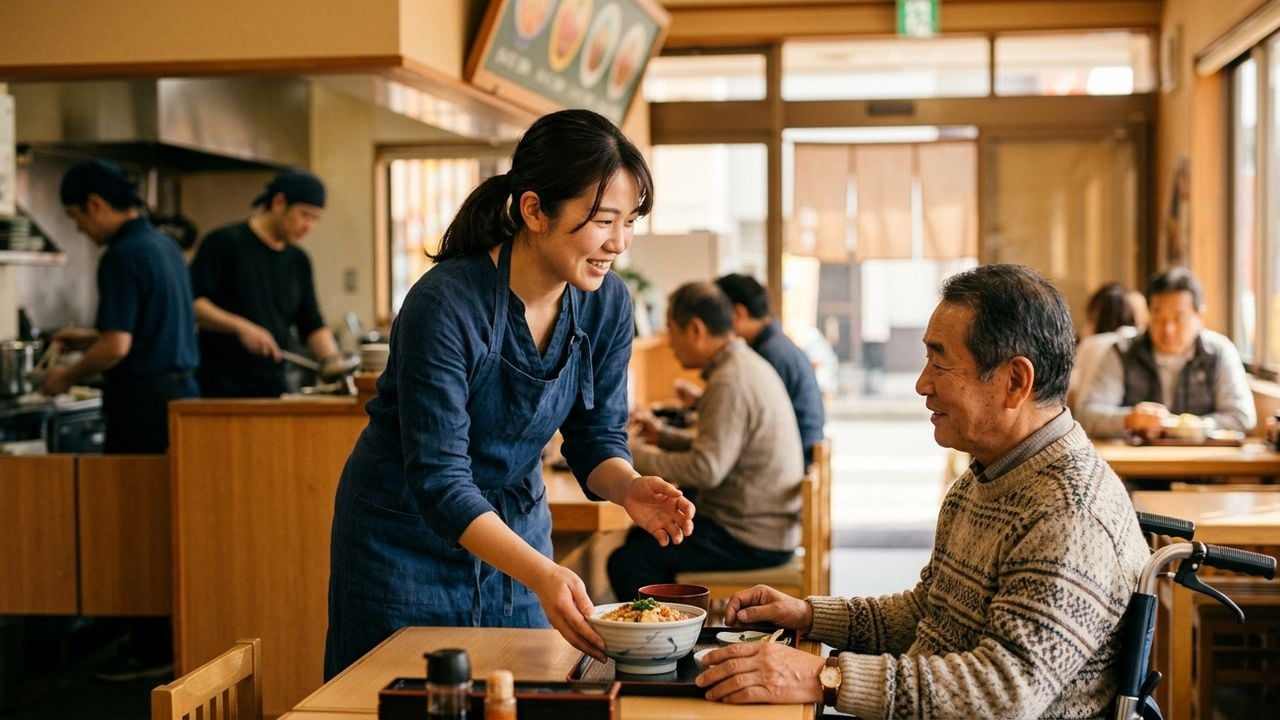
One important point to communicate clearly: Itadaki is on the second floor, and access requires taking a staircase. There is no elevator within the building. If you use a manual or powered wheelchair, please factor this in when planning. Strollers and lightweight wheelchairs can be brought into the restaurant, and staff may be able to assist with carrying when their availability allows — though we cannot guarantee assistance at every moment depending on the restaurant's condition at the time. If you are visiting with a companion who can help with stairs, the experience inside the restaurant itself is well-suited for relaxed, comfortable dining.
For wheelchair users for whom stair access presents a significant barrier, we recommend reaching out via Instagram DM in advance (@itadaki_gyudon.08) so we can discuss your specific situation and help you plan accordingly.
You now know the staircase is the key variable to plan around — but the next question is whether we're even open on the day you're arriving. Our operating days (Monday, Tuesday, Saturday, Sunday, and public holidays) follow a monthly calendar that occasionally changes due to irregular closures. The Instagram schedule gives you the confirmed open days for your specific travel dates before you finalize anything. Takes about 30 seconds to check.
Step 2: Inside the Restaurant — Seating and Comfort
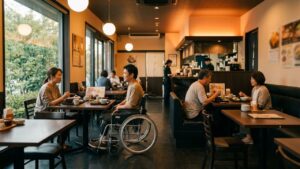
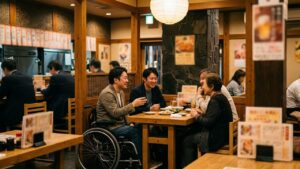
Once inside, Itadaki has 18 seats in total, all featuring comfortable sofa-style seating. The layout includes counter seats ideal for solo visitors, a five-person sofa table for groups or families, two-person sofa tables for couples, and a four-person sofa table for small groups.
The sofa seating means there's no hard chair to maneuver around — guests who transfer from a wheelchair to a seat have found the wide, cushioned sofa tables particularly accommodating. The atmosphere is calm and unhurried, which matters when you're planning a longer lunch stop during a busy travel day.
English menus are available in print, as are menus in Simplified Chinese and Korean. A photographic five-step guide to enjoying the dish is also provided — so even if communication with staff is limited by language, the experience is designed to be fully accessible and enjoyable.
✓ Key Takeaways
- Itadaki is on the 2nd floor via staircase only — no in-building elevator. Plan accordingly and consider reaching out in advance via Instagram if you have specific mobility needs.
- Inside, all seating is sofa-style, spacious, and well-suited for an extended, comfortable lunch.
- English menus and a visual five-step eating guide are available — no Japanese language skill required to enjoy the full experience.
You've read that Horai Wagyu is capped at 10 bowls per day and that walk-ins during peak hours frequently miss out — especially on weekends. The reservation page is where you lock in your bowl by pasting 鳳来牛希望 into the notes field, so it's held before you even leave your hotel. The form runs in English from start to finish.
Step 3: The Horai Wagyu Question — Will It Sell Out Before You Arrive?
This is the concern we hear most often from visitors who've done their research. And it's a legitimate one.
Horai Wagyu is one of Japan's rarest beef breeds — raised across just 3 farms in Aichi Prefecture's Okumikawa region, with only 300 heads produced annually out of approximately 500,000 wagyu cattle in Japan. At Itadaki, we prepare it using our proprietary two-stage cooking technique, which brings the core temperature above 70°C to fully meet Japan's Ministry of Health, Labour and Welfare food safety standards — while preserving the distinctive "rare" texture that makes this experience unlike any other wagyu you'll encounter.
Because of this extreme rarity, we limit Horai Wagyu to 10 bowls per day. Walk-in visitors arriving after peak lunch hours — especially on weekends and public holidays — frequently find it sold out.
For visitors planning a short stay in Nagoya, this is exactly the kind of risk you don't want to take. Here is what we recommend:
Option A (Recommended): Reserve in Advance via Tabelog Online
Tabelog is Japan's leading restaurant reservation platform. The website is available in English, and reservations can be completed without any Japanese language skill. When making your reservation, copy and paste the following phrase into the notes or requests field:
鳳来牛希望 (This tells us you'd like Horai Wagyu reserved for your visit.)
This is the most reliable way to guarantee your bowl is waiting for you when you arrive.
Option B: Arrive at Opening (11:00 AM sharp)
If a reservation isn't possible, arriving right as we open at 11:00 gives you the best chance of securing one of the 10 Horai Wagyu bowls as a walk-in. On public holidays, we open at 9:00 AM — an option worth noting for those with flexible itineraries.
Option C: Mikawa Beef Rare Gyudon — Always Available
If Horai Wagyu is unavailable, our Mikawa Beef Rare Gyudon is always prepared and ready for walk-in guests. It uses the same two-stage cooking technique and the same all-Aichi-Prefecture sourcing philosophy — and it's equally extraordinary in its own right. Starting from ¥1,800 (Fumoto, 100g beef, 200g rice), it's the entry point into the Itadaki experience that many guests return for specifically.
"The rare wagyu was unlike anything I've ever tasted — a life-changing culinary experience."
— A guest visiting Nagoya as part of their Japan trip
That guest arrived with a reservation. They knew their bowl was ready. They sat down, followed the five-step eating guide, and discovered something that most visitors to Japan — even those who've tried Kobe beef and Matsusaka beef — haven't encountered before. That peace of mind matters, especially when your time in Nagoya is limited.
Step 4: Operating Hours and Planning Around Your Schedule
Itadaki operates on a specific schedule that differs from most Nagoya restaurants, so planning ahead is essential — particularly for visitors coordinating with Asian Games or Asian Para Games event days.
- Monday, Tuesday, Saturday, Sunday: 11:00–15:00
- Public holidays: 09:00–15:00
- Wednesday, Thursday, Friday: Closed
- Last order is 30 minutes before closing. Irregular closures may apply.
We publish our monthly business calendar on Instagram — always worth checking before your visit, especially if your travel dates fall mid-week or around event periods. Our monthly schedule is updated on Instagram each month.
For visitors integrating Itadaki into a broader Nagoya day, we're located in the Osu district — steps from Osu Kannon Temple and the 1,200-shop Osu Shopping Street. The Hisaya-odori Garden Flarie, a free-admission urban garden featured in major English travel guides, is just a three-minute walk from Yabacho Station. It's a natural pairing: explore the garden in the morning, then walk to Itadaki for lunch before heading to your afternoon event or onward destination.
If you're combining Nagoya with a visit to Shirakawa-go or Takayama, a Saturday or Sunday lunch at Itadaki fits cleanly into the schedule — and our step-by-step guide for adding Nagoya to your Tokyo-Kyoto-Osaka itinerary walks through exactly how to time it.
Step 5: Making Your Reservation — A Walkthrough for First-Time Tabelog Users
If you've never used Tabelog before, here's a simple walkthrough:
- Visit the Tabelog reservation page for Itadaki (the link is on our official English page at itadaki8.com/english/).
- Select your preferred date and time. Remember: we are open Monday, Tuesday, Saturday, and Sunday (11:00–15:00), plus public holidays (09:00–15:00). Wednesday through Friday are closed.
- Enter the number of guests in your party.
- In the notes or special requests field, paste: 鳳来牛希望
- Complete the reservation form in English — the site supports English input throughout.
That's it. You'll receive a confirmation, and your Horai Wagyu bowl will be held for your arrival.
One final note on payment: Itadaki accepts credit cards and electronic payment methods including Apple Pay and Google Pay — no need to prepare exact cash, though yen cash is also accepted.
A Note From Our End
Founder Masayuki Goto built Itadaki on a simple belief: that food is a gift deserving of respect at every step — from the farmers in Okumikawa who raise 300 heads of Horai Wagyu each year, to the guests who travel from across the world to experience it. Every practical barrier we can remove — English menus, multilingual visual guides, flexible reservation options — is part of that same respect.
For wheelchair users and visitors with mobility considerations, we want you to arrive with a clear picture of what to expect, so your energy on the day goes toward enjoying the meal — not worrying about logistics. If you have specific questions about your visit that this guide doesn't answer, our Instagram DM is the best way to reach us directly before your trip.
For our complete menu, access details, and store information, visit our official page at itadaki8.com/english/.
You've worked through every step — access, seating, hours, and the Horai Wagyu availability question. The one thing left is placing the reservation itself, before your travel dates fill up or the 10 daily bowls are claimed by other visitors who planned ahead. Paste 鳳来牛希望 in the notes field and your bowl is secured.