5 Reasons Itadaki Is the Perfect Lunch During Asian Games Nagoya
 gotowp
A few days ago, a message came in through our Instagram from a visitor who was flying into Nagoya for the 2026 Asian Games. She had one specific question — and she was almost apologetic asking it:
"I only have two days in Nagoya. If I come on the second day and the Horai Wagyu is already sold out, I'll have missed my only chance. What should I do?"
I read that and immediately thought: this is exactly the fear I want to address. She wasn't being dramatic. She was being honest about the reality of a short trip — and Horai Wagyu is, genuinely, strictly limited to 10 bowls per day. During Asian Games week, with visitors flooding Nagoya's Osu district from across Asia and beyond, that concern is completely valid.
So let me answer her question — and yours — clearly and honestly, in the same way I'd explain it to a friend standing at our door.
Who This Is For
- ✅ Asian Games 2026 spectators planning a lunch stop in Nagoya between events
- ✅ Visitors worried about Horai Wagyu selling out before they arrive
- ✅ Travelers unfamiliar with Japanese reservation platforms who want a clear, step-by-step guide
- ✅ Anyone with only one or two days in Nagoya who can't afford a wasted trip
- ✅ First-time visitors to Itadaki who want to know what to expect before walking through the door
Why Horai Wagyu Sells Out — and Why That Matters More During Games Week
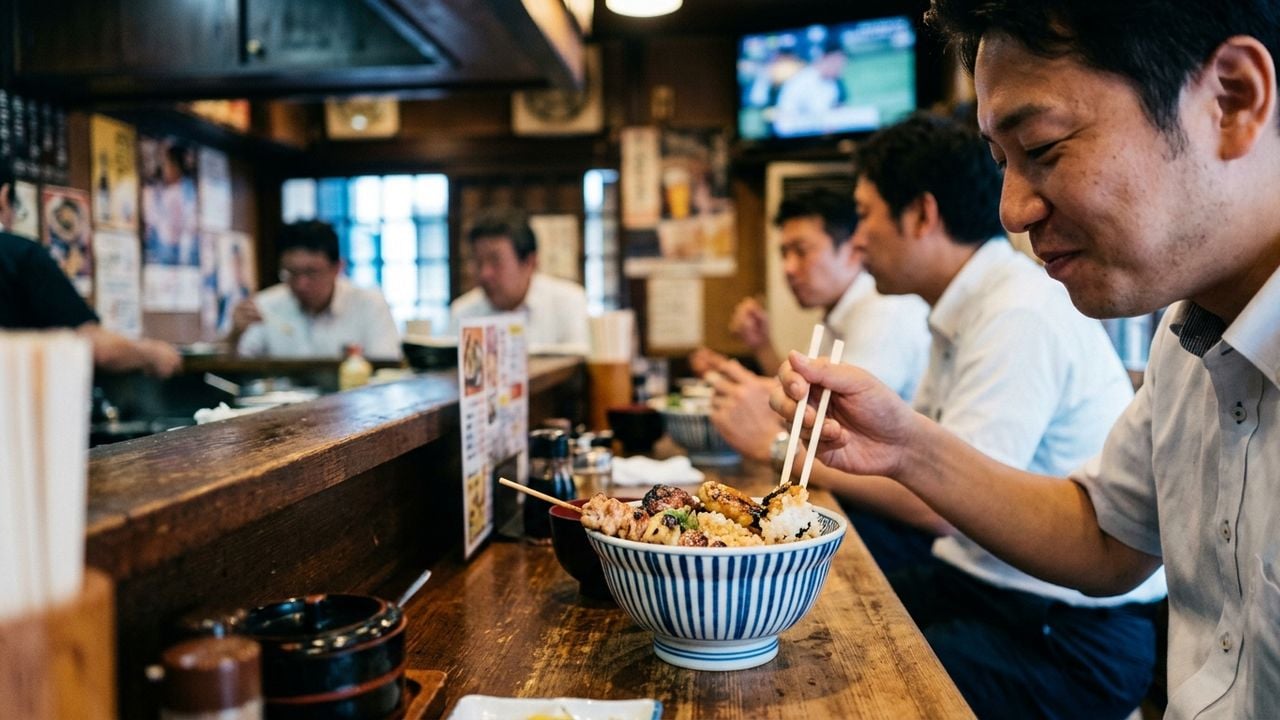
Horai Wagyu isn't limited to 10 bowls a day for theatrical effect. It's limited because of supply — pure and simple. Across all of Japan, only 3 farms raise this particular breed, producing just 300 heads annually. Out of approximately 500,000 wagyu cattle in Japan, only 300 are Horai Wagyu. Each animal is raised in Okumikawa, deep in Aichi Prefecture, and fed on sake lees from Horaisen Sora — a renowned local premium sake. That feeding method creates a flavor profile unlike any other wagyu: lean yet marbled, clean yet deeply savory.
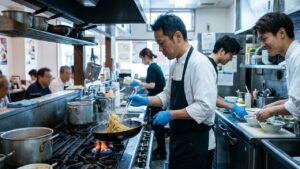
We source directly from those farms. We don't have a warehouse of backup stock. What arrives, we serve. When it's gone for the day, that's it.
On a typical Saturday, we might hit our 10-bowl limit by 12:30 or 1:00 PM. During Asian Games week in Nagoya — with thousands of additional visitors filling the Osu district between morning events and afternoon sessions — the likelihood of walk-in guests missing out increases significantly. For someone with a flight the next morning or a Shirakawa-go day trip already booked, arriving at 1:15 PM to hear "sold out" is not a footnote. It's the whole story of that afternoon.
You've just seen how quickly Horai Wagyu sells out — and how Games-week lunch hours compress that window even further. Our monthly schedule (including any irregular closures during Asian Games week) is posted before the month begins. Takes 10 seconds to check.
Before vs. After: Two Asian Games Visitors, Two Very Different Afternoons
Let me paint two real scenarios — because the difference between them comes down to one decision made 48 hours earlier.
Without a reservation: A group of four arrives at Itadaki at 12:45 PM on a Sunday during Games week. They've just come from watching a morning session at IG Arena and are hungry, excited, and looking forward to Horai Wagyu — which they read about on a travel blog the night before. We have to tell them the Horai Wagyu sold out 40 minutes ago. They order Mikawa Beef Rare Gyudon instead — which is genuinely delicious, prepared with the same two-stage cooking technique, and a dish I'm proud to serve. But they leave wondering what the Horai Wagyu would have tasted like.
With a reservation: The same group of four, same weekend, same schedule — but this time they reserved two days in advance via Tabelog Online, typed 鳳来牛希望 (copy and paste this phrase exactly) into the notes field to request Horai Wagyu, and arrived at 11:10 AM. Their bowls were waiting. They sat in our sofa seats, followed the five-step eating guide in English on our menu, and finished every grain of Aichi no Kaori rice. One of them messaged us afterward.
The only variable between those two afternoons was a two-minute reservation made in English on a Japanese website.
✓ Key Takeaways
- Horai Wagyu is capped at 10 bowls per day due to genuine supply constraints — this is not a marketing technique.
- During Asian Games week, peak lunch hours (12:00–1:30 PM) are the highest-risk window for walk-ins to miss out.
- Tabelog Online accepts reservations in English, and copying the phrase 鳳来牛希望 into the notes field is all it takes to request the Horai Wagyu bowl.
You now have the exact phrase to paste — 鳳来牛希望 — and the step-by-step process. The only thing left is locking in your date before someone else fills that 10-bowl limit. Tabelog Online accepts reservations in English.
How to Reserve Horai Wagyu at Itadaki — Step by Step
Tabelog is Japan's most widely used restaurant reservation platform, and while it isn't as internationally familiar as OpenTable or Resy, the reservation process itself is straightforward in English. Here's what to do:
- Go to Tabelog Online and search for Itadaki, or use the direct reservation link (see below).
- Select your date and party size. We're open Saturday, Sunday, Monday, and Tuesday — including public holidays — from 11:00 AM to 3:00 PM (last order at 2:30 PM). We are closed Wednesday, Thursday, and Friday. During Games week, check our monthly schedule on our official Instagram to confirm no irregular closures apply to your visit date.
- In the notes or request field, copy and paste this phrase: 鳳来牛希望
This tells our team in Japanese that you would like Horai Wagyu reserved for your table. You don't need to write anything else — we'll understand. - Arrive as close to 11:00 AM as possible. Even with a reservation, earlier arrival means a more relaxed experience before Games-day crowds build up in the Osu area.
For walk-in guests who arrive without a reservation: Mikawa Beef Rare Gyudon is always available. It uses beef from Aichi's Mikawa region — uchimomo lean cut, raised on okara feed with lactic acid bacteria gut management — and is prepared with the identical two-stage cooking technique that gives our bowls their signature rare texture. Starting price is ¥1,800 for the Fumoto (standard size, 100g beef, 200g rice). It is never an afterthought. It is its own culinary experience.
"Perfect lunch during our Nagoya stay before our Shirakawa-go trip the following day."
Guest review via Tabelog
This review stays with me because it captures something I hear often — Itadaki fitting into the rhythms of a carefully planned Japan trip. Whether it's Games sessions in the morning and Osu exploration in the afternoon, or Nagoya sightseeing before a mountain village the next day, a well-timed lunch here can anchor the whole day in a way that lingers long after.
Getting to Itadaki from Asian Games Venues
Itadaki is located on the 2nd floor of a building in Osu — a 4-minute walk from Yabacho Station Exit 4 on the Meijo Subway Line. If you're coming from IG Arena (Aichi International Arena, which opened in July 2025 and is one of the key Asian Games venues), the Meijo Line connects you directly. The Osu district itself is one of Nagoya's most iconic neighborhoods — home to Osu Kannon Temple, a 1,200-shop shopping street, and one of the best concentrations of interesting food and culture in central Nagoya. Arriving early for lunch before afternoon events, or stopping here between morning and evening sessions, fits naturally into most Games-week itineraries.
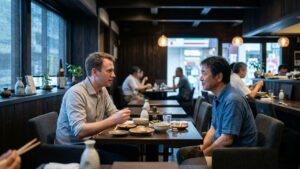
We have 18 seats, all sofa-style — counter seats for solo diners, and larger table configurations for groups of 4 or 5. The space is calm, the pace is unhurried, and our menu is available in English, Simplified Chinese, and Korean. A photographic five-step guide explains exactly how to eat the dish. No Japanese required.
If you're planning more than just lunch and want to think through how a Nagoya stay fits around Games events, this article on where to eat lunch during Asian Games 2026 in Nagoya offers a broader look at the district and timing options.
One More Thing About the Osu Experience During Games Week
The Osu district during Asian Games week will be unlike anything most visitors have seen here before. Athletes' families, spectators from across Asia, cosplay enthusiasts attending World Cosplay Summit events nearby, and regular weekend visitors from across Aichi Prefecture will all be moving through the same streets. The energy is real. So is the queue forming outside popular spots by noon.
My honest advice, shaped by four years of running Itadaki and 18 years in Nagoya's food and beverage scene: make the reservation early. The two minutes it takes to complete a Tabelog booking is the single most valuable thing you can do before your Nagoya visit. If circumstances mean you can't reserve in advance, arrive right at 11:00 AM when we open. That gives you the best possible chance without a reservation.
The Horai Wagyu bowl — 10 bowls a day, sourced from 3 farms, 300 heads a year — was designed to be discovered, not rushed. Come with time, come with intention, and the dish will do the rest.
For our complete menu, access details, and store information, visit our official page at https://itadaki8.com/english/
Asian Games week in Nagoya moves fast — venues, crowds, and sold-out lunches don't wait. Your Horai Wagyu reservation takes two minutes to make, and it's the one part of your Nagoya itinerary that won't be left to chance.