Are Nagoya Restaurants Crowded During Asian Games 2026?
 gotowp
A guest messaged us recently through Instagram, asking something I hadn't been asked quite this way before: "We're coming for the Asian Games. Should we just give up on finding a good lunch spot, or is there still a way to experience something real — something we can actually tell people about when we get home?"
It stopped me for a moment. Because behind that question was something more personal than logistics. They weren't just worried about crowds. They wanted their trip to be worth sharing. And that's a goal I can genuinely help with.
Yes, Nagoya will be busier than usual during the 2026 Asian Games (scheduled for September–October 2026). But busy doesn't mean impossible — and in some ways, the energy of a city hosting an international event makes the right discoveries feel even more meaningful. Here's what to realistically expect, and how to make the most of it.
Who This Is For
- ✅ Travelers attending or spectating at the 2026 Asian Games or Asian Para Games in Nagoya
- ✅ Visitors who want to eat something genuinely memorable — not just convenient — during their trip
- ✅ People planning their Nagoya itinerary around lunch spots that are worth photographing and sharing
- ✅ Repeat Japan visitors who've already done Tokyo and Kyoto and want something new to talk about
- ✅ Anyone wondering how to secure a great meal despite the expected event crowds
How Crowded Will Nagoya Really Be During Asian Games 2026?
The short answer: noticeably busier, but not unmanageable — if you plan ahead.
The 2026 Asian Games will bring athletes, support staff, media crews, and spectators from across Asia and beyond. Nagoya's main venues — including the newly opened IG Arena (which I love, by the way, as a basketball fan) — are spread across the city rather than concentrated in one district. That means the crowds won't feel like a single gridlocked area. Instead, expect certain pockets — near major stations like Nagoya Station, Sakae, and Yabacho — to feel livelier, especially at midday.
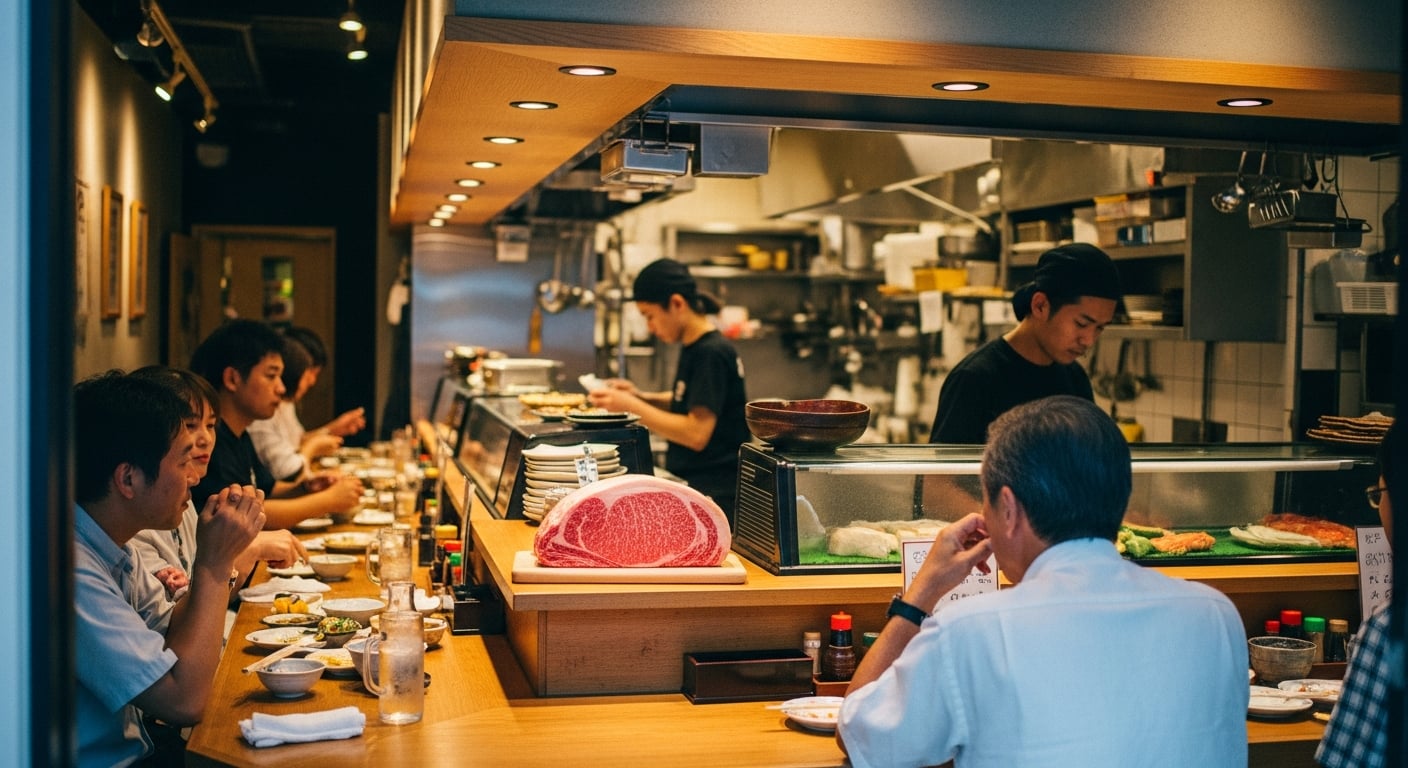
For restaurants, lunch hours between 12:00 and 13:30 will likely see the highest pressure. Popular spots with limited seating and no reservations will fill up quickly. At Itadaki, where we operate with 18 seats and offer a strictly limited number of our rarest dishes each day, this is exactly the scenario where advance planning makes the difference between a story you can tell and a meal that didn't happen.
Why Does the Crowd Factor Actually Matter for Your Instagram Story?
Here's something worth thinking about. During a major international event, everyone around you is documenting their experience. Your social feeds will be full of stadium shots, team flags, and city skylines. That's all wonderful — but it's also what everyone else will post.
The moments that truly stand out, the ones your followers will stop and ask about, are the ones where you clearly went beyond the obvious. A bowl of rare wagyu gyudon — glowing with a golden egg yolk, draped with thinly sliced Horai Wagyu beef, served in a traditional Japanese ceramic bowl — against the backdrop of a quiet Osu side street? That's a photograph with a story attached. And when someone asks, "What is that?" you get to explain: that the beef comes from one of only three farms in Japan, that just 300 heads are raised each year, that the restaurant that invented this dish is a four-minute walk from the subway.
That's not just content. That's a travel story.
Is the Osu District a Good Lunch Base During the Games?
Honestly, yes — and this is one reason I'm glad Itadaki is where it is.
Osu sits between Sakae and Kamimaezu, a short walk from multiple subway lines, and it has its own rhythm that doesn't completely change just because there's a big event in town. It's already home to the World Cosplay Summit, which draws international visitors every summer — so the neighborhood knows how to host a crowd without losing its character. The 1,200-shop Osu Shopping Street, Osu Kannon Temple, and Hisaya-odori Garden Flarie (just three minutes from our nearest station, and free to enter) make for a genuinely satisfying morning or afternoon before or after a meal.
During the Asian Games period, I'd suggest treating lunch in Osu as an anchor — a place to slow down, eat well, and let the city breathe around you. The stadium energy is exciting, but so is stepping away from it for an hour and discovering the Nagoya that locals actually move through every day.
✓ Key Takeaways
- Nagoya will be noticeably busier during Asian Games 2026, particularly at midday — reservations at limited-seat restaurants are strongly recommended
- The Osu district offers a calmer, more discoverable lunch experience than the main event corridors, with strong subway connections to game venues
- The meals worth posting are the ones with a story — not just a setting
What Should I Reserve in Advance to Avoid Missing Out?
If there's one thing I'd say clearly: don't leave Horai Wagyu to chance during the Games period.
We limit our Horai Wagyu Rare Gyudon to 10 bowls per day — not as a marketing strategy, but because that's genuinely all we can source responsibly. With only 300 heads raised annually across three farms in Aichi Prefecture, there's no way to scale this without compromising what makes it special. During peak seasons or event periods, those 10 bowls go quickly.
Reservations can be made in English through Tabelog Online. When you reserve, please copy and paste the following phrase into the notes field to request the Horai Wagyu: 鳳来牛希望 (this tells us you'd like the Horai Wagyu bowl). If Horai Wagyu isn't available for your chosen date, our Mikawa Beef Rare Gyudon is always on the menu — prepared with the same two-stage cooking technique, equally photogenic, and equally worth the trip.
"Perfect lunch during our Nagoya stay before our Shirakawa-go trip the following day."
— Guest review
That review stayed with me. Because it captures exactly the kind of experience I hope we offer: not a rushed stop between activities, but a genuine pause — one that earns its place in the memory of a trip. Whether you're heading to Shirakawa-go the next morning or back to the arena that afternoon, a meal built around rare ingredients, a unique concept, and good storytelling gives you something to carry forward.
How Do I Turn a Lunch Stop Into a Shareable Travel Moment?
A few practical thoughts from someone who genuinely loves food photography and storytelling:
First, arrive a little before noon if you can. The restaurant is calmer, the light through the window is usually better, and you're not rushing because there's a queue behind you. You have time to follow the five-step guide printed in our multilingual menu — separating the egg yolk onto the beef, tasting the wagyu on its own before mixing, adding the condiments one by one. Each step changes the flavor profile, and each step is a photograph.
Second, ask us about the story. Our staff is welcoming to international visitors, and even if language is sometimes a stretch, we have a multilingual menu in English, Simplified Chinese, and Korean that explains the ingredients, the sourcing, and the concept. When you understand that you're eating beef fed on sake lees from a renowned Aichi brewery, that the egg came from a Nagoya Cochin hen, that the pickled radish is from the Atsumi Peninsula — the dish becomes something you can narrate, not just taste.
Third, add the context of where you are. A quick shot framed with Osu's covered shopping arcade in the background, or a walk to Osu Kannon Temple after lunch — these details make your story feel placed, rooted in a specific city at a specific moment in time. The 2026 Asian Games gave you a reason to be in Nagoya. But a meal like this gives you a reason to remember it differently from everyone else who was there.
So — Is It Worth Planning Lunch in Nagoya During Asian Games 2026?
More than ever, I'd say yes.
The energy of a city hosting something on that scale is genuinely special. And the travelers who return home with the most memorable stories aren't usually the ones who stuck to the official program. They're the ones who slipped away for a lunch that became the conversation piece of their entire trip.
The crowds are real, but they're manageable with a reservation. The Horai Wagyu is rare, but it's available if you plan ahead. And the experience — a culinary concept invented in Osu, Nagoya, using ingredients that no one outside Japan has heard of, served in a 18-seat restaurant on the 2nd floor of a building a four-minute walk from the subway — is exactly the kind of thing your friends will keep asking about long after the Games are over.
For our complete menu, access details, and store information, visit our official page at https://itadaki8.com/english/
Ready to secure your bowl before the crowds arrive? Reserve Your Rare Wagyu Experience via Tabelog Online — and don't forget to add 鳳来牛希望 in the notes if you'd like the Horai Wagyu.
Our business calendar changes monthly, so if you're planning around the Games schedule, the easiest way to confirm our open days is to check our latest schedule: Check Our Monthly Schedule on Instagram. We look forward to welcoming you to Osu.