Nagoya Business Lunch vs Tokyo: Where Value Meets Authenticity
 gotowp
Tokyo is still the default setting for most business trips to Japan. The meetings happen there, the hotel is there, the expense account dinner is pre-booked there. But something has quietly been shifting over the past few years — more and more corporate travelers, particularly those visiting Toyota-related facilities, Central Japan's manufacturing hubs, or MICE events in Aichi Prefecture, are finding themselves with a free lunch hour in Nagoya. And increasingly, that lunch hour is becoming the most memorable part of the entire trip.
It's a comparison worth making honestly: Tokyo business lunches are world-class by any standard. But Nagoya, for a traveler willing to step one street beyond the obvious, offers something Tokyo simply cannot replicate — culinary discoveries that are genuinely exclusive to this city, made from ingredients grown only in this prefecture, prepared using techniques invented here and nowhere else.
This article is for anyone who has ever thought: I want at least one meal on this trip that becomes a story I'll tell for years.
Who This Is For
- ✅ Business travelers with a free lunch hour in Nagoya who want more than a hotel restaurant
- ✅ Repeat visitors to Japan ready to explore beyond Tokyo's well-known dining scene
- ✅ Wagyu enthusiasts who have tried Kobe and Matsusaka and want to discover what comes next
- ✅ Travelers staying in Nagoya before or after a trip to Shirakawa-go or Takayama
- ✅ Anyone whose Japan food bucket list still has one unchecked item on it
The Tokyo Business Lunch: Excellent, But Familiar
Let's be fair. Tokyo does the business lunch extraordinarily well. From the Michelin-starred kaiseki tucked into a Ginza basement to the perfectly executed sushi counter in Shimbashi, the caliber is undeniable. Corporate expense accounts were practically designed for these kinds of meals.
But there's a particular feeling that sets in after your third or fourth Tokyo business lunch — a quiet sense that you've seen this before. The omakase format is beautiful, but it's also the same beautiful format you experienced last trip. The Wagyu you ordered was exquisite, but it was probably Kobe or Matsusaka, and by this point, those names are so well-traveled internationally that they carry more familiarity than surprise.
None of this is a criticism. It's simply the consequence of excellence becoming expected. Tokyo's dining scene is one of the greatest in the world — and for that exact reason, it rarely surprises a well-traveled guest anymore. Discovery requires going somewhere the crowd hasn't fully arrived yet.
What Nagoya Offers That Tokyo Cannot
Nagoya's reputation in food circles has always been quietly self-assured. Locals know what they have — Miso Katsu, Hitsumabushi, Tebasaki — and they haven't needed outside validation. But beneath the city's well-known signature dishes, something more remarkable has been developing: a generation of specialty restaurants built on hyper-local Aichi ingredients that most visitors to Japan have never encountered.
The structural advantage Nagoya holds over Tokyo for a once-in-a-lifetime lunch is this: in Nagoya, you can still discover something that doesn't exist anywhere else. Not a famous restaurant with a long waitlist. Not a well-documented omakase that every food blogger has already covered. Something genuinely new — a concept invented here, using ingredients grown exclusively in this prefecture, prepared by a chef who built his entire career around a single, audacious question.
That question, asked by Masayuki Goto in 2022, was: Why has no one ever created a premium, rare-style wagyu gyudon? Every other donburi had its fine dining version — kaisendon with premium seafood, katsudon with heritage pork. But gyudon — Japan's beloved beef bowl — had been left entirely to fast food chains. Nobody had attempted to reimagine it.
Goto, who had spent eighteen years in the restaurant industry and founded MAX'S BAR in 2008, saw an opportunity that was simultaneously a mission. During the pandemic, the small Aichi farmers he had long sourced from — producers of ingredients most people in Japan had never heard of — were struggling with unsold inventory. He wanted to build something that would support them permanently, not just as charity, but as a genuine business partnership.
The result was Itadaki, which opened in Osu, Nagoya in April 2022. The name comes from itadakimasu — the Japanese expression of gratitude spoken before every meal. It reflects a philosophy that runs through every bowl served: food is a gift from farmers, from the land, from the craft of preparation. It deserves respect at every step.
The Comparison That Matters: What Makes a Lunch Memorable?
When business travelers compare lunch experiences months or years later, the meals they remember are rarely the most expensive ones. They remember the meals with a story.
This is where Nagoya's hidden specialty restaurants hold a structural advantage over even Tokyo's finest dining rooms. A Tokyo kaiseki lunch is extraordinary — but the story you tell afterward is essentially: I had a beautiful kaiseki in Tokyo. Everyone who has been to Japan knows what kaiseki is. The experience lands with a nod.
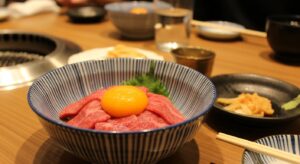
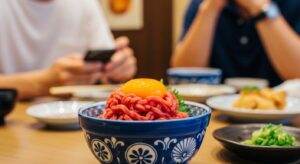
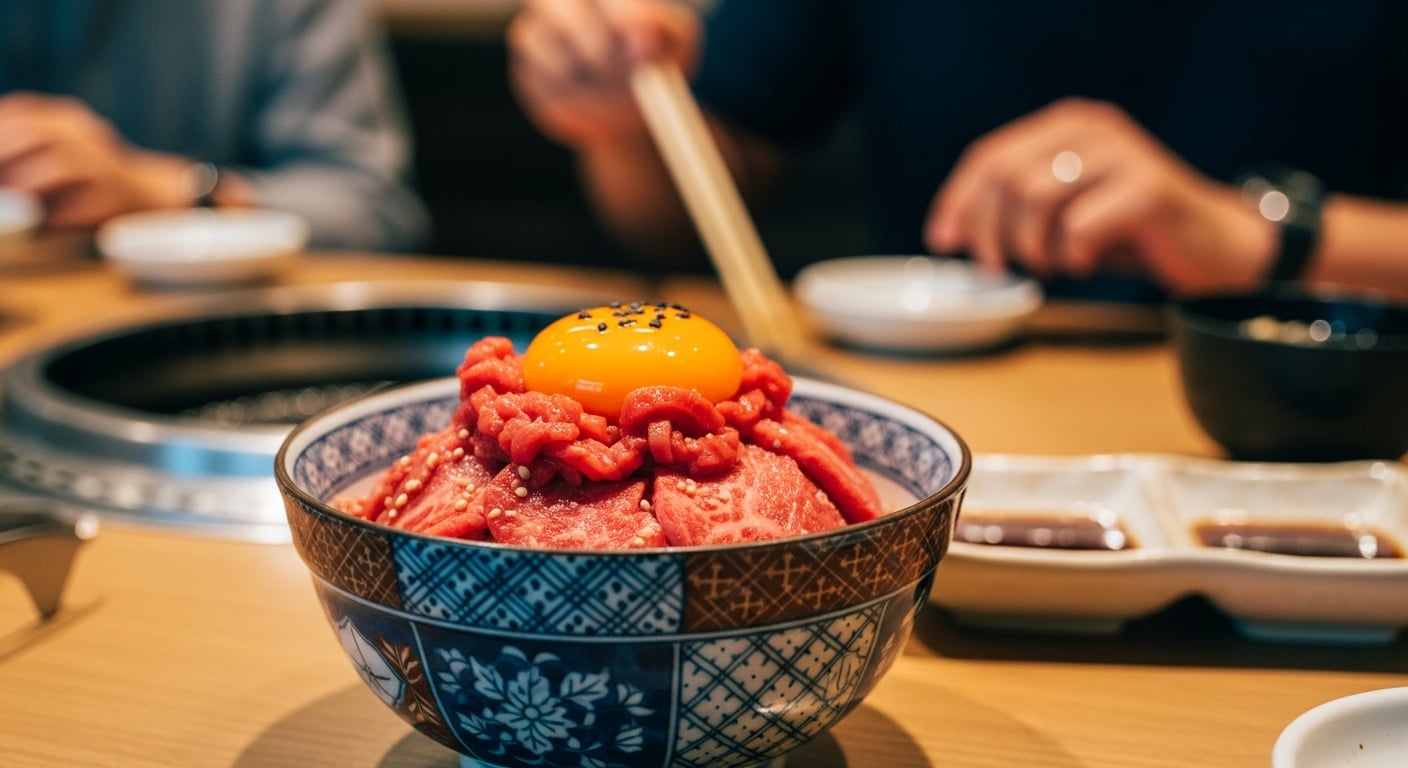
A lunch at Itadaki produces a different kind of story. You explain that Horai Wagyu — the beef in your bowl — is produced by only 3 farms in all of Japan, with just 300 heads raised annually. That out of approximately 500,000 wagyu cattle in Japan, these 300 are fed on sake lees from Horaisen Sora, a premium local sake from Okumikawa in Aichi Prefecture. That the rare-style texture in your bowl isn't raw in the conventional sense — it's achieved through a proprietary two-stage cooking technique, developed by the restaurant's founder, that heats the beef to over 70°C at the core while preserving a silky, rare mouthfeel. A technique that fully meets Japan's Ministry of Health, Labour and Welfare food safety standards, and that no other gyudon restaurant in Japan offers.
That story lands differently. Your listener leans in. They ask follow-up questions. This is the difference between a meal and a culinary narrative.
✓ Key Takeaways
- Tokyo business lunches are world-class but increasingly familiar to repeat Japan visitors — the element of genuine discovery is harder to find.
- Nagoya offers specialty restaurants built on hyper-local Aichi ingredients that exist nowhere else in Japan — or the world.
- The most memorable meals are defined by the story they carry, not by their price. Itadaki's Horai Wagyu — 300 heads annually, 3 farms in Japan — is a story worth telling.
Practical Comparison: Tokyo vs Nagoya for the Business Traveler
From a purely logistical standpoint, Nagoya has distinct advantages for the midday meal. Tokyo's most sought-after lunch destinations often require reservations weeks in advance, command price points that give finance teams pause, and demand at least ninety minutes of your afternoon. A kaiseki lunch in Ginza is a commitment.
Itadaki operates on a different model — one that was deliberately designed for flexibility. Lunch only, Tuesday, Monday, Saturday, Sunday, and on public holidays (check the monthly schedule on Instagram for exact dates), from 11:00 to 15:00. Eighteen seats. À la carte ordering with no set menus or fixed courses. The Rare Wagyu Gyudon featuring Horai Wagyu starts at ¥2,700 for the standard Shinkoccho size (100g beef, 200g Aichi no Kaori rice). A memorable lunch can be completed comfortably in forty-five minutes if you have a meeting to return to, or stretched into a leisurely hour if the afternoon is yours.
For those whose Nagoya schedule falls between a technical facility visit and an early evening Shinkansen, this kind of focused, unhurried specialty experience is exactly what the calendar allows. No twenty-course progression. No mandatory pairing menu. Just a singular dish, perfected over four years, made from ingredients that exist only in this prefecture.
From Nagoya Station, the journey to Itadaki takes approximately ten minutes by subway — Higashiyama Line to Sakae, transfer to the Meijo Line, exit at Yabacho Station Exit 4, and a four-minute walk. Look for the sign reading 元祖レア牛丼 頂 at street level and take the stairs to the second floor.
"Perfect lunch during our Nagoya stay before our Shirakawa-go trip the following day."
Guest visiting Nagoya and Gifu region
That single sentence captures something important. For travelers using Nagoya as a base for Shirakawa-go, Takayama, or wider Gifu exploration, Itadaki fits naturally into the rhythm of the trip — not as a detour, but as a destination lunch that anchors a remarkable day.
The Verdict: Different Purposes, Different Experiences
Comparing Tokyo and Nagoya for a business lunch isn't really about which city wins. It's about what kind of experience you're looking for and what you want to carry home.
If the goal is to impress a client with established prestige — a name they'll immediately recognize, a room they'll find comfortable — Tokyo's top restaurants do this reliably and brilliantly. That's a legitimate purpose, and Tokyo fulfills it better than almost anywhere on earth.
But if the goal is to experience something you cannot replicate anywhere else — a dish invented at the very location you're sitting in, made from ingredients so rare that the entire annual supply fits within the output of three small farms — then Nagoya, specifically a second-floor restaurant in the Osu district, offers something Tokyo simply doesn't have available to offer.
Goto built Itadaki on the belief that the gyudon — Japan's humblest comfort food — deserved its finest possible expression. Four years later, eight major Japanese TV programs including NHK have agreed. The guests who travel to Nagoya specifically for this bowl, and leave saying it was the highlight of their Japan trip, have agreed. And the farmers of Okumikawa, whose ultra-rare Horai Wagyu now reaches visitors from around the world, have perhaps the most eloquent agreement of all.
A once-in-a-lifetime culinary experience isn't defined by the restaurant's ranking or the price on the bill. It's defined by whether, years from now, you still remember exactly what you ate, where you ate it, and why it mattered. That's the standard Itadaki sets for every bowl it serves.
If you're planning a Nagoya lunch and want to reserve the Horai Wagyu before the daily ten-bowl limit is reached, advance booking via Tabelog is strongly recommended. You can add 鳳来牛希望 in the notes field to request this ultra-rare wagyu specifically. Walk-in guests are always welcome for the Mikawa Beef Rare Gyudon, which is available without reservation.
We'd love to welcome you. Reserve Your Rare Wagyu Experience and secure your seat for a lunch that goes well beyond a meal. For our complete menu, access details, and store information, visit our official page at https://itadaki8.com/english/.
And if you'd like to confirm we're open on the day you're visiting, Check Our Monthly Schedule on Instagram before you head out — we post our business calendar there each month, and we'd hate for you to make the trip on a day we're closed.