7 Facts About Itadaki That Make It Ideal for Corporate Visitors
 gotowp
A few months ago, I received a message from a guest who had visited Itadaki while on a business trip to Nagoya for a Toyota-related supplier meeting. He wrote to say that the meal had been the one moment of his trip that felt genuinely his — not a hotel restaurant recommended by the concierge, not a chain sushi bar near Nagoya Station that he recognized from Tokyo. He had found us on Google Maps, taken the subway to Yabacho, walked four minutes, and sat down to something he hadn't expected at all.
"I've been to Japan six times," he wrote. "This was the first time I felt like I found somewhere that wasn't meant for tourists."
That message stayed with me. Because honestly, that's exactly what Itadaki was built for — not in a way that excludes anyone, but in the sense that we set out to create a place worth finding. A place where the food speaks quietly, the story runs deep, and the experience belongs to whoever discovers it.
If you're traveling to Nagoya on business and wondering where to have a lunch that actually means something — not just calories between meetings — here are seven things about Itadaki that I think will help you decide.
Who This Is For
- ✅ Business travelers visiting Toyota-related sites, factories, or MICE events in Nagoya
- ✅ Repeat visitors to Japan looking for a lunch spot that goes beyond the familiar
- ✅ Corporate guests who want a genuine local experience without language stress
- ✅ Anyone arriving in Nagoya with only a short window for lunch but wanting it to count
- ✅ Travelers who prefer discovering a place through their own research, not a guidebook
1. It Exists Because of a Crisis — and That Story Changes How You Experience the Meal
I founded Itadaki in April 2022, in the middle of the pandemic's long aftermath. The bars I had been running since 2008 were restricted. The small Aichi farmers I had sourced from for years — producers of Horai Wagyu, Nagoya Cochin eggs, heritage onion varieties — were sitting on unsold harvests with nowhere to sell. I couldn't ignore that.
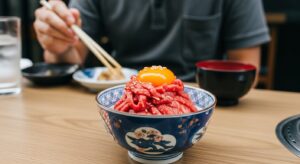
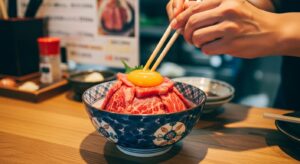
What came from that moment was a question I couldn't let go of: Why does Japan have premium versions of katsudon, oyakodon, and kaisendon — but never gyudon? The beef bowl had always been treated as fast food. I decided to change that. Everything from Aichi Prefecture. A proprietary cooking technique. A dish that treated the gyudon as a canvas for something genuinely new.
That origin story — born not from a business plan, but from a commitment to the people behind the food — is something corporate visitors often find unexpectedly resonant. Many of our guests come from industries where supplier relationships and supply chain integrity matter deeply. They recognize something familiar in how we built this place.
2. The Beef Itself Is a Supply Chain Story Worth Knowing
Horai Wagyu is produced by only three farms in Japan, with just 300 heads raised annually. To put that in context: there are approximately 500,000 wagyu cattle in Japan. Horai Wagyu represents a fraction so small it borders on the symbolic. These cattle are raised in Okumikawa, deep in the Aichi mountains, and fed on sake lees from Horaisen Sora — one of the region's most respected sake breweries.
We source directly from those farms. No middlemen. That direct relationship is what allows us to serve this beef at the standard we require — and it's what makes Horai Wagyu available here, in this small restaurant in Osu, in a way you won't find easily elsewhere in Nagoya.
For business travelers accustomed to thinking about provenance, traceability, and producer relationships, the Horai Wagyu story tends to land differently than a typical restaurant pitch. It's not marketing. It's just how rare this beef actually is.
3. The Cooking Technique Addresses the One Question Most Corporate Visitors Ask First
"Is it safe?" That's usually the first question. Rare-style beef preparation is familiar in Japan, but for business travelers from the US, Europe, or Australia, it can be an instinctive pause point.
The answer is yes — and it's backed by method, not just reassurance. Itadaki uses a proprietary two-stage cooking technique that heats the beef to over 70°C at the core, fully meeting Japan's Ministry of Health, Labour and Welfare food safety standards. The rare texture you experience is the result of precise temperature control, not undercooked meat. It took years to develop this technique to the point where it delivers the sensation of rare wagyu while satisfying Japan's strict regulatory requirements.
I hold a Certified Food Sanitation Supervisor qualification and operate under a licensed restaurant permit from the Aichi Prefecture Public Health Center. That foundation is not incidental — it's the reason this dish is possible at all.
✓ Key Takeaways
- Itadaki was founded to support Aichi's small farms directly — a story that resonates with supply-chain-minded corporate travelers
- Horai Wagyu is one of Japan's rarest wagyu varieties: only 300 heads per year, sourced directly from 3 farms in Okumikawa
- The rare-style preparation is fully compliant with Japanese food safety standards, using a proprietary two-stage cooking technique
4. The English Menu Was Built So You Don't Need to Ask Twice
Time is not a flexible resource for most business travelers. You may have a meeting at 2:00 PM and exactly 90 minutes for lunch. The last thing you need is an extended negotiation with a menu you can't read.
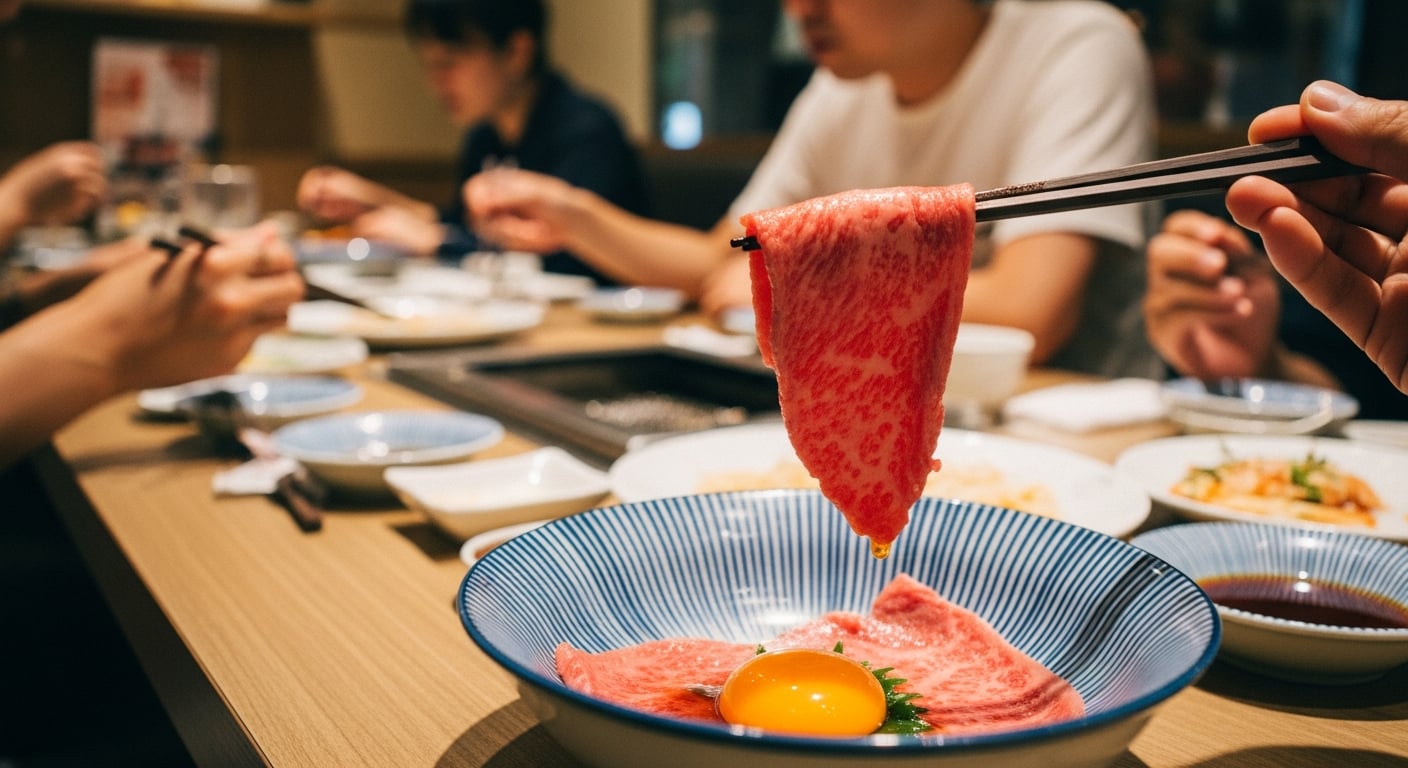
Our printed menu is fully translated into English (as well as Simplified Chinese and Korean), with clear photos, ingredient details, and pricing. It also includes a five-step visual guide titled "How to Enjoy Rare Gyudon" — so you understand exactly how the dish is meant to be experienced, from separating the egg to adding condiments at your own pace.
This was a deliberate decision from the beginning. Itadaki is a hidden gem in the Osu district, but being hidden doesn't mean being inaccessible. The goal was always to welcome international visitors with the same genuine warmth we offer anyone who walks through the door.
"The staff were welcoming and made us feel at home even without perfect Japanese."
— International guest
That kind of experience doesn't happen by accident. It's something we think about every day.
5. Access from Nagoya's Business Districts Is Straightforward
Itadaki is a four-minute walk from Yabacho Station, Exit 4 (Meijo Subway Line). From Nagoya Station, the journey takes approximately 10 minutes: Higashiyama Line to Sakae, transfer to the Meijo Line, one stop to Yabacho. That puts us well within reach of a midday window, even for guests with tight schedules.
The restaurant is on the 2nd floor — look for the sign reading "元祖レア牛丼 頂" (Ganso Rea Gyudon Itadaki) at street level and take the stairs up. We're within the Osu district, which means after lunch you have the option of a short walk through the Osu Kannon Temple grounds or along the shopping street — a useful mental reset before an afternoon of meetings.
No parking, but multiple coin lots are available within a one-to-three-minute walk if you're arriving by car.
6. The Format Fits a Business Lunch Without Ceremony
There are no set menus, no courses, and no expectation that you'll be at the table for two hours. Itadaki operates on a simple à la carte basis. You arrive, you choose your bowl size, you add a side dish or a Chita Highball if the afternoon allows it, and you eat.
We have 18 seats total — five counter seats that are excellent for solo diners, plus sofa-style table seating for small groups. The sofa seating, in particular, tends to surprise guests who expect a cramped counter experience. It's comfortable, unhurried, and easy to have a conversation across the table if you're dining with a colleague.
For groups of up to 18 — a full buyout of the restaurant — advance inquiry via Instagram DM is available. This has been a quiet option for small corporate team lunches and works well for groups that want a private, exclusive-feeling experience without the formality of a traditional private dining setup.
7. The Before-and-After of a Nagoya Business Lunch Changes After You Come Here
Before discovering Itadaki, the typical pattern for business travelers in Nagoya looks like this: hotel restaurant, convenience store onigiri, or a well-known chain near the venue. Functional. Forgettable. Something to get through.
After: you have a story. You ate Horai Wagyu — one of only 300 heads produced in Japan that year — in a small specialist restaurant in Osu that almost no one outside Japan has heard of. You followed a five-step eating guide, asked the staff a question, and got a real answer. The afternoon meetings felt different, because somewhere between the egg yolk and the wasabi finish, the day had become yours in a way that hotel dining never quite manages.
That shift — from a meal as logistics to a meal as experience — is what we hear about most often from business travelers who return to Itadaki on a second or third Nagoya trip. They didn't come back because it was the most convenient option. They came back because it was the one lunch they still remembered.
"I traveled to Nagoya specifically to eat here — it was 100% worth it."
— Guest who made a dedicated trip
Planning Your Visit
Itadaki is open for lunch only — 11:00 to 15:00 on Saturdays, Sundays, Mondays, and Tuesdays (public holidays: 9:00–15:00). Last order is 30 minutes before closing. We are closed Wednesday through Friday. Irregular closures do apply, and the monthly schedule is published on our official Instagram.
If you'd like to secure a bowl of Horai Wagyu — limited to 10 per day — a reservation via Tabelog Online is genuinely worth the few minutes it takes. When booking, copy and paste 鳳来牛希望 into the notes field to request it specifically. For walk-in visits, our Mikawa Beef Rare Gyudon is always available and prepared using the same two-stage technique.
For our complete menu, access details, and store information, visit our official page at https://itadaki8.com/english/.
When you're ready to secure your table, we'd be glad to welcome you — Reserve Your Rare Wagyu Experience through Tabelog Online. And to stay current with our monthly business calendar before your trip, Check Our Monthly Schedule on Instagram.
We'll see you on the 2nd floor.