What Is the Best Solo Lunch Spot for Business Travelers in Nagoya?
 gotowp
For the business traveler on a tight schedule, lunch in an unfamiliar city can feel like a low-priority checkbox — grab something nearby, eat quickly, move on. But here's the thing: some of the best meals of your life happen precisely in those stolen midday hours, in cities you didn't expect much from. Nagoya is exactly that kind of city.
Maybe you're here for a supplier meeting near Toyota's facilities, a MICE conference in the city center, or a site visit that leaves you with exactly ninety minutes between commitments. You want something genuinely memorable — not a hotel restaurant, not a chain, and definitely not another bowl of ramen chosen purely out of convenience. You want something you'll still be talking about at dinner parties three years from now.
The answer, as it turns out, is a 4-minute walk from Yabacho Station.
Who This Is For
- ✅ Business travelers visiting Nagoya with limited time but high expectations for lunch
- ✅ Solo diners who want a comfortable, unhurried meal without the awkwardness of dining alone
- ✅ Travelers looking for a uniquely Japanese food experience they can share with friends and followers back home
- ✅ Wagyu enthusiasts who have tried Kobe and Matsusaka beef and are ready to discover something new
- ✅ Anyone who wants a Nagoya lunch story worth telling — not just worth eating
Why Is Solo Dining in Nagoya Harder Than It Sounds?
Most business travelers in Nagoya face the same quiet frustration. You finish your morning meeting earlier than expected, you have an hour and a half, and you open Google Maps only to find an overwhelming list of options — ramen shops with no English signage, full-course restaurants that require two hours minimum, and conveyor belt sushi that feels like a step backward after three days of working lunches.
What you're actually looking for is rare: a place that's quick enough to fit into a real schedule, comfortable for one person, genuinely exciting to eat at, and — if you're honest — worth a photo. Because in 2025, a lunch that nobody sees might as well not have happened.
Itadaki, located on the 2nd floor of a quiet building in Osu, Nagoya's most layered and fascinating district, was built with exactly this kind of guest in mind. Five counter seats. Sofa-style table seating. Lunch only. No elaborate ceremony, no hours-long tasting menu — just one extraordinary dish, prepared with more intention than most multi-course meals you'll encounter in Japan.
What Makes a Dish Genuinely Worth Sharing?
There's a difference between a dish that photographs well and a dish that comes with a story. Plenty of restaurants in Japan have mastered the visual side. What's rarer — genuinely rare — is a dish where the narrative is as compelling as the presentation.
Itadaki's founder, Masayuki Goto, spent 18 years in the food and beverage industry before opening Itadaki in April 2022. His question, when he conceived the concept, was straightforward: why had every major Japanese dish category developed a high-end, premium version — katsudon, oyakodon, kaisendon — except gyudon? Everyone knew gyudon as everyday fast food from chains. Goto saw an unanswered question and built a restaurant around it.
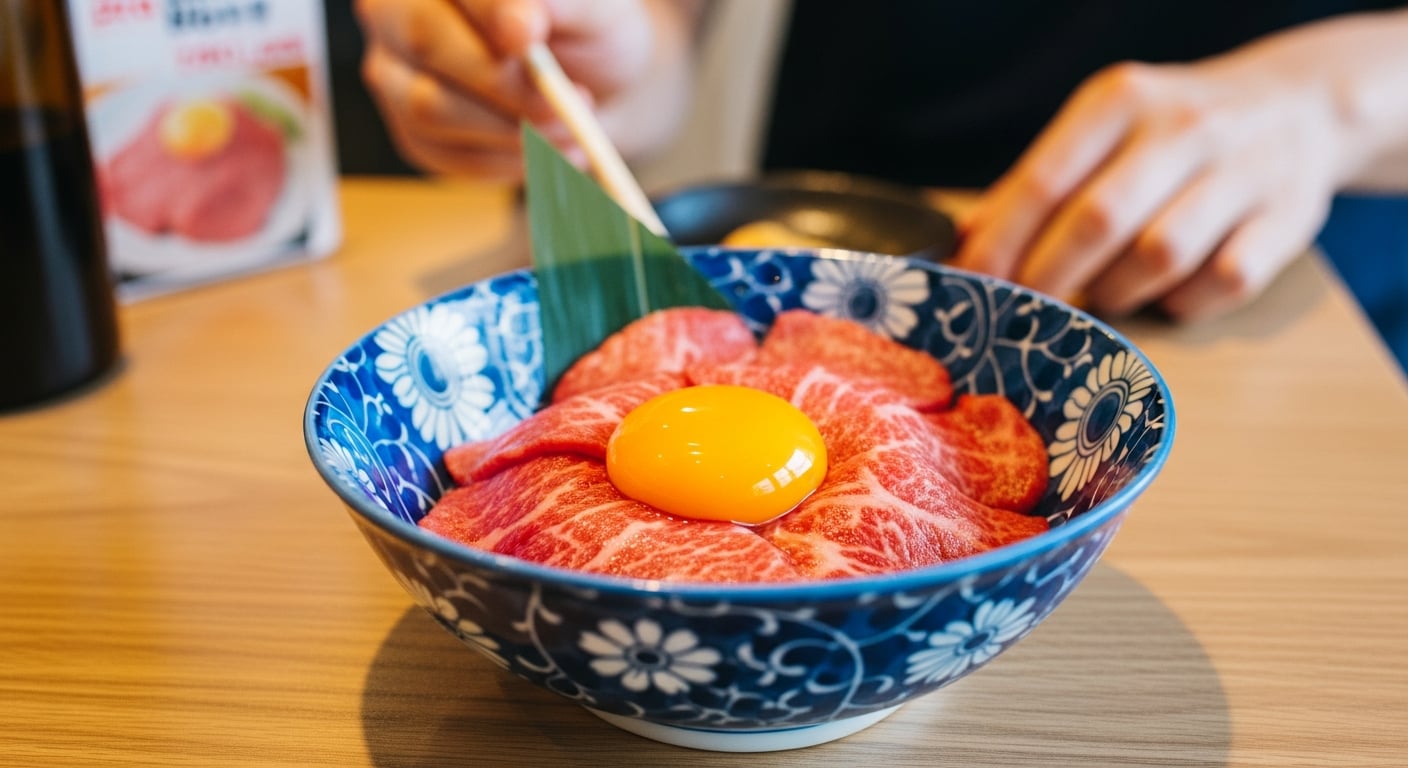
The result is what he calls the Original Rare Wagyu Gyudon: a beef bowl featuring Horai Wagyu, one of Japan's most exclusive wagyu brands, produced by only 3 farms in Aichi Prefecture with just 300 heads raised annually. To put that in context — there are approximately 500,000 wagyu cattle in Japan. Horai Wagyu represents 300 of them. These animals are raised in the Okumikawa highlands and fed on sake lees from Horaisen Sora, a premium local sake brewery. The feeding process gives the beef a distinctive flavor profile — delicate marbling layered with a depth that lean wagyu rarely delivers.
When your followers ask what they're looking at in your photo, you won't say "beef bowl." You'll say: "This is Horai Wagyu. Three hundred cattle, three farms, one prefecture. You can't find it anywhere else in the world like this."
That's a story. That's why people ask follow-up questions.
✓ Key Takeaways
- Itadaki was founded on a genuine culinary question: why does every Japanese dish category have a premium version except gyudon? The answer became The Original Rare Wagyu Gyudon.
- Horai Wagyu — the restaurant's signature ingredient — is produced by only 3 farms in Japan, with 300 heads annually. The story behind the beef is as striking as its flavor.
- Solo dining is explicitly accommodated: 5 counter seats, comfortable sofa seating, and a lunch-only format designed to fit into a real schedule.
Is Rare-Style Wagyu Safe to Eat?
This is the question that stops many Western travelers before they even consider visiting. In the United States and much of Europe, rare or undercooked beef carries real public health advisories — E. coli, salmonella, the works. The caution is reasonable, and Goto anticipated it.
Itadaki's signature preparation uses a proprietary two-stage cooking technique developed under Goto's direction, which heats the beef to over 70°C at the core — fully meeting Japan's Ministry of Health, Labour and Welfare food safety standards. The result is a texture that delivers the sensation of rare wagyu while leaving no ambiguity about safety. Goto himself holds a Certified Food Sanitation Supervisor qualification, and the restaurant operates under an Aichi Prefecture Public Health Center license. This isn't a loophole. It's a technical achievement that took years to develop and is unique to Itadaki.
In practical terms: you're not taking a risk. You're experiencing a carefully engineered culinary technique that exists nowhere else.
How Do You Actually Experience the Dish?
The menu at Itadaki is fully printed in English, with photos and prices clearly displayed. There's no point-and-guess ordering, no anxiety about ingredients. The menu also includes a five-step visual guide titled "How to Enjoy Rare Gyudon" — because this isn't a dish you rush through.
You start by separating the Nagoya Cochin egg: the white goes into your miso soup, the golden yolk rests on top of the beef. First, you eat the wagyu as it is — appreciating the texture and the subtle flavor of Horai Wagyu without interference. Then the yolk gets folded in, adding a richness that transforms each bite. The tabletop condiments — pickled ginger from Inazawa, dried whitebait from Minamichita, Itadaki's original 8-spice blend — invite you to keep adjusting, keep discovering. Finish with wasabi for a clean, bright final note.
Each ingredient on the table, from the Aichi no Kaori rice to the white soy sauce-based "magic sauce" from Hekinan City, to the Aikei No.1 shiso leaves from Toyohashi — every single element comes from Aichi Prefecture. Goto's commitment to his home prefecture is total, and you taste it in the coherence of the bowl.
"I've had Kobe beef and Matsusaka beef, but Horai Wagyu at Itadaki was on another level."
Guest review
That's not marketing language. That's the reaction of someone who came in with calibrated expectations — someone who had already eaten well in Japan — and left recalibrated.
Can I Walk In, or Do I Need a Reservation?
For the Horai Wagyu option, reservation is strongly recommended. Itadaki limits it to 10 bowls per day — not as a marketing tactic, but because supply genuinely doesn't allow for more. If you'd like to guarantee your bowl, reserve via Tabelog Online (available in English) and add the following phrase to the notes field: 鳳来牛希望 (this means "Horai Wagyu, please"). Copy and paste it directly — the staff will understand.
Walk-in guests are always welcome for Mikawa Beef Rare Gyudon, the second signature offering, prepared with the same two-stage technique and equally exquisite in its own right. Arriving right at the 11:00 opening also maximizes your chances of Horai Wagyu without a prior booking.
Getting there from central Nagoya is straightforward: from Nagoya Station, take the Higashiyama Line to Sakae, transfer to the Meijo Line, and exit at Yabacho Station Exit 4. Four minutes on foot. The sign at street level reads 元祖レア牛丼 頂 — look for it, then head upstairs.
Itadaki is open Tuesday, Monday, Saturday, and Sunday from 11:00 to 15:00, with last order 30 minutes before closing. On public holidays, doors open at 9:00. Irregular closures do happen — check the monthly business calendar on Instagram before you plan.
What Will You Actually Take Home From This Lunch?
A meal at Itadaki takes about forty-five minutes if you eat thoughtfully and enjoy the five-step process. That fits comfortably inside the lunch window of almost any business schedule. What you take home, though, lasts considerably longer.
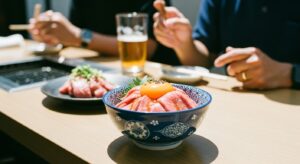
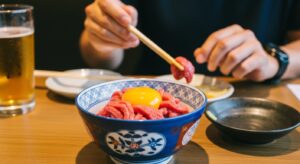
You'll have photos that don't look like anything your followers have seen before — the marbled wagyu arrangement, the golden yolk, the ceramic bowl, the quiet elegance of a dish that doesn't perform for the camera but photographs beautifully anyway. More importantly, you'll have a story with real substance behind it: a wagyu so rare it represents 300 out of 500,000 cattle in Japan, a cooking technique invented at this specific address, a founder who built a new category of Japanese cuisine from the ground up during a pandemic to support the farmers he believed in.
That's the kind of lunch that doesn't end when you leave the table. It continues in the conversation you have with a colleague who asks why you're still thinking about beef on Thursday.
If you're traveling to Nagoya for work and you have exactly one chance to eat somewhere genuinely worth remembering — make it here. Itadaki is a 4-minute walk from Yabacho Station, and the story it gives you is one you won't find anywhere else in the world.
For our complete menu, access details, and store information, visit our official page at https://itadaki8.com/english/
Ready to secure your bowl? Reserve Your Rare Wagyu Experience on Tabelog before your Nagoya visit — especially if you have your heart set on Horai Wagyu. And for the latest monthly schedule and any irregular closures, Check Our Monthly Schedule on Instagram so you don't arrive on an unexpected day off. We look forward to welcoming you.