Discover the New Nagoya Specialty in the Land of Warlords
 gotowp
Nagoya has always been a city that rewards those who look a little closer. This is, after all, the land that gave Japan Oda Nobunaga, Toyotomi Hideyoshi, and Tokugawa Ieyasu — three warlords who reshaped an entire nation not by following the obvious path, but by seeing possibilities where others saw only obstacles. It feels fitting, then, that a small second-floor restaurant tucked into the maze of Osu's centuries-old shopping district is doing something quietly revolutionary: reimagining Japan's most humble everyday dish as something genuinely extraordinary.
But here's a question I hear from international visitors more often than you might expect — not "Is the wagyu worth it?" or "How do I get there?" The question that stops people at the door, quite literally, is this: "Will I actually be able to enjoy this meal without speaking Japanese?"
It's a fair concern. Authentic specialty restaurants in Japan can feel intimidating for foreign visitors — unfamiliar dishes, staff who may not speak English, menus written entirely in kanji. Many travelers, hesitant and unsure, end up walking past exactly the kind of place they came to Japan to find. That's the experience I want to talk about today.
Who This Is For
- ✅ Foreign visitors to Nagoya who want an authentic local dining experience but feel uncertain about the language barrier
- ✅ Travelers exploring Osu district and looking for a specialty lunch beyond the obvious tourist stops
- ✅ Wagyu enthusiasts curious about lesser-known Japanese beef beyond Kobe and Matsusaka
- ✅ Repeat Japan visitors seeking a genuine hidden-gem discovery in Central Japan
- ✅ Anyone who has ever hesitated outside a Japanese restaurant, menu in hand, unsure how to begin
The Anxiety That Makes Travelers Choose the Familiar
Let me be honest about something. When a traveler arrives in Nagoya for one or two days — perhaps as part of a broader itinerary that includes Shirakawa-go, or as an add-on to the Tokyo-Kyoto route — every meal choice carries weight. You don't want to spend your one Nagoya lunch at a restaurant where you end up pointing randomly at a laminated photograph and hoping for the best.
The anxiety is real, and it shapes behavior. Surveys consistently show that language uncertainty leads international visitors to default to familiar international chains or tourist-facing restaurants — not because those places are better, but because they feel safer. In doing so, travelers trade the possibility of genuine discovery for the comfort of predictability.
At Itadaki — The Original Rare Wagyu Gyudon in Osu — we built the entire guest experience around making that anxiety disappear. Not just for Japanese-speaking visitors. For every guest who walks through the door.
An English Menu That Actually Explains the Dish
When founder Masayuki Goto launched Itadaki in April 2022, he did so with a clear vision: to introduce Aichi Prefecture's finest ingredients to the world. That word — the world — wasn't decorative. It meant that the restaurant had to be genuinely accessible to international visitors from the very first day.
The result is a fully multilingual printed menu available in English, Simplified Chinese, and Korean. Every dish is listed with clear photographs, ingredient explanations, and pricing. There's no guesswork. You can see exactly what Horai Wagyu looks like before you order it, read about why it's limited to just 10 bowls per day, and understand what each size option contains.
But the menu goes further than a simple translation. It includes something we call the "How to Enjoy Rare Gyudon" five-step visual guide — a step-by-step instruction that walks you through the experience of eating our signature dish exactly as it was designed to be eaten:
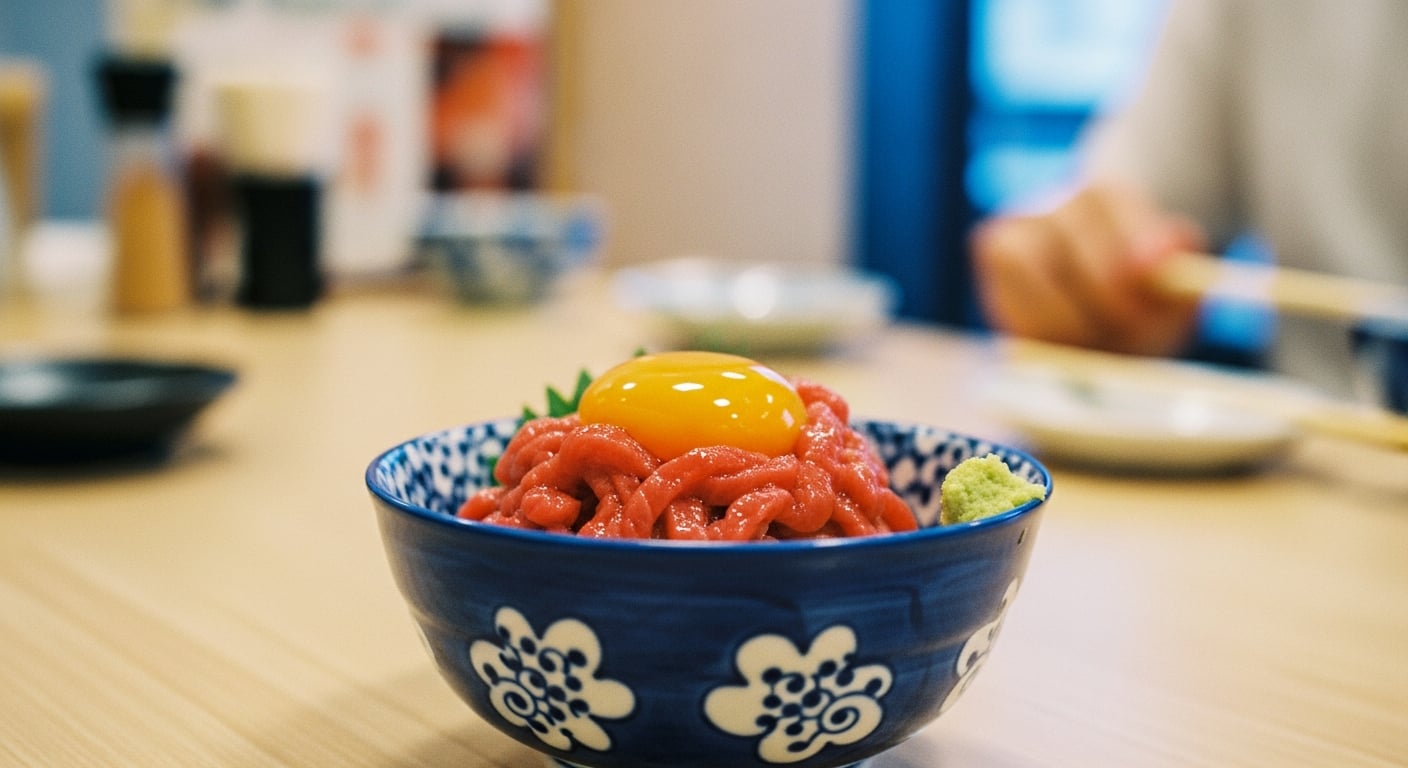
- Separate the raw Nagoya Cochin egg — white into the miso soup, yolk atop the beef
- Taste the wagyu on its own first, appreciating the rare texture and the distinctive character of Aichi-raised beef
- Mix the golden yolk with the beef for a silkier, richer bite
- Add the complimentary condiments — pickled ginger, dried nori seaweed, chirimen jako, and Itadaki's original 8-spice blend — to explore new layers of flavor
- Finish with wasabi for a clean, refreshing final note
This guide exists because rare wagyu gyudon is genuinely unlike anything most visitors have encountered before. Without context, even a beautifully presented bowl can feel puzzling. With the five-step guide, the experience unfolds exactly as intended — a culinary journey, not just a meal.
One guest recently put it simply: "The five-step eating guide made the dish even more enjoyable and memorable." That's precisely what it was designed to do.
✓ Key Takeaways
- Itadaki offers a fully printed multilingual menu in English, Simplified Chinese, and Korean — with photos, prices, and ingredient descriptions
- The "How to Enjoy Rare Gyudon" five-step visual guide is included in the menu, showing exactly how to eat the dish for the full experience
- Language anxiety is one of the most common reasons foreign visitors skip authentic local restaurants — at Itadaki, it's been systematically removed
What Happens at the Table
The menu handles the ordering. But what about the experience itself?
Itadaki is an 18-seat restaurant with counter seats, cozy sofa tables for two, and a larger sofa table that fits up to five people. The atmosphere is relaxed — the kind of lunch spot where you can take your time, look around, ask questions, and not feel rushed. Staff are welcoming to international guests, and while not every team member speaks fluent English, communication has never been the barrier it might be elsewhere.
Translation apps work comfortably here. Point-and-order works seamlessly with the multilingual menu. And if you have questions about ingredients or allergens — the menu notes that soy is present in the soy sauce and miso, wheat in the soy sauce, and egg comes standard with every bowl (removable at -¥150 if needed) — you can ask using your phone without any awkwardness.
The goal was never to create a tourist-facing performance of Japanese hospitality. It was to ensure that anyone sitting at one of these tables — whether from Tokyo, Hong Kong, Sydney, or São Paulo — could focus entirely on what's in front of them: a bowl of something genuinely rare, prepared by a team that cares deeply about every ingredient.
"The rare wagyu was unlike anything I've ever tasted — a life-changing culinary experience."
— A guest at Itadaki
That kind of reaction doesn't happen by accident. It happens when the guest is comfortable enough to be fully present — not distracted by confusion, not anxious about ordering incorrectly, not wondering what they've just been served. The English menu, the five-step guide, and the warm welcome from the team all work together to create the conditions for exactly that moment.
The Warlords Would Have Approved
There's something quietly poetic about the setting. Osu has been a center of Nagoya's commercial and cultural life for over 400 years — a neighborhood that Oda Nobunaga himself would have known, in a city that shaped the course of Japanese history. Today, Osu Kannon Temple still anchors the district, and the shopping street that winds around it has evolved from Edo-period merchant stalls into one of Japan's most eclectic urban destinations.
Itadaki sits in this neighborhood not as a tourist attraction, but as a specialty restaurant doing one thing with extraordinary focus: serving the world's only Rare Wagyu Gyudon, using ingredients sourced entirely from Aichi Prefecture — from Horai Wagyu raised in Okumikawa on sake lees from the Horaisen brewery, to the Aichi no Kaori rice in the bowl, to the white soy sauce from Hekinan that forms the base of our signature magic sauce.
None of that story requires you to speak Japanese to appreciate it. The menu tells it. The five-step guide unlocks it. And the bowl itself delivers it.
If you're planning a day in Nagoya — whether you're arriving from the direction of Shirakawa-go, coming in from Tokyo on the Shinkansen, or simply spending an afternoon in Osu before heading to Nagoya Castle — a lunch here is worth building your afternoon around. The restaurant is a 4-minute walk from Yabacho Station Exit 4 on the Meijo Subway Line, and open for lunch on Saturdays, Sundays, Mondays, and Tuesdays (11:00–15:00), with earlier opening at 9:00 on public holidays.
For Horai Wagyu — limited to just 10 bowls per day due to the extreme rarity of the beef (300 heads raised annually across only 3 farms in Japan) — a reservation via Tabelog is strongly recommended. When booking, paste 鳳来牛希望 into the notes field to request the Horai Wagyu. For walk-in visits, Mikawa Beef Rare Gyudon is always available and prepared with the same proprietary two-stage cooking technique.
For our complete menu, access details, and store information, visit our official page at https://itadaki8.com/english/
When you're ready to secure your bowl, we'd love to have you. Reserve Your Rare Wagyu Experience — and come discover what Nagoya has been quietly perfecting.
And since our business calendar is updated monthly with any schedule changes or special announcements, it's worth a quick check before your visit: Check Our Monthly Schedule on Instagram.
The warlords built their legacies in this city by refusing to accept that things had to stay the way they were. A beef bowl, in their spirit, didn't have to stay humble. Come see what it became.