Where Locals Eat Lunch Before Their Hida Region Journey
 gotowp
A few weeks ago, a couple came in just as we opened at 11:00. They had rolling suitcases with them — the compact kind that travelers learn to pack when they know they'll be moving between cities. Before they even sat down, one of them looked up from their phone and said, "We're heading to Shirakawa-go this afternoon. Someone on Reddit said we should stop here first."
That's a sentence I hear more often than you might expect. And honestly, it captures something I've always believed about Nagoya — it's not a city you pass through. It's a city that, once you actually stop and pay attention, quietly becomes the most memorable part of your itinerary.
I'm Masayuki Goto, founder of Itadaki in Osu, Nagoya. We specialize in one thing: Rare Wagyu Gyudon, a culinary concept I developed here from scratch, using ingredients sourced exclusively from Aichi Prefecture. This article is for travelers heading into the Hida region — Shirakawa-go, Takayama, Gero Onsen — who want to make their Nagoya stopover genuinely worth the time.
こんな方におすすめ
- ✅ Travelers planning a day trip or overnight stay in Shirakawa-go or Takayama from Nagoya
- ✅ Visitors who want a meaningful, story-worthy lunch before heading into the Hida mountains
- ✅ Wagyu enthusiasts curious about rare beef varieties beyond the famous brands
- ✅ Repeat visitors to Japan seeking local discoveries off the Golden Route
- ✅ Anyone who wants their Nagoya stopover to feel like more than just a transit connection

The Moment Before a Great Journey Deserves a Great Meal
There's a rhythm to Japan travel that experienced visitors understand. The best days are the ones where the morning or early afternoon is thoughtfully anchored — before the bus ride, the train platform, the mountain road. You eat something that grounds you, something you'll still be thinking about when you're standing in front of a 300-year-old gassho-zukuri farmhouse in the snow.
The Hida region is extraordinary. Shirakawa-go, designated as a UNESCO World Heritage Site, is one of those places that photographs can't fully prepare you for. Takayama's preserved merchant district feels suspended in time. These destinations more than earn the journey. But here's what most travel itineraries miss: Nagoya, your departure point, is sitting on some of Japan's most exceptional ingredients — and most travelers blow straight past them.
Before I opened Itadaki in April 2022, I spent years asking myself a question that kept nagging at me: every major Japanese dish had its premium version — kaisendon, katsudon, oyakodon. But gyudon, the beloved beef bowl, had never been elevated. It was chain restaurant territory. Why hadn't anyone made the world's first truly premium gyudon, using rare wagyu, rare-style preparation, and local craftsmanship?
That question is what Itadaki became.
Before Itadaki: What Most Visitors Experience on Their Way Out of Nagoya
Here's what a typical pre-Shirakawa-go morning looks like for most international travelers: wake up at the hotel near Nagoya Station, grab something quick at a convenience store or a chain coffee shop, rush to the bus terminal at Meitetsu Bus Center, and spend the 2.5-hour ride wondering if you should have eaten a real breakfast.
They're leaving one of Japan's most underrated food cities with a convenience store onigiri in their stomach. And they don't even know what they've missed.
This isn't a criticism — it's simply a matter of information. Nagoya's food culture is deep and specific. Hatcho miso from Okazaki. White soy sauce from Hekinan. Atsumi pickles from the peninsula. Nagoya Cochin eggs. And hidden within all of this, Horai Wagyu — a Japanese black wagyu produced in the Okumikawa mountains of Aichi Prefecture, raised by just three farms, with only 300 heads produced annually across the entire country. In a nation of approximately 500,000 wagyu cattle, Horai Wagyu represents something genuinely rare.
Most travelers heading to Hida have no idea this exists. Until they stop at Itadaki.
After Itadaki: What the Journey Feels Like When You Begin It Right
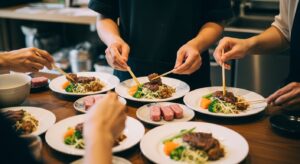
The couple with the rolling suitcases ordered the Shinkoccho — our standard Horai Wagyu Rare Gyudon, 100g of beef over Aichi no Kaori rice, with a Nagoya Cochin egg, miso soup made with Hatcho miso from Okazaki, and Atsumi Ichō-zuke pickles on the side.
Following the five-step guide printed on our multilingual menu, they separated the egg yolk, placed it atop the wagyu, and tried the beef in its purest form first. The reaction was quiet — the kind of quiet that means something. Not the performative surprise you sometimes see. Just a moment of genuine stillness, followed by: "What is this beef again?"
Horai Wagyu is fed on the sake lees of Horaisen Sora — a premium sake brewed in the same mountain region where the cattle are raised. This creates a distinctive fat profile: the marbling is lighter than many wagyu breeds, but the flavor carries a depth that's genuinely its own. It doesn't taste like Kobe. It doesn't taste like Matsusaka. It tastes like Okumikawa, like the mountains of Aichi.
Our proprietary two-stage cooking technique heats the beef to over 70°C at the core — fully meeting Japan's Ministry of Health, Labour and Welfare food safety standards — while preserving the silky, rare-style texture that makes the experience so memorable. It's a technical achievement that took significant development to get right. The result is a bowl that is simultaneously safe, extraordinary, and unlike anything served anywhere else.
When those guests finished their lunch and stood to leave, the suitcases still beside them, one of them said: "I'm going to think about this in Shirakawa-go." I don't think they meant it as a compliment to us specifically. They meant the whole morning had shifted — the texture of the day had changed because of how they'd started it.
"Perfect lunch during our Nagoya stay before our Shirakawa-go trip the following day."
Guest review
"I've had Kobe beef and Matsusaka beef, but Horai Wagyu at Itadaki was on another level."
Guest review
✓ ここまでのポイント
- Itadaki is a natural and deeply rewarding lunch stop for travelers heading from Nagoya into the Hida region — Shirakawa-go, Takayama, and beyond.
- Horai Wagyu, produced by only 3 farms in Aichi with 300 heads annually, is one of Japan's rarest wagyu breeds — and most Hida-bound travelers pass it without ever knowing it exists.
- The before-and-after is simple: a forgettable transit meal versus a lunch that becomes part of the story of your Japan trip.
Practical Notes for Hida-Bound Travelers
Itadaki is located in the Osu district of Naka-ku, Nagoya — a 4-minute walk from Yabacho Station Exit 4 on the Meijo Subway Line. From Nagoya Station, take the Higashiyama Line to Sakae, transfer to the Meijo Line, and get off at Yabacho. The whole journey takes about 10 minutes, and the neighborhood itself — Osu's lively mix of centuries-old temples, vintage electronics shops, and independent cafés — is worth arriving early to explore.
We serve lunch only, from 11:00 on our scheduled business days (Saturday, Sunday, Monday, and Tuesday). Buses to Shirakawa-go from Meitetsu Bus Center typically depart mid-morning, so arriving at Itadaki right at 11:00 opening and finishing by 12:00 leaves plenty of time to reach the bus terminal comfortably.
A few things worth knowing before you come:
- Horai Wagyu is strictly limited to 10 bowls per day. If this is the dish you've come for, I genuinely recommend reserving in advance via Tabelog. When you book, add "Horai Wagyu request" (鳳来牛希望) in the notes field. Reservations can be made in English on the Tabelog platform.
- If you're walking in without a reservation, arriving at 11:00 is your best chance. Our Mikawa Beef Rare Gyudon is always available and prepared with the same two-stage cooking technique — a wonderful dish in its own right.
- Our menu is fully available in English, with photos, prices, and a visual five-step guide for enjoying the dish. No Japanese required.
- Business days vary monthly. Please check our Instagram before your visit to confirm we're open on your travel date — irregular closures do occasionally happen.
A Meal That Becomes Part of Your Journey's Story
I've been in the hospitality industry for 18 years, and I've watched Nagoya go from a city that travelers skipped to a city that repeat visitors specifically return to. Part of that shift is the Hida region — as more international travelers discover Shirakawa-go and Takayama, Nagoya becomes unavoidable as a gateway. But the city rewards those who stop, look carefully, and eat with intention.
The name Itadaki comes from "itadakimasu" — the expression of gratitude spoken before every meal in Japan. It's a philosophy, not just a word. Food is a gift from the farmers who raise it, the land that sustains it, and the craft that prepares it. Every bowl we serve carries that understanding.
Whether you're heading to Shirakawa-go tomorrow morning, planning a day trip to Takayama, or simply spending a day in Nagoya before moving on — we'd be glad to be part of that story. A journey into the Hida mountains deserves a beginning that matches it.
We'll see you at 11:00.
For our complete menu, access details, and store information, visit our official page at https://itadaki8.com/english/
Ready to reserve your spot? Horai Wagyu is limited to 10 bowls per day — Reserve Your Rare Wagyu Experience and secure your bowl before your Hida region departure.
Not sure which day we're open during your travel dates? Check Our Monthly Schedule on Instagram — we post our business calendar there every month.