Nagoya MICE Lunch vs Tokyo Conference Dining: A Value Comparison
 gotowp
Here's a number that might surprise you: according to Japan Tourism Agency data, Nagoya ranks among the top cities in Japan for MICE (Meetings, Incentives, Conferences, and Exhibitions) events — yet surveys consistently show that business travelers arriving in Nagoya still default to Tokyo habits when it comes to lunch. They choose the familiar. They play it safe. And then, somewhere between the conference hall and the airport, they realize they have almost nothing to post.
Tokyo is extraordinary. But when every attendee at your international conference has already photographed the same tonkatsu set and the same department store bento, "lunch in Tokyo" stops being a story. It becomes a caption.
This piece is for business travelers who are already heading to Nagoya for a conference, a MICE event, or a technical visit — and who want to use their lunch break to create something genuinely worth sharing. Not because the food is cheaper here, or because the queues are shorter (though both are often true), but because Nagoya offers culinary concepts that simply don't exist anywhere else in Japan.
Who This Is For
- ✅ Business travelers attending conferences or MICE events in Nagoya who want a lunch that doubles as a memorable experience
- ✅ Repeat Japan visitors who have "done" Tokyo dining and are ready for something genuinely new
- ✅ Conference attendees looking for a lunch spot with a shareable story — not just a meal
- ✅ Anyone planning a Nagoya stay around the 2026 Asian Games or other major events who wants to maximize their time between sessions
- ✅ Foodies who believe the best travel content comes from discoveries, not itineraries
What Tokyo Conference Dining Actually Looks Like
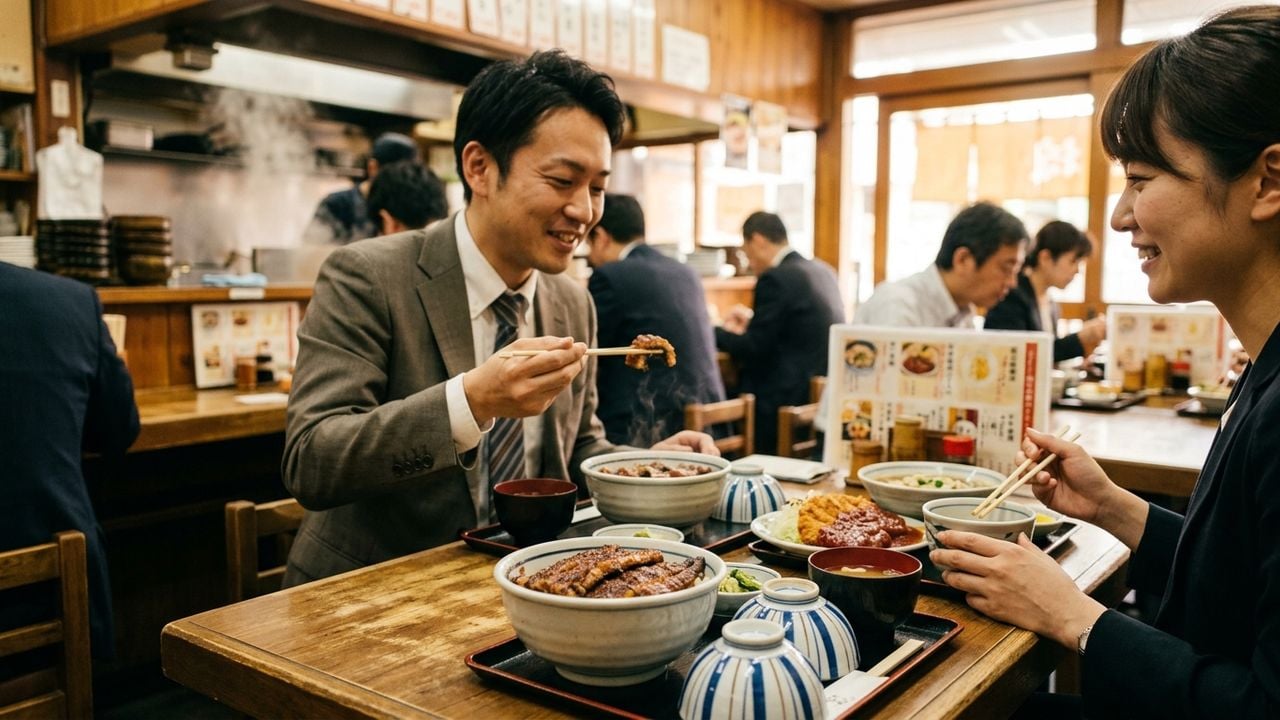
Let's be honest about the Tokyo MICE lunch experience. The food is excellent — nobody disputes that. But the conditions around it are a specific kind of stressful.
Conference venues in Tokyo's major business districts — Shinjuku, Marunouchi, Odaiba, Makuhari — tend to funnel hundreds of attendees toward the same cluster of restaurants during a 60 to 90-minute break. Lines form. Decisions get rushed. You end up somewhere that was fine, eat something that was good, and take a photo that looks like everyone else's photo from every other Tokyo conference they've attended.
There's nothing wrong with that lunch. But it doesn't give you a story.
What it gives you is a meal — functional, reliable, forgettable in the best possible way. For many business travelers, that's exactly what they want. But for those who measure a work trip partly by what it gave them to talk about afterward, Tokyo's density works against the discovery impulse. The signal-to-noise ratio on "great lunch in Tokyo" is simply very high. Standing out requires real effort.
If you're already thinking about how to fit a lunch like this into a conference schedule, the next practical question is whether the date you're in Nagoya actually falls on a business day. Itadaki operates on a scheduled calendar that changes monthly, and the most current version lives on Instagram. A quick check before you plan takes less than a minute.
What Nagoya MICE Dining Offers That Tokyo Cannot Replicate
Nagoya's conference infrastructure has matured significantly in recent years. The venues are world-class, the transport links are exceptional (Nagoya Station connects directly to both Shinkansen and multiple subway lines), and the lunch options near major conference districts are genuinely underexplored by international attendees.
But the more interesting comparison isn't logistical — it's conceptual.
Tokyo dining is deep and diverse, but it's also extensively documented. Every exceptional restaurant in Tokyo has been photographed, reviewed, and recommended hundreds of thousands of times. The genuine discoveries are increasingly difficult to find, and when you do find one, the queue tells you everyone else already found it too.
Nagoya, by contrast, still has culinary concepts that are genuinely novel — not just "hidden gems" in the sense of being under-marketed, but novel in the sense of having been invented here and existing nowhere else. The difference between Nagoya and Tokyo business lunch culture runs deeper than price or portion size. It's a difference in how discovery feels.
Osu district — a short subway ride from Nagoya's main conference areas — is a particularly good example. It combines 400-plus years of shopping street history with a live subculture scene, and it contains restaurants built around concepts that have never existed in Japanese culinary tradition before.
✓ Key Takeaways
- Tokyo conference dining is reliable and high-quality, but the discovery experience is increasingly crowded — finding a genuinely new story requires significant effort.
- Nagoya MICE attendees have shorter distances to travel between venues and lunch destinations, and access to culinary concepts that cannot be found in Tokyo.
- The most shareable travel content comes from experiences that combine visual impact with a narrative nobody in your network has posted before.
Horai Wagyu — the ultra-rare beef at the center of this comparison — is capped at 10 bowls per day, and MICE season in Nagoya means competition for those bowls is real. Securing your bowl before the conference lunch rush is exactly what the Tabelog reservation is designed for. The process takes a few minutes online.
The Lunch That Becomes the Story of Your Trip
There's a specific kind of travel content that performs differently from standard food posts. It's not just "beautiful dish in a nice restaurant." It's the post where your followers stop scrolling and type: "Wait — what is that?"
That reaction requires two things simultaneously: visual impact and a story so unusual that the image alone raises questions. A marbled beef arrangement on premium Japanese rice, topped with a golden egg yolk and served in a traditional ceramic bowl — that image raises questions. And the story behind it raises more.
At Itadaki in Osu, Nagoya's founder Masayuki Goto created a culinary concept in 2022 that had never existed before: the Rare Wagyu Gyudon. Japan has premium versions of katsudon, oyakodon, and kaisendon. Gyudon — the beef bowl — had always been positioned as everyday fast food. Goto asked why that should be the case, and then spent years answering that question through a proprietary two-stage cooking technique that brings the beef to over 70°C at the core (fully meeting Japan's food safety standards) while preserving the texture of rare-style wagyu.
Every ingredient comes from Aichi Prefecture. The most exclusive option — Horai Wagyu from Okumikawa — is produced by only three farms in Japan, with just 300 heads raised annually. To put that in perspective: there are approximately 500,000 wagyu cattle in Japan. Horai Wagyu represents 300 of them. The cattle are fed on sake lees from Horaisen Sora, a renowned local premium sake, which contributes to a flavor profile that is genuinely distinct from better-known wagyu brands.
This is not a dish you can eat in Tokyo. It is not a dish you can eat anywhere else in Nagoya. It exists only here, only at lunch, and only in limited quantities — Horai Wagyu is capped at 10 bowls per day.
"I traveled to Nagoya specifically to eat here — it was 100% worth it."
— Guest review
That's the difference between a Tokyo conference lunch and a Nagoya MICE lunch done right. One feeds you. The other gives you the sentence you'll say for years: "I traveled specifically for this."
The five-step eating guide that comes with the dish — separating the egg yolk, tasting the wagyu pure, then layering condiments including pickled ginger, dried nori from Mikawa Bay, and Itadaki's original 8-spice blend — turns the meal into a deliberate ritual rather than a passive experience. That ritual is what makes the photos mean something beyond the visual. When your followers ask what they're looking at, you have ten minutes of story ready.
For more on how conference visitors in Nagoya have been incorporating Itadaki into their professional schedules, the experience of making Itadaki a regular conference lunch in Nagoya offers a useful reference point.
Practical Comparison: Logistics for MICE Attendees
For business travelers making a genuine comparison, logistics matter as much as the meal itself. Here's how the two cities compare on the variables that MICE attendees actually care about during a lunch break.
Travel time from venue to restaurant: Nagoya's conference venues are compact relative to Tokyo's spread. From Nagoya Station or Sakae-area venues, Itadaki in Osu is reachable in under 15 minutes by subway (Higashiyama Line to Sakae, transfer to Meijo Line, exit at Yabacho, 4-minute walk from Exit 4). Tokyo equivalents often require 20 to 35 minutes each way from major conference zones to discovery-level restaurants.
Queue reality: Horai Wagyu is limited to 10 bowls per day, which means a reservation via Tabelog is genuinely recommended — not as a marketing device, but as practical advice. The Mikawa Beef version (from ¥1,800) is always available and requires no advance booking for walk-in guests. Either way, the seated experience at Itadaki — 18 seats, sofa-style table seating — is designed for a relaxed pace, not a rushed turnover.
English support: Printed menus in English are available, and the photographic five-step guide is designed specifically for international guests. For business travelers accompanying non-Japanese-speaking clients or colleagues, this removes the friction that can make restaurant selection stressful during a busy conference day.
Operating hours: Itadaki serves lunch only, Tuesday through Saturday (10:00–15:00 on weekdays, with last order 30 minutes before closing). Please check the monthly schedule on Instagram before visiting, as the restaurant operates on scheduled business days and irregular closures may apply. For conference attendees with predictable lunch windows, this model fits well — but it does require a few minutes of advance planning.
Payment: Credit cards and electronic payments are accepted. No cash-only friction for international travelers.
The question of where to have business lunch during a Nagoya conference has a longer answer than any single article can give — but Osu, and specifically Itadaki, consistently comes up among attendees who prioritize experience over convenience.
Which City Wins for MICE Lunch? The Honest Answer
The honest answer is that they're not competing for the same thing.
Tokyo wins on density, variety, and the reassurance that comes from choosing something that has been vetted a thousand times. If your goal is a reliable, high-quality lunch with minimal decision fatigue, Tokyo's conference district restaurants deliver that every time.
Nagoya wins on discovery, story, and the specific experience of eating something that cannot be eaten anywhere else. If your goal is to leave your conference with a meal that becomes part of your Japan narrative — something you'll reference in conversations, post about because it genuinely warrants it, and recommend to the next colleague traveling to Central Japan — Nagoya's underexplored culinary scene is the stronger choice.
The 2026 Asian Games and Asian Para Games are bringing a significant international audience to Nagoya this autumn. Many of those visitors will arrive with a Tokyo comparison already in mind. The ones who use their lunch breaks to explore Osu will leave with something the others won't: a story that starts with "I went to Nagoya, and you won't believe what I found."
That story is worth planning for.
For our complete menu, access details, and store information, visit our official page at https://itadaki8.com/english/
You've read the comparison — Tokyo lunch is reliable, Nagoya lunch is the story you'll still be telling. The only thing left between you and that story is a reservation for one of the 10 daily Horai Wagyu bowls. Book your spot now before your conference dates fill the calendar.