Guest Story: A Kimono Photo Session Ending With Rare Wagyu Bowl
 gotowp
September in Nagoya carries a particular kind of energy. The summer heat is just beginning to soften, and the streets of Osu fill with visitors who've arrived not because a guidebook told them to, but because someone — a friend, a fellow traveler, a chance recommendation — pointed them here and said, trust me on this one.
That's the kind of guest I love most, honestly. The ones who show up with curiosity instead of a checklist.
I'm Masayuki Goto, founder of Itadaki. We've been open in Osu since April 2022, and if you'd told me back then that kimono-clad visitors would become one of our most beloved guest groups, I'd have smiled and nodded — because it makes perfect sense. Osu is exactly that kind of neighborhood. A place where old and new live comfortably side by side, where a 400-year-old temple stands a few minutes from a vintage anime shop, and where someone in a rented furisode can walk into a rare wagyu specialty restaurant and feel completely at home.
Let me walk you through what a typical day looks like at Itadaki — and how a kimono photo morning often ends with a bowl that guests say they're still thinking about weeks later.
Who This Is For
- ✅ Repeat visitors to Japan looking for authentic discoveries beyond Tokyo, Kyoto, and Osaka
- ✅ Travelers planning a kimono photo experience in Osu and wondering what to do next
- ✅ Anyone searching for a restaurant that locals actually eat at — not one built for tourist traffic
- ✅ Visitors curious about rare-style wagyu and whether it's safe to eat
- ✅ Guests who want a story to bring home, not just another meal
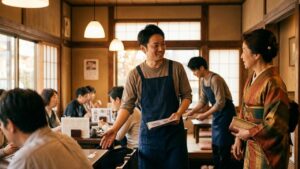
Before the Doors Open: The Quiet Hour That Defines Everything
We open at 11:00 on our business days — Saturdays, Sundays, Mondays, and Tuesdays — but the real work starts well before that.
My first task every morning is the beef. Horai Wagyu, produced by only three farms in Aichi Prefecture with just 300 heads raised annually, doesn't forgive carelessness. It's fed on the sake lees of Horaisen Sora — a local premium sake from Okumikawa — which gives the meat a flavor profile you genuinely cannot find anywhere else in Japan. Out of approximately 500,000 wagyu raised annually across the country, only 300 are Horai. That's not a marketing story. That's just the reality of what we source.
I portion the day's allocation carefully. We limit Horai Wagyu to 10 bowls per day — not as an artificial scarcity tactic, but because that's what our direct-supply relationship with the farms allows us to offer fresh and at the standard we refuse to compromise on.
The rice goes in next. We use Aichi no Kaori, a premium brand rice grown right here in Aichi, and the cooker settings are adjusted seasonally to match each harvest's moisture level. It sounds obsessive, I know. But rice is half the bowl. It deserves the same attention as the wagyu.
While the kitchen comes to life, I do a quiet check of the condiment stations. The pickled ginger from Kimura Farm in Inazawa. The chopped seaweed from Himakajima island in Mikawa Bay. The chirimen jako from Minamichita. Every item on that table tells a small story about Aichi Prefecture. I like that guests can reach for any of them without being told to — that the table itself becomes a form of exploration.
If Horai Wagyu is limited to 10 bowls a day, the last thing you want is to climb those stairs and find it sold out. Our monthly business calendar — including irregular closures — is posted on Instagram before each month begins. A quick check before your visit takes less than a minute.
Mid-Morning: The Kimono Guests Arrive
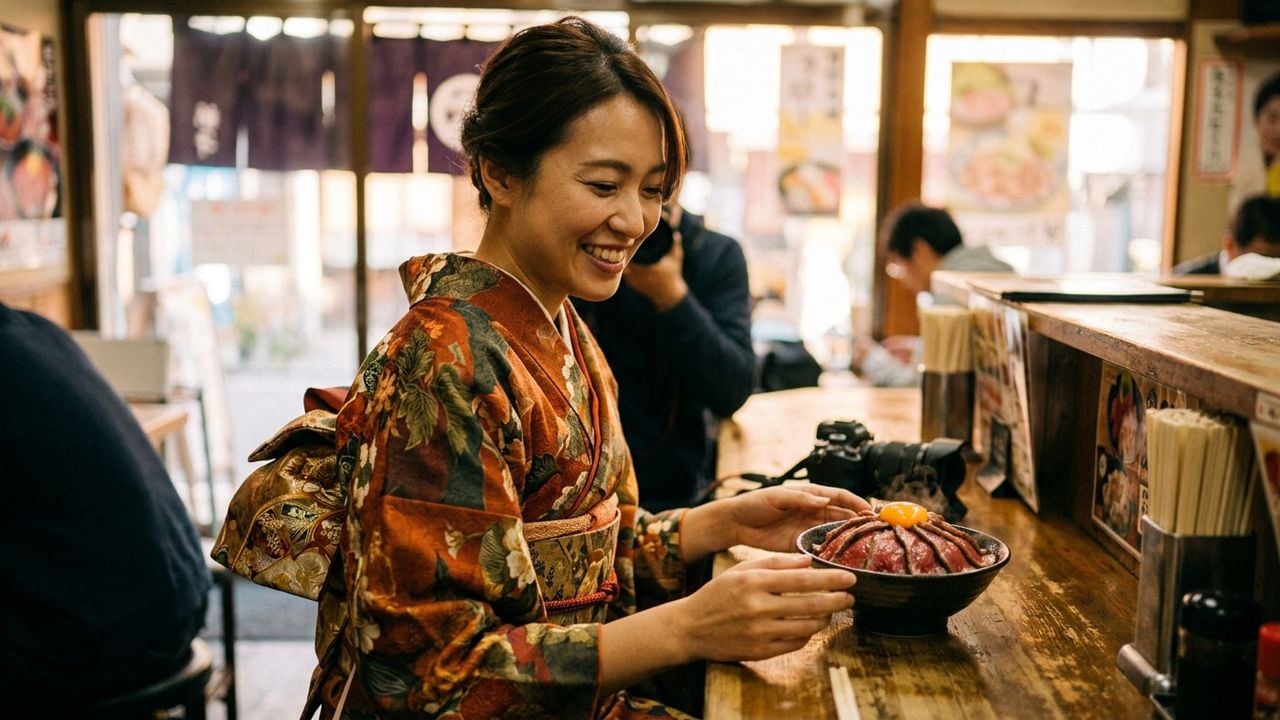
By 11:30, Osu is already busy. On weekends especially, I'll spot guests in kimono walking past our second-floor window on their way back from Osu Kannon Temple or the shopping street below. Many of them have rented their kimono that morning from one of the shops nearby, spent a couple of hours photographing, and are now looking for somewhere to sit down that feels like a genuine extension of the experience — not a chain restaurant, not a tourist trap.
Some of them find us through Google Maps. A few are guided here by a Japanese friend. Occasionally, someone walks up the stairs simply because they noticed the entrance and something about it felt right.
That's my favorite kind of discovery. The unplanned ones.
When a guest in kimono steps into Itadaki for the first time, I watch their expression shift. The space is small — 18 seats, sofa-style table seating, counter seats along one wall. It doesn't look like a restaurant trying to impress anyone. It looks like a place that knows exactly what it does and does it well. For a certain kind of traveler, that's immediately reassuring.
We hand them our printed menu. English, Simplified Chinese, Korean — all available. We also walk every first-time guest through our five-step eating guide, because the Rare Wagyu Gyudon isn't something you just eat top-to-bottom. It unfolds. You start by separating the Nagoya Cochin egg — the white goes into the miso soup, the yolk rests on the beef. You taste the wagyu first, undressed, to appreciate what the Horai breed actually tastes like. Then you let the yolk change it. Then the condiments. Then, finally, wasabi. It's a sequence, not a bowl.
For guests who've spent years ticking wagyu brands off a list — Kobe, Matsusaka, Omi — this often lands differently than they expected. Read how one wagyu enthusiast described their first Rare Gyudon experience here.
✓ Key Takeaways
- Horai Wagyu is limited to 10 bowls per day — arriving before noon on weekends significantly increases your chances of securing one.
- Itadaki's five-step eating guide transforms the bowl from a single dish into a progressive tasting experience designed to be savored slowly.
- Every ingredient on the table — from the pickled ginger to the chirimen jako — comes from Aichi Prefecture, making this as much a regional food journey as a meal.
You've just read that Horai Wagyu sells out on busy days — and September weekends in Osu are exactly that. Reserving your bowl via Tabelog is the one step that turns a hoped-for discovery into a confirmed one. The reservation system is in Japanese, but the process is straightforward.
"The lunch was the highlight of my Nagoya trip — I'm telling all my friends about it."
— Guest review
The Question I Get Most Often: Is Rare Wagyu Safe?
Almost every first-time guest asks. And I always welcome the question, because it's the right one to ask.
When I developed the concept for Itadaki before we opened in 2022, this was the challenge I spent the most time on. I wanted to create a gyudon with a rare-style texture — the kind of mouthfeel that makes wagyu remarkable at its finest. But I'm a Certified Food Sanitation Supervisor, and I hold a licensed restaurant operator certification from the Aichi Prefecture Public Health Center. I wasn't going to serve anything that compromised safety to chase a sensation.
What we developed is a proprietary two-stage cooking technique. Without giving away the details, it heats the beef to over 70°C at the core — fully satisfying Japan's Ministry of Health, Labour and Welfare food safety standards — while preserving the soft, yielding texture that makes rare wagyu what it is. It took time to get right. It's difficult to replicate. And it's the reason the dish works.
If you've avoided rare-style preparations in the past out of caution, I understand. But at Itadaki, the rarity is in the flavor and the craft, not in cutting corners.
The Hidden Gem Question — And Why Osu Is the Answer
There's a particular kind of repeat Japan visitor I've come to know well over the past four years. They've done Tokyo. They've done Kyoto. They've eaten at places recommended by every English-language travel guide ever published. And now they're asking a different question: Where do people in Japan actually eat?
The honest answer, at least in Nagoya, is: not in the places those guides describe.
Osu is where Nagoyans come to browse, eat, wander, and feel at ease. It has 400 years of history layered under a neighborhood that embraces subculture, street food, temple visits, and vintage electronics in the same afternoon. It's also, notably, not the Osu that most English guidebooks describe — because most English guidebooks haven't caught up to what it actually is.
Itadaki opened here specifically because of that. I wanted to be in a neighborhood where guests arrived with openness, not expectations. Where a meal could feel like a genuine discovery rather than a scheduled stop.
When kimono-dressed visitors come up those stairs after a morning of photo sessions — having just passed Osu Kannon Temple, having just browsed the shopping street — they're already in the right headspace. They've spent the morning doing something that slows you down, that asks you to pay attention to details. The bowl that follows that morning fits perfectly. See why kimono rental guests repeatedly find their way to Osu's rare wagyu restaurant.
And when they leave, they tell their friends. Not because I asked them to. Because finding something that feels genuinely off the tourist map — something you can call your own discovery — is the whole point of coming back to Japan for the eighth, ninth, tenth time.
Wrapping Up the Day
Last order at Itadaki is 30 minutes before closing — 14:30 on regular business days, 14:30 on public holidays (when we open earlier, at 9:00). By the time the final bowl goes out, the condiment stations are cleaned, the rice cooker settings are logged for the next day, and I'm usually thinking about what I want to adjust, improve, or simply observe more carefully tomorrow.
It's a short service window — lunch only, four days a week. That's intentional. A small kitchen running a limited menu at the highest standard it can manage, sourcing from farms I know and trust, preparing each bowl the way it's meant to be prepared. That's what Itadaki is.
If you're planning a Nagoya visit and want to add a stop that the guidebooks haven't caught up to yet, the Osu district is where to start — and a rare wagyu bowl is a very good reason to make the walk up the stairs. If Horai Wagyu is on your list, I'd recommend reserving in advance via Tabelog; the 10-bowl daily limit does sell out on busy days, especially weekends. You can also check our monthly schedule on Instagram before you come — we occasionally have irregular closures, and I'd rather you know before making the trip.
For our complete menu, access details, and store information, visit our official page at https://itadaki8.com/english/
A kimono morning in Osu followed by a rare wagyu bowl that becomes the highlight of your Japan trip — that's a story worth securing in advance. With only 10 Horai Wagyu bowls available each day, a Tabelog reservation is the simplest way to make sure the bowl is waiting for you when you arrive.