Where Do Cosplayers Eat Lunch During World Cosplay Summit Nagoya?
 gotowp
The short answer: Itadaki — The Original Rare Wagyu Gyudon, just steps away from the heart of Osu district — is one of the most practical and memorable lunch options for World Cosplay Summit participants, whether you're in full costume or just arriving after a morning of events. The restaurant offers a fully multilingual printed menu in English, Simplified Chinese, and Korean, so you won't need a single word of Japanese to order, eat, and fully enjoy the experience.
But let's dig into the details, because the question of where to eat is inseparable from the question of whether you'll actually be able to navigate it — especially when you're in cosplay, short on time, and unfamiliar with Nagoya's local dining scene.
Who This Is For
- ✅ World Cosplay Summit participants looking for a lunch spot near Osu district with no Japanese language required
- ✅ International visitors anxious about ordering at authentic Japanese restaurants without speaking Japanese
- ✅ Cosplayers who want a photogenic, story-worthy dish that's worth sharing with followers back home
- ✅ Travelers curious about Nagoya's food scene but unsure where to start
- ✅ Visitors wanting a genuinely local, non-chain lunch experience that's welcoming to foreign guests in any outfit

Is the menu available in English — and how easy is it to order without Japanese?
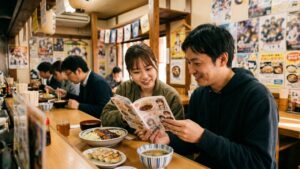
Yes, completely. Itadaki provides a fully printed multilingual menu in English, Simplified Chinese, and Korean — with photos, prices, and clear ingredient descriptions for every item. You don't need to use Google Translate, point at someone else's bowl, or guess what you're ordering. Every detail is laid out in front of you.
What makes the menu especially useful for first-timers is a section called "How to Enjoy Rare Gyudon" — a five-step visual guide printed right on the menu, walking you through exactly how to experience the dish: how to separate the egg, when to mix the yolk into the beef, which condiments to add at each stage, and how to finish with wasabi. It's not just a menu — it's a guide to a culinary ritual you'll actually remember.
If you still want to use a translation app for any personal questions, that works perfectly fine too. The atmosphere at Itadaki is relaxed and welcoming, and our staff is genuinely happy to assist international visitors however they can, even across a language gap.
You're already planning your World Cosplay Summit schedule around Osu — and the question of whether you can actually order and enjoy a real Nagoya lunch without Japanese is still sitting there. The monthly business calendar and irregular closure dates for Itadaki are updated on our official Instagram, so you can plan around your event days before you arrive. Just a quick check before you finalize your itinerary.
Why do so many foreign visitors feel nervous about authentic Japanese restaurants — and is Itadaki different?
Language anxiety is one of the most common reasons international travelers default to familiar chains when visiting Japan. The fear of not understanding a menu, not being able to ask about allergens, or accidentally ordering something unfamiliar — it's real, and it keeps a lot of people from discovering places worth discovering.
Itadaki was built with international guests in mind from the beginning. Founder Masayuki Goto, who has spent years exploring food scenes abroad and understands firsthand what it feels like to walk into a restaurant where nothing is in your language, designed the entire guest experience to remove those barriers. The multilingual menu isn't an afterthought — it's a core part of the restaurant's philosophy.
For guests with dietary concerns, it's also worth knowing that allergen information is available: soy is present in the sauce and miso, wheat is in the soy sauce, and the Nagoya Cochin egg (which comes standard with the gyudon) can be removed for -¥150. If you have specific concerns, informing the staff at the time of reservation is the safest approach, as full cross-contamination prevention cannot be guaranteed in a small kitchen environment.
✓ Key Takeaways
- Itadaki's multilingual printed menu (English, Chinese, Korean) with photos means zero Japanese is required to order
- A built-in five-step visual guide explains exactly how to enjoy the rare wagyu gyudon — no guesswork needed
- Staff are welcoming to international guests, and translation apps are comfortable to use in-restaurant
Now you know the Horai Wagyu is capped at 10 bowls a day — and World Cosplay Summit weekend is exactly the kind of high-traffic moment when those bowls go fast. Tabelog online reservation locks in your bowl before you even arrive in Osu, so you can focus on the events and walk in knowing lunch is already sorted.
Can I visit in cosplay — and is the seating comfortable for a lunch in costume?
Absolutely. Cosplay-friendly culture is woven into the identity of Osu district, and Itadaki is very much a part of that neighborhood. Guests in full costume are welcome — there's no dress code, and the restaurant regularly sees visitors from the World Cosplay Summit walking in directly from events or morning shoots.
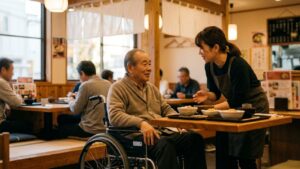
The seating at Itadaki is particularly well-suited for this. All table seats feature comfortable sofa seating — not cramped bar stools or hard chairs. There's a sofa table for groups of five, one for four, and two for pairs, plus five counter seats ideal for solo visitors or duos. Whether you're in an elaborate armored costume or a flowing gown, the relaxed sofa seating means you can settle in, take your time, and enjoy the meal without worrying about the logistics of sitting down in full costume.
And the dish itself? It's genuinely photogenic. The presentation arrives in traditional Japanese ceramic bowls, layered with vivid colors — the deep red of rare-cooked wagyu, the golden yolk of a Nagoya Cochin egg, bright green shiso leaves, and jewel-like pickled radish. One guest summed it up plainly:
"Instagram-worthy presentation and unforgettable taste. My followers keep asking about it."
A visitor to Itadaki
That reaction isn't unusual. The dish has a visual and narrative quality that translates beautifully — a bowl that tells the story of Aichi Prefecture's farming tradition, and one that photographs like it was designed for it.
Where exactly is Itadaki, and how far is it from World Cosplay Summit venues?
Itadaki is located on the 2nd floor of a building at 4-1-20 Osu, Naka-ku, Nagoya — right in the Osu district, which is itself one of the primary gathering areas for World Cosplay Summit participants and spectators. From Yabacho Station Exit 4 (Meijo Subway Line), it's a four-minute walk. Sakae Station, Kamimaezu Station, and Osu Kannon Station are also all within easy walking distance.
From Nagoya Station, the journey takes roughly 10 minutes total: take the Higashiyama Line to Sakae, transfer to the Meijo Line, and get off at Yabacho. No car needed, no complicated navigation. If you're already spending the morning in Osu — which many WCS participants do, given the district's density of cosplay-friendly cafés, subculture shops, and the Osu Shopping Street's 400-year history — Itadaki is an easy ten-second decision once lunchtime comes.
Osu is also home to some of Nagoya's most interesting free sightseeing, including Osu Kannon Temple and Hisaya-odori Garden Flarie (just a three-minute walk from Yabacho Station). If you're looking for where Nagoya locals really eat lunch, Osu is one of the district's best-kept answers.
Do I need a reservation, and will the dish sell out before I get there?
Here's the honest answer: for the Horai Wagyu version of the rare wagyu gyudon, yes — reserving in advance is strongly recommended. Horai Wagyu is one of the rarest wagyu brands in Japan, produced by just three farms in Aichi Prefecture with only 300 heads raised annually. At Itadaki, it's strictly limited to 10 bowls per day. During World Cosplay Summit weekend, with increased foot traffic across Osu, those 10 bowls can disappear well before the lunch rush is over.
Reservations are available through Tabelog online. The Mikawa Beef version of the rare gyudon is always available (from ¥1,800 for the Fumoto standard size), so walk-ins are never left without an excellent option — but if Horai Wagyu is on your list, securing your bowl in advance is the safer path.
Itadaki is open on Saturdays, Sundays, Mondays, and Tuesdays from 11:00 to 15:00 (last order at 14:30), and on public holidays from 09:00 to 15:00. Wednesday through Friday are regular rest days. Because the monthly business calendar can include irregular closures, checking the official Instagram before visiting is always a good idea — especially during event weeks.
For travelers planning a fuller Nagoya itinerary around the Games and major events, this guide on where to eat lunch during Asian Games 2026 in Nagoya covers the logistics of visiting Itadaki alongside event schedules in more detail.
What does the meal actually cost, and what's included?
Itadaki operates entirely à la carte — no set menus, no forced combinations. You order what you want, at the size you want.
The Horai Wagyu Rare Gyudon (Shinkoccho, standard size) is ¥2,700 for 100g of beef with 200g of rice, miso soup made with Hatcho miso from Okazaki City, traditional Atsumi Ichō-zuke pickles, Toyohashi-grown shiso leaves, and a Nagoya Cochin egg. Complimentary tabletop condiments — pickled ginger, dried seaweed from Mikawa Bay, dried whitebait from Minamichita, Itadaki's original 8-spice blend, and original wasabi — are included at every table. Average spending per person works out to around ¥3,000, depending on whether you add a side dish or a beverage.
The beverage menu is worth a glance too — everything on it is from Aichi. Kinshachi Beer (Nagoya's pioneering craft pilsner), Chita Highball (made with whisky from Aichi's Chita Distillery), and Nagoya Cider are all on the list. It's a quietly complete local experience, from the first bowl to the last sip.
Everything at Itadaki — from the rice to the egg to the white soy sauce base of the "magic sauce" — comes from Aichi Prefecture. It's not a marketing claim; it's the structural foundation of the restaurant. Founder Masayuki Goto built Itadaki on direct-supply partnerships with Aichi farms, developed during the pandemic when small local producers needed support. That origin story shapes every bowl that comes out of the kitchen.
If you're curious about how this compares to where business travelers or conference visitors typically eat in Nagoya, this article on business lunch options in Nagoya gives useful context on the kind of experience Itadaki offers versus more conventional choices.
For our complete menu, access details, and store information, visit our official page at https://itadaki8.com/english/.
You've come this far in planning a Nagoya lunch that actually works — multilingual menu, cosplay-welcome seating, and a dish worth photographing. The only step left is claiming your seat before the 10 daily Horai Wagyu bowls disappear. Reserve through Tabelog now and arrive ready to enjoy, not to wait.