Can Children Eat Rare Wagyu at Itadaki Safely?
 gotowp
You've been dreaming about this lunch since you started planning your Japan trip. You have a mental picture of the dish — marbled wagyu, a golden egg yolk, a ceramic bowl of Aichi rice — and you already know it's going to be the most photogenic meal you eat this entire journey. Then a small voice pipes up from behind the stroller: "I'm hungry too."
Travelling with children doesn't mean setting aside the experiences that matter most to you. But it does mean you need honest answers before you sit down. Is the rare-style preparation safe for kids? Will there be somewhere comfortable for a toddler to sit? Can a picky eater find something to enjoy? These are real questions, and they deserve real answers — not vague reassurances.
Below, we walk through every family-specific question we hear at Itadaki, so you can plan with complete confidence.
Who This Is For
- ✅ Families travelling in Nagoya with young children or infants who want to experience authentic local food
- ✅ Parents who have heard about Itadaki's rare wagyu and are wondering whether the preparation is appropriate for kids
- ✅ Travellers visiting Legoland Nagoya, Ghibli Park, or Nagoya Port Aquarium who are looking for a memorable family lunch in the city
- ✅ Anyone exploring the Osu district with children and wondering whether the restaurant is stroller-friendly and comfortable
- ✅ Foodies who want to document a genuinely unique Japan food experience — and happen to be bringing the whole family along
Is the rare-style wagyu at Itadaki safe for children to eat?
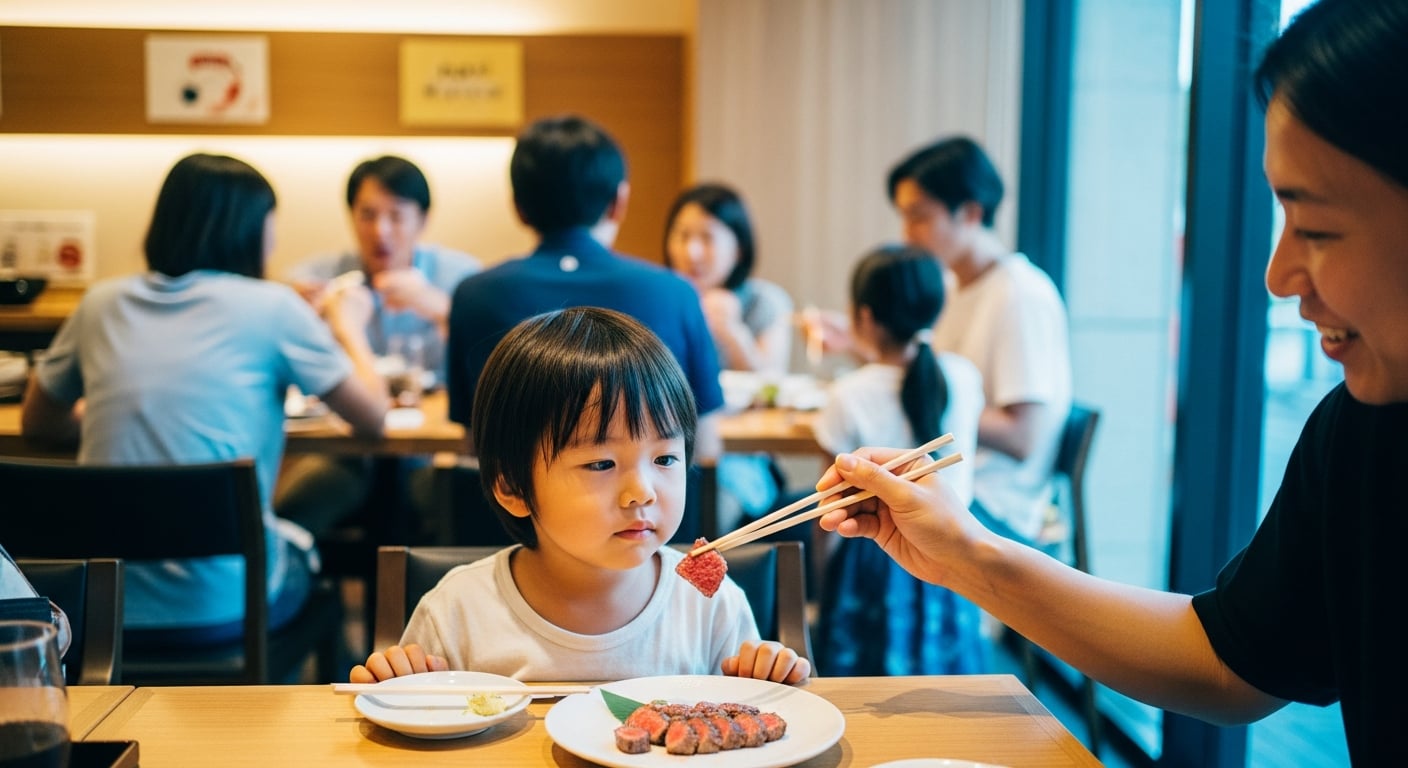
The short answer is: Itadaki's rare wagyu fully meets Japan's strict food safety standards — and that applies regardless of whether the guest is an adult or a child. Our proprietary two-stage cooking technique heats every portion of beef to over 70°C at the core, satisfying the requirements set by Japan's Ministry of Health, Labour and Welfare. The result looks and feels like rare beef, but it is not raw in the food-safety sense of the word. That distinction matters enormously.
For adults from Western countries, this is already a reassuring detail. For parents, it carries an extra layer of meaning: the same technique that makes Itadaki safe for a first-time wagyu visitor makes it safe for a child who is old enough to eat beef in general. We use only Aichi Prefecture's premium Horai Wagyu and Mikawa Beef, both raised under rigorous quality control by local farms we know personally.
That said, parents are always the best judges of their own children's dietary needs. If your child has a specific allergy or a medical condition that affects how they process beef, please factor that in when ordering. For the youngest diners who are not yet eating solid meat, our menu does not include a dedicated children's dish, but the Fumoto size of the Mikawa Beef Rare Gyudon (100g beef, 200g rice, ¥1,800) is a manageable portion that families often share with older children. The Nagoya Cochin egg that comes with every bowl can be removed at −¥150 if needed.
You're still weighing up whether the timing, the stroller logistics, and the rare wagyu question all line up for your family visit. Itadaki's business calendar includes occasional irregular closures that aren't listed on standard booking sites — the monthly schedule on our official Instagram is the only reliable way to confirm your date before you commit to the detour. Takes about thirty seconds to check.
What allergens should parents be aware of?
Itadaki is a wagyu specialty restaurant, and every ingredient on the table tells a story about Aichi Prefecture. That also means there are a few allergens parents should know about before ordering:
- Soy: Present in our soy sauce, miso paste, and the Atsumi Ichō-zuke pickled radish.
- Wheat: Present in the soy sauce used in our signature magic sauce.
- Egg: The Nagoya Cochin egg from Yamada Poultry Farm comes with every gyudon as standard. It can be omitted at −¥150.
- Sesame: The complimentary chirimen jako (dried whitebait) tabletop topping contains sesame. Please simply avoid this condiment if your child has a sesame allergy. Our original 8-spice blend does not contain sesame.
If your child has a severe allergy, please mention it when making your reservation. Because Itadaki operates in a compact kitchen, full cross-contamination control cannot be guaranteed — we want you to have that information clearly before you visit.
✓ Key Takeaways
- Itadaki's rare wagyu is cooked to over 70°C at the core using a proprietary two-stage technique, fully meeting Japanese food safety standards — the same standards apply whether the guest is an adult or a child.
- The Nagoya Cochin egg can be removed on request, and the Fumoto size (Mikawa Beef, ¥1,800) is a practical choice for younger children.
- Parents with children who have severe allergies should note the soy, wheat, egg, and sesame information above, and flag concerns at reservation stage.
Horai Wagyu is limited to 10 bowls a day, and families travelling with children rarely have the flexibility to arrive at 11:00 sharp on the off-chance a bowl is still available. A Tabelog reservation locks in your bowls before you leave your hotel — just paste 鳳来牛希望 into the notes field to request Horai Wagyu. The process can be completed in English.
Is the restaurant comfortable for families with strollers or young children?
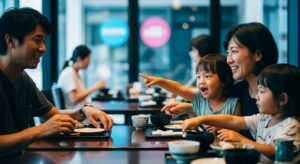
Itadaki has 18 seats, all in sofa-style table configuration. There are no hard chairs, no bench stools — every table seat is upholstered sofa seating, which means small children can sit comfortably, and past guests have used the spacious sofa tables to set a sleeping infant beside them or manage bottle feeding without feeling cramped. Families have arrived with babies in arms and left with exactly the unhurried lunch experience they were hoping for.
One practical note about strollers: Itadaki is on the 2nd floor, accessible by staircase. Strollers can be brought into the restaurant, and staff may be able to assist with carrying depending on how busy the kitchen is at that moment — but please understand that guaranteed assistance cannot be promised. Many families find it easiest to fold a compact stroller and carry it up the stairs. If your stroller is large or you would prefer to leave it at street level, please know that the Osu area has easy spots nearby.
The lunch-only, daytime service (11:00–15:00) also fits naturally into a family itinerary. If you are visiting Nagoya with children and have Legoland, Nagoya Port Aquarium, or Osu Kannon Temple on your list, a midday stop at Itadaki slots in without disrupting nap schedules or the pace of a day out.
Will my children — and I — actually enjoy this dish? What is the experience like?
Here is where the story behind the bowl becomes as important as the bowl itself.
Every dish at Itadaki is designed to be experienced in five deliberate steps: you separate the Nagoya Cochin egg, placing the white into your miso soup and the yolk on top of the wagyu; you taste the beef in its purest form first; then you break the yolk and mix; then you layer in the tabletop condiments — pickled ginger, dried seaweed, chirimen jako, the 8-spice blend — one at a time; finally, a small dot of wasabi brings the whole thing to a close. The visual at step one — that deep golden yolk resting on marbled wagyu in a traditional ceramic bowl — is the kind of image that stops thumbs mid-scroll on Instagram.
Our fully multilingual printed menu (available in English, Simplified Chinese, and Korean) includes a photographic five-step guide, so even first-time visitors know exactly what to do and when. For children who are old enough to follow instructions, this step-by-step format often becomes a small ritual they remember.
As for the Horai Wagyu itself — it is genuinely unlike anything most visitors have tasted. Out of approximately 500,000 wagyu raised in Japan each year, only 300 heads of Horai Wagyu are produced annually, across just 3 farms in Okumikawa, Aichi. The cattle are fed on sake lees from Horaisen Sora, one of the region's finest local breweries, which gives the beef a delicate character that sits apart from the richer, heavily marbled wagyu most travellers associate with premium Japanese beef.
"I've had Kobe beef and Matsusaka beef, but Horai Wagyu at Itadaki was on another level."
— Guest review
That kind of reaction isn't a coincidence. When you arrive at Itadaki knowing the story — the 3 farms, the 300 heads, the sake lees feed — the first bite carries meaning that a plate of generic wagyu simply cannot replicate. And that meaning translates directly into the kind of content your followers will ask you about for months. Not "where did you eat in Japan?" but "wait, what is that bowl and how do I find it?"
If you're planning the wider Nagoya leg of your trip and want to understand how this kind of rare wagyu experience fits into a Samurai City itinerary, this piece on a full day exploring Nagoya Castle and arriving at Itadaki for a rare wagyu bowl might give you a useful picture of how the day can flow.
How should families plan their visit — reservation, timing, and what to order?
A few practical details make a meaningful difference when you're travelling with children.
Reservation: Itadaki is open for lunch only, Tuesday to Saturday and on public holidays (11:00–15:00, last order 30 minutes before closing). Wednesday, Thursday, and Friday are closed. Because our business calendar includes occasional irregular closures, we strongly recommend checking the monthly schedule on our official Instagram before finalising your plans.
The ultra-rare Horai Wagyu is strictly limited to 10 bowls per day. For families who have specifically come to Nagoya to try it — and who cannot afford the timing to go wrong — advance reservation via Tabelog Online is the most reliable way to secure your bowls. When completing the reservation, paste 鳳来牛希望 into the notes field to request Horai Wagyu. The Tabelog reservation process can be completed in English.
If you are visiting as a walk-in, arriving right at opening (11:00) gives you the best chance of Horai Wagyu without a reservation. The Mikawa Beef Rare Gyudon is always available and is prepared using the exact same two-stage technique — it is an equally considered dish in its own right.
Getting there with children: Itadaki is a 4-minute walk from Yabacho Station Exit 4 (Meijo Subway Line). From Nagoya Station, take the Higashiyama Line to Sakae, transfer to the Meijo Line, and get off at Yabacho — about 10 minutes total. Osu Kannon Temple and the main Osu Shopping Street entrance are nearby landmarks. Look for the sign reading 元祖レア牛丼 頂 at street level and take the stairs to the 2nd floor.
What to order for a family: Most families order the Shinkoccho (Horai Wagyu, standard size, ¥2,700) for the adults and the Fumoto (Mikawa Beef, standard size, ¥1,800) for older children to share. The Teppen side dish — 50g of premium Horai Wagyu prepared with a different cut and sear — is a popular addition for adults who want to compare the wagyu at its most straightforward. The Super Mochi Barley Rice from Toyohashi is a fun rice swap (+¥200) that younger children often find interesting. All beverages are Aichi specialities, including Kinshachi Beer Pilsner for the grown-ups and Nagoya Cider for a softer option.
If you're wondering how the Itadaki experience fits alongside a day trip from Nagoya to Takayama or Shirakawa-go — which many families combine — this article on enjoying rare wagyu before catching the bus to Takayama maps out the timing in detail.
What makes this a story worth sharing — beyond the food itself?
Travelling with children changes the rhythm of a trip, but it doesn't have to reduce the depth of the experiences you collect along the way. Some of the most memorable moments our guests describe are the ones shared at the table — the five-step ritual, the first taste, the explanation to a curious child about where the beef came from and why it's so rare.
Itadaki was built on a philosophy of gratitude — the name itself comes from itadakimasu, the Japanese expression spoken before a meal to acknowledge the farmers, the land, and the craft behind every ingredient. That philosophy shapes how the restaurant feels, from the sofa seating to the multilingual menu to the story printed on the condiment stand. It's an experience designed to be remembered — and shared.
The visual of the dish alone — shimmering wagyu arranged over Aichi rice, a golden Nagoya Cochin yolk at the centre, served in a ceramic bowl — is the kind of image that earns questions from followers who have seen every sushi plate and matcha dessert your feed has ever carried. But the story behind it is what keeps those questions coming: 300 heads of Horai Wagyu, 3 farms, sake lees from a local brewery, a proprietary cooking method that creates a rare texture while meeting full food safety standards. That's a narrative, not just a photograph.
For our complete menu, access details, and store information, visit our official page at https://itadaki8.com/english/
You now have the food safety details, the allergen list, the stroller access note, and the ordering logic for a family visit — the only thing left is to lock in the date so the 10 daily Horai Wagyu bowls are waiting for you when you arrive. Secure your reservation through Tabelog Online; the form is available in English.