Bucket List Item: Tasting the 300-Head-a-Year Horai Wagyu
 gotowp
Let's start with the conclusion: if you want a single meal during your Japan trip that you'll still be talking about years from now, eating Horai Wagyu at Itadaki in Nagoya is it. Not because of the price. Not because of the hype. Because out of roughly 500,000 wagyu cattle raised in Japan every year, only 300 heads of Horai Wagyu are produced annually — across just three farms in the entire country. And in Nagoya, Itadaki is one of the very few restaurants that sources it directly.
That number deserves a moment. 300 out of 500,000. That's what's waiting for you in a bowl at the top of a staircase in Osu, Nagoya.
Who This Is For
- ✅ Wagyu enthusiasts who have already tried Kobe beef or Matsusaka beef and want to discover Japan's next hidden treasure
- ✅ Repeat visitors to Japan seeking experiences that go beyond Tokyo, Kyoto, and Osaka
- ✅ Foodies who care more about a dish's story and uniqueness than its brand recognition
- ✅ Travelers building a Japan food bucket list and want at least one truly irreplaceable meal
- ✅ Anyone staying in or passing through Nagoya who wants their trip to include something genuinely unforgettable

Why Horai Wagyu Is in a Category of Its Own
Most wagyu conversations start — and end — with Kobe and Matsusaka. Those are extraordinary beefs, and they deserve their reputation. But Japan's wagyu world is far deeper than its two most exported names, and Horai Wagyu sits in a part of that world very few travelers ever reach.
Horai Wagyu is a Kuroge Wagyu (Japanese Black) raised in the Okumikawa region of Aichi Prefecture — the mountainous interior that most tourists never visit. What makes it singular is not just the small production volume. It's the feeding method. These cattle are raised on sake lees from Horaisen Sora, one of Aichi's most celebrated premium sake breweries. The result is a beef with an unusually balanced character: light, delicate marbling alongside genuine lean-cut flavor — a combination rarely found in wagyu, which typically leans one way or the other.
This is not a manufactured story built around a marketing campaign. Horai Wagyu is scarce because it is genuinely difficult to produce at scale. The farmers who raise these cattle have chosen depth over volume, and what lands on your rice is the direct consequence of that choice.
The Five Moments That Make This Dish Unforgettable
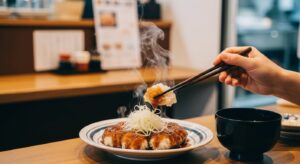
At Itadaki, founder Masayuki Goto didn't simply source rare beef and serve it on rice. He spent years developing a proprietary two-stage cooking technique that heats the beef to over 70°C at the core — fully meeting Japan's Ministry of Health, Labour and Welfare food safety standards — while preserving the silky, rare-style texture that makes the experience so unlike anything else. This is the technical achievement at the heart of what Itadaki invented: the world's first Rare Wagyu Gyudon.
The dish arrives beautifully composed in a traditional Japanese ceramic bowl, and the menu includes a five-step visual guide for how to enjoy it. Here is how those five moments unfold:
- Separate the egg. The raw Nagoya Cochin egg — from Yamada Poultry Farm — arrives whole on the bowl. Separate the white into the accompanying miso soup, and place the golden yolk atop the beef. The transformation begins.
- Taste the wagyu first, undisturbed. Before mixing anything, eat a piece of the Horai Wagyu on its own with the Aichi no Kaori rice. This is the moment to understand what 300 heads a year actually tastes like.
- Introduce the yolk. Mix the egg yolk gently through the beef. The richness shifts. The flavor deepens. This is where the dish finds its full voice.
- Explore the condiments. Pickled ginger from Kimura Farm in Inazawa, dried nori seaweed from Mikawa Bay, chirimen jako, and Itadaki's original 8-spice blend — each one changes the character of the bowl completely. There is no single right way to eat this.
- Finish with wasabi. A clean, refreshing contrast that closes the experience on a note you don't expect but immediately understand.
Every ingredient on the table — the rice, the sauce made from white soy sauce from Hekinan City, the Atsumi Ichō-zuke pickles, the shiso leaves from Toyohashi — comes from Aichi Prefecture. Nothing from outside the region. This is the commitment Goto calls everything from Aichi, and it gives the meal a coherence that goes beyond flavor.
✓ Key Takeaways
- Horai Wagyu is produced by only 3 farms in Japan, with just 300 heads raised annually — making it one of Japan's rarest wagyu varieties, with a flavor profile unlike any other.
- Itadaki's two-stage cooking technique delivers a rare-style texture while fully meeting Japanese food safety standards — no compromises on either front.
- Every ingredient in the bowl, from the rice to the pickles, is sourced exclusively from Aichi Prefecture — making this a complete expression of the region's food culture.
What Guests Who Have Made the Trip Say
Itadaki has been featured on eight major Japanese TV programs, including NHK. But the most honest measure of what a dish means is what the people who ate it say afterward — not to a broadcaster, but to their friends.
"The rare wagyu was unlike anything I've ever tasted — a life-changing culinary experience."
Guest review
"I've had Kobe beef and Matsusaka beef, but Horai Wagyu at Itadaki was on another level."
Guest review
These are not responses to a generic wagyu meal. They are responses to something that has no equivalent elsewhere. That's the difference between a memorable restaurant and a bucket list item.
How to Actually Get Here — and How to Make Sure Horai Wagyu Is Waiting for You
Itadaki is located on the 2nd floor at 4-1-20 Osu, Naka-ku, Nagoya — a four-minute walk from Yabacho Station Exit 4 on the Meijo Subway Line. From Nagoya Station, the journey takes roughly ten minutes: Higashiyama Line to Sakae, transfer to the Meijo Line, and off at Yabacho. At street level, look for the sign reading 元祖レア牛丼 頂 (Ganso Rea Gyudon Itadaki) and take the stairs up.
Now, the part that matters most for planning: Horai Wagyu is strictly limited to 10 bowls per day. During peak lunch hours, those bowls go fast. If you are traveling specifically to try this — and many guests do — advance reservation via Tabelog Online is strongly recommended. When making the reservation, copy and paste the following Japanese phrase into the notes field to request Horai Wagyu: 鳳来牛希望
Itadaki is open Saturday, Sunday, Monday, and Tuesday from 11:00 to 15:00 (last order at 14:30), and from 09:00 to 15:00 on public holidays. There is no dinner service. The restaurant is closed Wednesday, Thursday, and Friday, and irregular closures can apply — so always check the monthly business calendar before visiting.
The menu is available in English, Simplified Chinese, and Korean, with photos, prices, and the full five-step guide. You don't need Japanese to order or to enjoy the meal fully.
Building Your Nagoya Day Around This Experience
One of the reasons Itadaki works so well as a bucket list centerpiece is that it sits inside one of Nagoya's most interesting neighborhoods. The Osu district — home to Osu Kannon Temple, the 1,200-shop Osu Shopping Street, and a genuinely unique mix of traditional culture and subculture — is an ideal place to spend a morning before your 11:00 bowl of Horai Wagyu.
Hisaya-odori Garden Flarie, a free-admission urban garden featuring six themed spaces including a European-style Harmony Garden and a Crystal Garden greenhouse, is just three minutes from Yabacho Station — the same station you'll use to reach Itadaki. Many guests combine the two into a single morning.
If you're continuing on to Shirakawa-go, Takayama, or Gifu after your Nagoya stay, an 11:00 lunch at Itadaki fits naturally into the day before an afternoon departure. Several guests have described it exactly this way — as the perfect closing note on a Nagoya morning before heading into the mountains.
The Shinkoccho: Where to Start
For first-time visitors, the Shinkoccho is the right entry point: the standard-size Horai Wagyu Rare Gyudon, with 100g of beef, 200g of Aichi no Kaori rice, miso soup, pickles, shiso, and a Nagoya Cochin egg, at ¥2,700 (tax included). If you want more beef, the Cho-ten (150g, ¥3,200) and Zettcho (200g, ¥3,600) offer larger portions under the same names as steps on a mountain — a deliberate nod to the journey upward.
If Horai Wagyu has sold out by the time you arrive, Mikawa Beef Rare Gyudon — prepared with the same two-stage technique, starting from ¥1,800 — is always available. It is, by any honest measure, an exceptional dish in its own right.
A Final Note on What Makes Something Worth Traveling For
Goto named this restaurant Itadaki — from itadakimasu, the Japanese expression of gratitude spoken before every meal. The idea is simple: food is a gift from farmers, from the land, and from the people who've spent years learning how to handle it well. That philosophy is why the bowl in front of you contains Horai Wagyu that only 300 animals in Japan will ever produce this year, rice grown specifically in Aichi's fields, and eggs from a single farm outside Nagoya.
You can eat wagyu in many places during a Japan trip. You can eat it in a famous steakhouse in Tokyo, or at a celebrated teppanyaki counter in Osaka. But you cannot eat Horai Wagyu prepared as a Rare Wagyu Gyudon anywhere but here. That is the difference between a good meal and a story you carry home.
If this is on your Japan food bucket list, we'd love to be ready for you when you arrive. The best way to secure your Horai Wagyu bowl is to reserve in advance — just don't forget to include 鳳来牛希望 in the notes.
Reserve Your Rare Wagyu Experience
For our complete menu, access details, and store information, visit our official page at https://itadaki8.com/english/
And since our schedule changes monthly with occasional irregular closures, we always recommend a quick check before your visit: Check Our Monthly Schedule on Instagram