The Complete Guide to Rare Wagyu Gyudon for Beef Connoisseurs
 gotowp
Here's a number that might surprise you: according to travel research on repeat visitors to Japan, nearly 30% of tourists from Hong Kong have visited Japan more than 10 times. And yet, the majority of them have never set foot in Nagoya's Osu district. That's not because there's nothing to find there — it's because the best things in Osu aren't listed in most English travel guides. They're discovered by people who are genuinely curious, who wander off the Golden Route, and who ask locals where they actually eat.
This article is written for exactly those people. If you've already done Kobe beef, Matsusaka, and Omi — and you're ready to find the wagyu experience that most Japan visitors haven't heard of yet — keep reading.
Who This Is For
- ✅ Repeat visitors to Japan looking for an authentic discovery beyond Tokyo, Kyoto, and Osaka
- ✅ Beef connoisseurs who want to experience wagyu breeds and cuts they've never encountered before
- ✅ Travelers in Nagoya (before or after Shirakawa-go, Takayama, or Gifu trips) seeking a lunch that becomes a story worth telling
- ✅ Foodies who value a restaurant's backstory and sourcing as much as its flavors
- ✅ Anyone who wants to find the kind of place where Japanese food enthusiasts actually eat — not where the guidebooks send tourists
Why Nagoya — and Why Osu — Is Where Discerning Travelers Are Heading Now
For years, Nagoya occupied an awkward position in Japan travel itineraries: too far from Kyoto to skip, too close to Tokyo to linger in. Most visitors passed through without stopping. That's changing — and the repeat-visitor community knows it.
Osu is one of the reasons. Locals will tell you it's Nagoya's most layered neighborhood: a Buddhist temple at its heart, 400 years of merchant history in its shopping arcades, and a thriving subculture scene that draws cosplayers, vintage collectors, and anime enthusiasts alongside elderly shopkeepers who've been here for decades. It's the kind of place that rewards slowness — and one of those rewards, tucked on the second floor of a building a four-minute walk from Yabacho Station, is Itadaki.
Itadaki opened in April 2022. Its founder, Masayuki Goto, had spent 18 years in the food and beverage industry — first establishing MAX'S BAR in 2008, then, during the pandemic, finding himself thinking not just about restaurants but about the Aichi Prefecture farmers whose livelihoods were quietly collapsing. Many of them produced extraordinary ingredients — wagyu breeds, heritage rice varieties, specialty miso — that were suddenly going unsold. Goto's response was to build something around those farmers, not just source from them. The result was Itadaki, and the concept at its center was one that nobody had thought to create before: a specialty restaurant dedicated entirely to Rare Wagyu Gyudon.
The Culinary Concept That Didn't Exist Until Goto Created It
Consider the landscape of Japanese donburi (rice bowl) cuisine. Katsudon has a premium version. Kaisendon — with its seasonal sashimi — can cost tens of thousands of yen at a high-end seafood counter. Even oyakodon has elevated interpretations at serious poultry-focused restaurants. But gyudon? Japan's iconic beef bowl had never made that leap. It was, almost by definition, fast food.
Goto asked what seemed like an obvious question once someone finally asked it: why not create a gyudon worthy of the finest wagyu in Japan — rare-style preparation, ultra-premium sourcing, and every ingredient from a single prefecture? That question became Itadaki's founding principle, and the answer became a dish that Japanese food media couldn't stop talking about. Itadaki has since been featured on eight major Japanese television programs, including NHK, Japan's national public broadcaster.
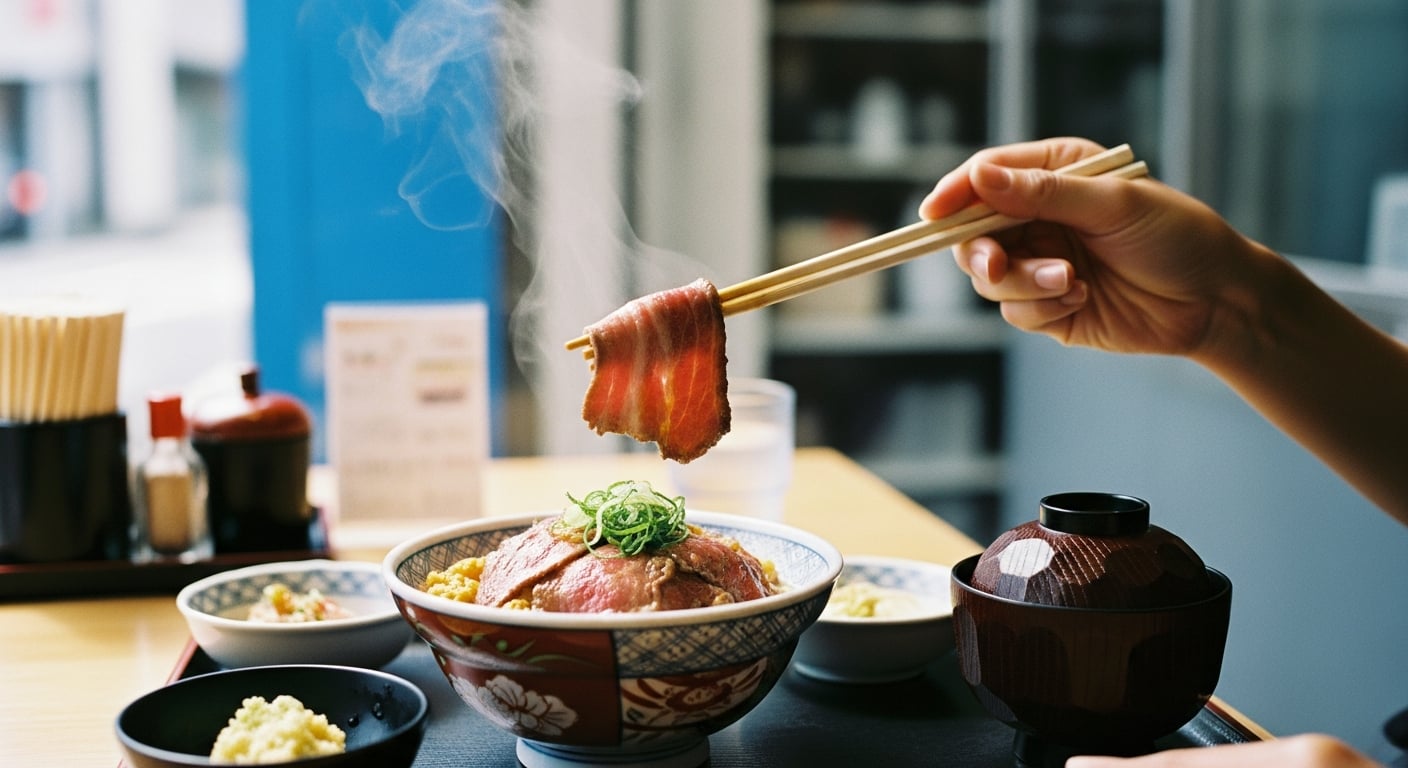
The wagyu at the center of this concept is Horai Wagyu — a Japanese Black (Kuroge Wagyu) raised in the Okumikawa highlands of Aichi Prefecture. Only three farms produce it. Only 300 heads are raised each year, out of approximately 500,000 wagyu cattle in Japan. The cattle are fed on sake lees from Horaisen Sora, a renowned local brewery, which contributes to the beef's distinctive flavor: lighter marbling than the famous fat-forward wagyu brands, with a clean finish and an almost mineral delicacy that experienced tasters describe as genuinely unlike anything they've had before.
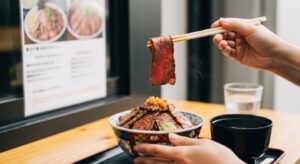
Because this is a gyudon — a bowl — the preparation matters as much as the sourcing. Goto developed a proprietary two-stage cooking technique that heats the beef to over 70°C at its core, fully meeting Japan's Ministry of Health, Labour and Welfare food safety standards, while preserving the texture and visual quality of rare-style beef. This technique took time to develop and represents Itadaki's core intellectual property. No other gyudon restaurant in Japan offers it.
✓ Key Takeaways
- Osu district in Nagoya is where repeat Japan visitors are now discovering their most memorable food experiences — off the Golden Route and off the standard guidebook trail.
- Itadaki invented the Rare Wagyu Gyudon category from scratch — it did not exist before founder Masayuki Goto conceived it in 2022, and no other restaurant replicates the full concept.
- Horai Wagyu, the star ingredient, is one of Japan's rarest beef breeds: 300 heads per year, 3 farms, fed on premium sake lees from an Aichi brewery.
What Guests Who've Found It Say
One of the things that stands out most in the feedback Itadaki receives from international visitors isn't the beef itself — though the descriptions of the beef are consistently striking. It's how comfortable the experience feels for people who don't speak Japanese.
"The English menu with clear serving instructions made the experience stress-free."
— A visitor from overseas
This matters more than it might initially seem. For many foreign travelers, the anxiety around visiting an authentic Japanese specialty restaurant isn't about the food — it's about not knowing what to do once the bowl arrives. Itadaki's multilingual printed menu (available in English, Simplified Chinese, and Korean) includes a five-step visual guide showing exactly how to enjoy the dish: how to separate the Nagoya Cochin egg, when to add the condiments, and how to experience the progression of flavors from first bite to last. That guide transforms a potentially confusing experience into a deliberate culinary journey — and it's the kind of thoughtfulness that keeps guests talking about Itadaki long after they've left Nagoya.
"I've had Kobe beef and Matsusaka beef, but Horai Wagyu at Itadaki was on another level."
— A returning visitor to Japan
This is, consistently, the response from guests who arrive with a real reference point. Horai Wagyu is not trying to compete with Kobe on richness or Matsusaka on marbling intensity — it's doing something different, and for a beef connoisseur, different is the whole point.
Everything on the Table Is From Aichi — and That's the Point
The Horai Wagyu is the centerpiece, but Goto's commitment to Aichi Prefecture extends to every element of the bowl. The rice is Aichi no Kaori, a premium variety grown in the prefecture. The sauce is built on white soy sauce from Hekinan City, blended with wine. The miso soup uses Hatcho miso from Okazaki — the same city that gave this aged, deeply savory miso to the world centuries ago. The pickles are Atsumi Ichō-zuke from the Atsumi Peninsula. The shiso leaves are Aikei No.1, from Toyohashi. The egg is from Yamada Poultry Farm's Nagoya Cochin chickens.
None of this is incidental. The name Itadaki comes from "itadakimasu" — the expression of gratitude Japanese speakers offer before eating. It's a word that acknowledges the farmers, the land, and the effort behind the ingredients. Goto built the restaurant to embody that acknowledgment literally: every producer on the list has a name, a location, and a story that connects directly to the bowl in front of you.
For a beef connoisseur who has traveled to Japan before and knows what a sourcing story sounds like — who can tell the difference between genuine farm-to-table relationships and marketing language — this level of specificity is immediately recognizable as the real thing.
Planning Your Visit: What You Need to Know
Itadaki is open for lunch only, on Saturdays, Sundays, Mondays, and Tuesdays (and public holidays, from 9:00), with last order 30 minutes before closing at 15:00. There is no dinner service, and no take-out. The experience is designed to be enjoyed in the restaurant, in the moment.
Horai Wagyu is strictly limited to 10 bowls per day. During peak lunch hours, it sells out. If your visit to Nagoya is time-limited — a single day between Shirakawa-go and Tokyo, for example — a reservation via Tabelog Online is strongly recommended. When reserving, copy and paste this phrase into the notes field to request Horai Wagyu: 鳳来牛希望. Reservations can be made in English on the Tabelog platform.
If you're arriving as a walk-in, the Mikawa Beef Rare Gyudon (from ¥1,800 for the Fumoto size, 100g beef and 200g rice) is always available — prepared with the same two-stage cooking technique, using Aichi's Mikawa region beef. Arriving right at 11:00 opening also gives you the best chance of securing Horai Wagyu without a prior reservation.
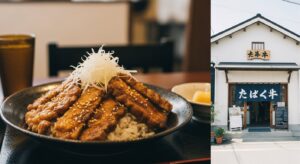
Getting there is straightforward: Yabacho Station on the Meijo Subway Line, Exit 4, four-minute walk. From Nagoya Station, take the Higashiyama Line to Sakae, transfer to the Meijo Line, and get off at Yabacho — approximately 10 minutes total. Look for the sign reading 元祖レア牛丼 頂 ("Ganso Rea Gyudon Itadaki") at street level, then take the stairs to the second floor. The restaurant has 18 seats, including comfortable sofa seating ideal for solo diners, couples, and small groups.
For complete menu details, current opening hours, and directions, visit the official English page at https://itadaki8.com/english/.
The Kind of Discovery You'll Actually Want to Talk About
Japan has no shortage of excellent wagyu. But the experience of finding the one that nobody else on your travel feed has posted about — the one that requires a subway transfer, a second-floor staircase, and a four-minute walk through a neighborhood that still feels genuinely local — that's a different kind of satisfaction entirely.
The guests who make it to Itadaki don't just eat well. They come away with a story: about Okumikawa farmers raising 300 cattle a year, about a restaurateur who built his concept to save the livelihoods of people he respected, about a bowl of rice and beef that somehow managed to say something new in a culinary tradition that's hundreds of years old.
That's the hidden gem you were looking for. It's in Osu. It's on the second floor. And it's open for lunch.
If you'd like to secure your Horai Wagyu bowl before it sells out, we'd love to welcome you — Reserve Your Rare Wagyu Experience via Tabelog Online. And to check our monthly business schedule before you finalize your plans, Check Our Monthly Schedule on Instagram — we update it at the start of each month.
Itadakimasu.