Underrated Nagoya: The Hidden Gem Repeat Visitors Love
 gotowp
You've done Tokyo. You've walked Kyoto's Philosopher's Path, ticked off Fushimi Inari, eaten ramen in Osaka. And now — on your second, third, maybe fourth trip to Japan — you're asking a different question: Where do I go to find something that almost nobody else has found yet?
It's a familiar feeling among repeat visitors. The Golden Route is wonderful, but after a certain number of trips, the most exciting thing on the itinerary isn't a famous landmark. It's a meal you didn't plan for. A neighborhood you almost skipped. A dish that genuinely surprises you — and becomes the story you tell when you get home.
That's what Nagoya keeps delivering. Quietly, persistently, without fanfare.
Who This Is For
- ✅ Repeat Japan visitors ready to explore beyond Tokyo, Kyoto, and Osaka
- ✅ Wagyu enthusiasts who've tried Kobe and Matsusaka beef and want to discover what comes next
- ✅ Foodies who value a compelling story as much as the taste on the plate
- ✅ Travelers building a Nagoya itinerary and looking for one genuinely memorable lunch
- ✅ Anyone who wants a culinary experience worth telling — not just eating

Why Repeat Visitors Keep Choosing Nagoya
Here's a number worth noting: according to the Japan Tourism Agency's inbound tourism data, Nagoya and Aichi Prefecture have seen consistent growth in repeat foreign visitors — particularly from Hong Kong, Taiwan, and South Korea, where a significant share of travelers have visited Japan five or more times. Among Hong Kong visitors surveyed, 29.7% had made ten or more trips to Japan. For Taiwanese visitors, that figure is 19.4%.
What draws repeat visitors back to Japan isn't the iconic sights they've already seen. It's the discovery layer — the specialty restaurants, the neighborhood shrines, the crafts and ingredients that mainstream tourism never surfaces. And Nagoya, consistently overlooked by first-timers rushing between Tokyo and Kyoto on the Shinkansen, has quietly become one of the richest discovery destinations in the country.
The Osu district is a perfect example. On the surface, it looks like a lively shopping street — 1,200 shops, a Buddhist temple, anime stores, Taiwanese food stalls, vintage clothing. But beneath the surface energy, Osu is where local food enthusiasts actually eat. It's not in the guidebooks. It doesn't come up in listicles. You find it by walking slowly, looking up at second floors, and following the instinct that says: something interesting is happening here.
The Dish That Didn't Exist Until 2022
When Masayuki Goto opened Itadaki on the second floor of a building in Osu in April 2022, he was answering a question that nobody had asked out loud: Why has gyudon — Japan's iconic beef bowl — never had a premium version?
Katsudon has premium iterations. Oyakodon has upscale versions. Kaisendon with sea urchin and fatty tuna is everywhere in Tokyo. But gyudon? For decades, it existed almost entirely as fast food — cheap, fast, and utterly without aspiration.
Goto, who has spent 18 years in the restaurant and bar industry and founded MAX'S BAR in 2008, saw that gap and filled it. His concept: take the most humble format in Japanese cuisine, and reimagine it from the ground up using ingredients so rare and a technique so precise that the result becomes something no chain restaurant could ever dream of producing.
The result was the world's first Rare Wagyu Gyudon — and Itadaki is the restaurant where that culinary category was born.
The star of the bowl is Horai Wagyu, raised in the Okumikawa mountains of Aichi Prefecture by just three farms in Japan, with only 300 heads produced annually. Out of approximately 500,000 wagyu cattle raised across Japan each year, 300 are Horai Wagyu. The cattle are fed on sake lees from Horaisen Sora, one of Aichi's most celebrated local breweries — a feeding method that produces marbling with an unusually delicate, clean flavor profile.
To bring this wagyu to the table in a rare-style preparation that meets Japan's Ministry of Health, Labour and Welfare food safety standards, Goto developed a proprietary two-stage cooking technique that heats the beef to over 70°C at the core. The result is a mouthfeel that feels like rare beef — silky, yielding, deeply marbled — while being completely safe by Japanese regulatory standards. No other gyudon restaurant in the world offers this.
Itadaki has since been featured on 8 major Japanese TV programs, including NHK and Central Japan's leading networks, recognized as the originator of the Rare Wagyu Gyudon concept.
✓ Key Takeaways
- Nagoya attracts an unusually high share of repeat Japan visitors seeking authentic, off-the-beaten-path experiences — and Osu district is one of its richest discovery zones.
- Itadaki invented the "Rare Wagyu Gyudon" culinary category in 2022 — the concept does not exist anywhere else in the world.
- Horai Wagyu is produced by only 3 farms in Japan with just 300 heads annually, making it one of the rarest wagyu brands available anywhere.
The Five Steps That Transform a Bowl Into a Memory
One of the most telling things about eating at Itadaki is what happens before the first bite.
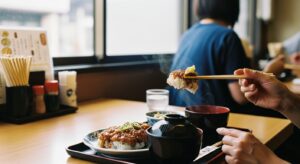
Your bowl arrives — Horai Wagyu laid over "Aichi no Kaori" rice, a raw Nagoya Cochin egg perched on top, the table set with pickled ginger from Kimura Farm in Inazawa, dried seaweed from Mikawa Bay, and Itadaki's own original 8-spice blend. It's a striking presentation: earthy, precise, warm in color.
And then your menu opens to a section titled: How to Enjoy Rare Gyudon.
Five steps, clearly illustrated, available in English, Simplified Chinese, and Korean. Separate the egg white into the miso soup first. Place the golden yolk directly on the wagyu. Taste the beef before mixing anything. Then add the yolk. Then begin layering condiments — pickled ginger, dried whitebait, nori, spice blend — each one shifting the flavor in a different direction. Finally, a small amount of wasabi for a refreshing, clean finish.
This isn't a gimmick. It's a structured progression that reveals the ingredient at multiple angles — which is how a dish with this much thought behind it deserves to be encountered.
"The five-step eating guide made the dish even more enjoyable and memorable."
— Visitor to Itadaki, Osu, Nagoya
That response captures something real. The guide transforms what could be an intimidating unknown into a journey you feel confident taking. And it gives you a story — not just a photo, but a sequence — to bring home.
What Makes This Experience Impossible to Replicate
The word "unique" gets used loosely in food writing. So let's be specific about what makes eating at Itadaki genuinely unrepeatable anywhere else.
The ingredient: Horai Wagyu is strictly limited to 10 bowls per day at Itadaki. This isn't a marketing choice — it reflects the actual scarcity of the beef. When 300 heads are produced annually across Japan, the supply reaching any single restaurant is inherently limited. You cannot order this beef online, find it at a supermarket, or encounter it at another restaurant in Nagoya with the same sourcing relationship.
The technique: The two-stage cooking process Goto developed represents years of iteration and is proprietary to Itadaki. The "rare" texture it creates is a technical achievement that no standard kitchen can replicate without the same equipment and training protocol.
The provenance: Every single ingredient on the table — the rice, the egg, the miso soup, the pickles, the shiso leaves, the beverages — comes from Aichi Prefecture. The Chita Highball uses whisky from Aichi's Chita Distillery. The cider is brewed locally. The onions are sourced from multiple contract farms across the prefecture. This is not sourcing for its own sake — it's a coherent expression of what Aichi's food culture actually tastes like, assembled in a single bowl.
The origin story: Goto conceived Itadaki during the COVID-19 pandemic, when small Aichi farms — including producers of Horai Wagyu and other premium local ingredients — were struggling with unsold harvests. His response was to build a restaurant model that would create long-term direct partnerships with those farms. The name "Itadaki" comes from itadakimasu — the Japanese expression of gratitude before eating. That philosophy isn't branding. It's the foundation of every sourcing decision the restaurant makes.
"I've had Kobe beef and Matsusaka beef, but Horai Wagyu at Itadaki was on another level."
— Visitor to Itadaki
Planning Your Visit: What You Need to Know
Itadaki is open for lunch only — Tuesday, Saturday, Sunday, and Monday from 11:00 to 15:00 (last order 30 minutes before closing), and on public holidays from 09:00 to 15:00. There is no dinner service. Given the limited Horai Wagyu availability (10 bowls per day), arriving at opening or reserving in advance via Tabelog Online is strongly recommended.
When making a reservation, copy and paste the following into the notes field to request Horai Wagyu: 鳳来牛希望. This phrase tells the kitchen to set aside your bowl of the day's ultra-rare allocation.
Getting there is straightforward: Itadaki is a 4-minute walk from Yabacho Station Exit 4 on the Meijo Subway Line. From Nagoya Station, take the Higashiyama Line to Sakae, transfer to the Meijo Line, and get off at Yabacho — approximately 10 minutes total. Look for the sign reading 元祖レア牛丼 頂 at street level and take the stairs to the second floor.
The restaurant seats 18 guests across counter seats and comfortable sofa-style tables — a relaxed, unhurried space that suits solo diners, couples, and small groups equally well. The fully multilingual menu (English, Simplified Chinese, Korean) means you won't need Japanese to order, ask questions, or navigate the five-step experience.
If Horai Wagyu has sold out for the day, the Mikawa Beef Rare Gyudon — starting from ¥1,800 — is always available and prepared using the same two-stage cooking technique. It's a worthy introduction to the concept in its own right.
One Bowl. One Story. One Nagoya.
The meals we remember from travel are rarely the most expensive ones. They're the meals that gave us something to explain — a process, an ingredient, a reason it could only exist in this particular place. Itadaki's Rare Wagyu Gyudon is exactly that kind of meal.
Horai Wagyu. Two-stage cooking. Five steps. Everything from Aichi. A culinary concept born in Osu, Nagoya, in 2022 — and available nowhere else on earth.
If you're building a Japan itinerary that goes beyond the familiar, this is where Nagoya earns its place on the list.
For our complete menu, access details, and store information, visit our official page at https://itadaki8.com/english/
Horai Wagyu is limited to 10 bowls per day. To secure yours, we warmly recommend booking in advance — we'd love to have you at the table.
Reserve Your Rare Wagyu Experience
For our latest business calendar and any irregular closure notices, follow us on Instagram:
Check Our Monthly Schedule on Instagram