10 Things You Need to Know About Horai Wagyu Before Visiting
 gotowp
You've done your research, saved the location on Google Maps, and you're genuinely excited — Horai Wagyu, one of Japan's rarest wagyu varieties, served as a rare-style gyudon in the Osu district of Nagoya. But then the nerves set in. Osu's winding covered shopping streets look like a maze on the map. You're not sure which subway line to take, which exit to use, or whether you'll even be able to find the restaurant once you're there. And once you arrive — will the Horai Wagyu still be available?
These are real concerns, and they stop more than a few visitors from following through on a lunch they'd been looking forward to for weeks. This guide is here to change that. Below are 10 things you genuinely need to know before visiting Itadaki — The Original Rare Wagyu Gyudon — so that by the time you walk through our door, you feel confident, prepared, and ready to enjoy every bite.
Who This Is For
- ✅ Wagyu enthusiasts who want to try Horai Wagyu but aren't sure how to find Itadaki in Osu
- ✅ First-time visitors to Nagoya who find the Osu shopping district confusing to navigate
- ✅ Travelers who want to secure a bowl of Horai Wagyu and not risk missing out on the day's 10-bowl limit
- ✅ Repeat Japan visitors seeking an authentic hidden gem beyond Tokyo, Kyoto, and Osaka
- ✅ Anyone with practical questions about access, reservations, menus, and what to expect at the table
1. Horai Wagyu Is One of Japan's Rarest Wagyu Varieties — Here's Why
Out of approximately 500,000 wagyu cattle raised across Japan each year, Horai Wagyu accounts for just 300 heads annually — produced by only 3 farms in the Okumikawa region of Aichi Prefecture. What makes it distinct isn't just scarcity. These cattle are fed on sake lees from Horaisen Sora, one of the region's most celebrated local sake breweries, creating a flavor profile that is simultaneously clean and deeply layered — lighter in fat than some well-known wagyu brands, yet unmistakably rich in character.
One guest put it this way:
"I've had Kobe beef and Matsusaka beef, but Horai Wagyu at Itadaki was on another level."
Guest from overseas
That reaction captures something genuine. Horai Wagyu isn't trying to compete with Kobe or Matsusaka — it has its own identity, shaped by the land, the sake tradition, and the careful raising practices of three small farms in Aichi.
2. It's Limited to 10 Bowls Per Day — And It Does Sell Out
The limitation isn't a marketing strategy. It's a direct reflection of how little Horai Wagyu exists in the world. Itadaki sources directly from these farms, and on any given service day, only 10 bowls of Horai Wagyu Rare Gyudon are available — period. During peak lunch hours, those 10 bowls can be claimed well before 1:00 PM.
If Horai Wagyu is the reason you're making the trip to Nagoya, a reservation via Tabelog Online is strongly recommended. When making your reservation, copy and paste the following Japanese phrase into the notes field: 鳳来牛希望 — this lets our team know you're requesting Horai Wagyu specifically. Reservations can be completed in English on the Tabelog website. If you're walking in, arriving right at opening (11:00 AM) maximises your chances.
3. Getting Here from Nagoya Station Is Simpler Than It Looks
Here's where a lot of visitors get stuck — not because the journey is complicated, but because Osu's visual complexity on a map makes it feel that way. Let's break it down step by step.
From Nagoya Station:
- Take the Higashiyama Subway Line toward Fujigaoka — two stops to Sakae Station
- Transfer to the Meijo Subway Line — one stop to Yabacho Station
- Exit from Exit 4
- Walk for approximately 4 minutes — Itadaki is on your right
Total journey from Nagoya Station: approximately 10 minutes. That's it.
You can also reach Itadaki on foot from Sakae Station, Kamimaezu Station, and Osu Kannon Station — all within comfortable walking distance for those already exploring the area.
4. Itadaki Is on the 2nd Floor — Don't Walk Past
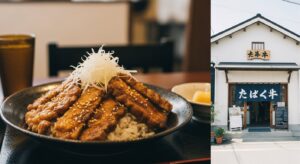
This is the single most common navigation mistake visitors make. Itadaki is located on the 2nd floor of a building at 4-1-20 Osu, Naka-ku. If you're walking along the street-level shops, you won't see the dining room — you'll see a staircase entrance with a sign in Japanese that reads:
元祖レア牛丼 頂
(pronounced: Ganso Rea Gyudon Itadaki — meaning "The Original Rare Wagyu Gyudon, Itadaki")
Look for that sign, and take the stairs up. The entrance is modest — intentionally so — but once you're upstairs, you'll find 18 seats in a clean, comfortable space with sofa-style table seating and counter seats near the window. A good nearby landmark to orient yourself: Osu Kannon Temple is a short walk away, and the main entrance to Osu Shopping Street is within the same area.
A direct Google Maps link is available on our official English page at itadaki8.com/english/ — we recommend opening it before you leave your hotel so you have it ready offline.
✓ Key Takeaways
- Horai Wagyu is limited to just 10 bowls per day — reserve via Tabelog and add 鳳来牛希望 to your notes to secure one
- From Nagoya Station: Higashiyama Line to Sakae, transfer to Meijo Line, one stop to Yabacho, Exit 4 — approximately 10 minutes total
- Itadaki is on the 2nd floor — look for the sign 元祖レア牛丼 頂 at street level and take the stairs up
5. The Rare-Style Preparation Is Safe — And Backed by Japanese Food Safety Standards
If you've heard "rare wagyu" and felt a moment of hesitation, you're not alone. Many visitors from Western countries are accustomed to food safety guidance that discourages undercooked beef. What we serve at Itadaki is not raw beef — it's prepared using a proprietary two-stage cooking technique that heats the beef to over 70°C at the core, fully meeting Japan's Ministry of Health, Labour and Welfare food safety standards.
The result is a texture that delivers the sensation of eating rare beef, while ensuring complete safety. This technique was developed by founder Masayuki Goto — a Certified Food Sanitation Supervisor — specifically to make this experience possible within Japan's strict food safety framework. It's one of the reasons Itadaki has been featured on 8 major Japanese TV programs, including NHK.
6. Everything on the Menu Comes from Aichi Prefecture
This isn't a marketing tagline — it's an operating principle. The rice is Aichi no Kaori, grown in Aichi. The egg is a Nagoya Cochin egg from Yamada Poultry Farm. The miso soup uses Hatcho miso from Okazaki City. The pickles are traditional Atsumi Ichō-zuke from the Atsumi Peninsula. The sauce is built on white soy sauce from Hekinan City, blended with wine into what our regulars call the "magic sauce."
When Goto founded Itadaki in 2022, his goal wasn't just to create a great bowl of gyudon — it was to introduce Aichi Prefecture's extraordinary agricultural heritage to visitors who might otherwise never encounter it. Every ingredient on the table tells a part of that story.
7. You Don't Need Japanese to Order — The Menu Is in English, Chinese, and Korean
Itadaki offers a fully printed multilingual menu in English, Simplified Chinese, and Korean, complete with photos, prices, and ingredient descriptions. Also included is a step-by-step visual guide — "How to Enjoy Rare Gyudon" — that walks you through the five-stage eating experience: separating the egg, appreciating the beef on its own, mixing the yolk, adding condiments, and finishing with wasabi.
You can point and order comfortably without knowing a single word of Japanese, and our team is genuinely happy to welcome international visitors. Translation apps work well in the restaurant if you have additional questions.
8. If Horai Wagyu Is Unavailable, Mikawa Beef Is Always an Option
Walk-in visitors who arrive after the 10 Horai Wagyu bowls have been claimed still have a meaningful choice: Mikawa Beef Rare Gyudon, which is always available and prepared using the same two-stage cooking technique. Mikawa Beef is sourced from Aichi's Mikawa region — an uchimomo lean cut raised on okara feed with lactic acid bacteria gut management, creating a clean, nuanced flavor profile of its own.
Starting from ¥1,800 for the Fumoto (standard) size, it's a genuine expression of Aichi wagyu — not a consolation prize.
9. Know the Opening Hours Before You Go
Itadaki operates on a schedule that differs from most restaurants. Here's what you need to know:
- Open: Saturday, Sunday, Monday, Tuesday — 11:00 AM to 3:00 PM (last order 2:30 PM)
- Closed: Wednesday, Thursday, Friday
- Public holidays: Open from 9:00 AM to 3:00 PM
- Lunch service only — no dinner service
- Irregular closures may apply — always check the monthly business calendar on Instagram before your visit
Because the schedule can change month to month, checking Check Our Monthly Schedule on Instagram a day or two before your planned visit is the safest way to confirm we're open.
10. The Experience Stays With You Long After the Bowl Is Empty
There's a reason Goto named this restaurant Itadaki — derived from itadakimasu, the Japanese expression of gratitude spoken before a meal. It's a word that acknowledges the farmers, the land, the craft, and the act of eating itself. That philosophy shapes everything here: the sourcing, the technique, the way the dish is presented, and the way guests are welcomed.
Before you discovered Horai Wagyu, perhaps "gyudon" meant something from a chain restaurant — quick, filling, forgettable. After a bowl at Itadaki, the word means something else entirely. That shift — from assumption to genuine discovery — is exactly what this place was built to create.
"The lunch was the highlight of my Nagoya trip — I'm telling all my friends about it."
Guest from overseas
Ready to Visit? Here's How to Make It Happen
If Horai Wagyu is on your list — and after reading this, we hope it is — the most important step is securing your reservation in advance. With only 10 bowls available each service day, planning ahead makes the difference between a bowl you'll remember for years and a missed opportunity.
To reserve your seat and request Horai Wagyu, use the link below and add 鳳来牛希望 in the notes field:
Reserve Your Rare Wagyu Experience
And if your schedule is still flexible, check our monthly business calendar first — we update it every month so you can plan with confidence:
Check Our Monthly Schedule on Instagram
For our complete menu, access details, and store information, visit our official page at itadaki8.com/english/. We look forward to welcoming you.