My Journey Beyond Tokyo and Kyoto: Discovering Nagoya's Hidden Gem
 gotowp
You've done Tokyo. You've done Kyoto. You've done Osaka. Maybe you've already ticked off Nishiki Market, Dotonbori, and Tsukiji. And yet, somewhere in the back of your mind, a quiet question lingers: Is there something I'm missing? A meal that will actually stay with me for years — not just because it tasted good, but because it felt impossible to find anywhere else?
Sound familiar? You're not alone. After a few trips to Japan, the Golden Route starts to feel like a beautiful, well-worn path. The ramen is excellent. The sushi is extraordinary. But the truly transformative meal — the one you describe at dinner parties three years later — that one takes a little more digging.
This is the story of how I found mine in Nagoya, in a second-floor restaurant tucked above a street in Osu — and why it became the dish I tell every Japan-bound friend to seek out before anything else.
Who This Is For
- ✅ Repeat visitors to Japan looking for authentic experiences beyond the well-known tourist circuit
- ✅ Wagyu enthusiasts who have already tried Kobe or Matsusaka beef and want to go deeper
- ✅ Travelers passing through Nagoya on the way to Shirakawa-go, Takayama, or Gifu
- ✅ Anyone who wants at least one meal on their Japan trip that becomes an unforgettable story
- ✅ Foodies who value concept, craft, and ingredient rarity over price tags and brand recognition
Why Nagoya Keeps Getting Overlooked — And Why That's About to Change for You
Here's the honest truth about Nagoya that most travel itineraries skip over: it has always been more interesting than its reputation suggests. It's the birthplace of Japan's three great warlords — Oda Nobunaga, Toyotomi Hideyoshi, and Tokugawa Ieyasu. It sits at the center of Central Japan's transit network, making it a natural gateway to Shirakawa-go, Takayama, and Ise Shrine. And yet, most first-time visitors treat it as nothing more than a shinkansen stop.
The repeat visitors know better. Travelers from Hong Kong and Taiwan — communities where a significant portion of Japan enthusiasts have visited ten or more times — have been quietly making Nagoya a priority. Not because of a guidebook recommendation, but because of a different kind of curiosity: the desire to discover something theirs, something that hasn't yet been claimed by the mainstream travel narrative.
Osu is where that discovery begins. A neighborhood with over 400 years of market history, anchored by the beautiful Osu Kannon Temple and stretching through 1,200 shops of anime, vintage clothing, street food, and local life. It's Nagoya's most alive district — and within it, hidden on a second floor above a quiet stretch of street, is Itadaki.
The Dish That Didn't Exist Until Someone Decided to Invent It
This is where I want to share something that isn't on any menu board — the story behind what you're eating, because understanding it changes the entire experience.
Masayuki Goto, the founder of Itadaki, spent years sourcing ingredients from small Aichi Prefecture farms through his bar business. When the pandemic hit, many of those farmers found themselves with unsold harvests and no market. Goto felt a responsibility to act — not through charity, but through building something sustainable.
He chose the gyudon, Japan's classic beef bowl, as his canvas. And he asked a question that, remarkably, no one had thought to ask before: why does every classic Japanese dish have a premium, high-end version — except gyudon? Katsudon, oyakodon, kaisendon — all exist across a full spectrum of quality. But gyudon had been handed entirely to the fast-food chains. It had been left behind.
Goto's answer became Itadaki: the world's first specialty restaurant dedicated to Rare Wagyu Gyudon. Not just better beef in a bowl — a genuinely new culinary category, built on a proprietary two-stage cooking technique that delivers a rare-style texture while fully meeting Japan's Ministry of Health, Labour and Welfare food safety standards. Every single ingredient sourced from Aichi Prefecture. And at its heart, one of the rarest wagyu breeds in Japan: Horai Wagyu, raised by only 3 farms, with just 300 heads produced annually across the entire country.
For context — there are approximately 500,000 wagyu cattle in Japan. Horai Wagyu accounts for 300 of them.
These cattle are raised in Okumikawa, Aichi's deep mountain region, and fed on sake lees from Horaisen Sora — one of Aichi's finest sake breweries. The result is a beef with an unusual character: light, elegant marbling combined with genuine lean meat flavor. It doesn't taste like any wagyu I had tried before. It tasted like a place.
✓ Key Takeaways
- Itadaki invented the "Rare Wagyu Gyudon" culinary category — this dish exists nowhere else in the world
- Horai Wagyu is one of Japan's rarest wagyu breeds: 300 heads per year across just 3 farms in Aichi
- The two-stage cooking technique delivers a rare mouthfeel while meeting Japanese food safety standards
What Eating Here Actually Feels Like
I want to be specific, because the details matter.
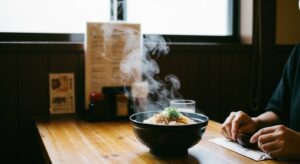
The bowl arrives with marbled wagyu arranged over a mound of Aichi no Kaori rice — Aichi's own premium rice variety. A raw Nagoya Cochin egg sits alongside it. The restaurant's printed menu, available in English, Chinese, and Korean, walks you through five steps: separate the egg white into your miso soup, place the yolk directly onto the beef, taste the wagyu first on its own to appreciate its character, then fold the yolk in, then layer in the complimentary condiments — pickled ginger, seaweed from Mikawa Bay, dried whitebait from Minamichita, and Itadaki's original 8-spice blend. Finally, a touch of their house wasabi to close.
Each step is a different experience within the same bowl. It's structured like a tasting — methodical, intentional — but it never feels fussy. The miso soup is made with Hatcho miso from Okazaki, arguably the most distinctive miso in Japan. The pickles are Atsumi Ichō-zuke from the Atsumi Peninsula. Even the shiso leaves have a name: Aikei No.1, grown in Toyohashi.
Everything in that bowl has an address. That's the point.
"Perfect lunch during our Nagoya stay before our Shirakawa-go trip the following day."
Guest visiting Nagoya en route to Gifu
This review stayed with me because it captures exactly how Itadaki fits into a broader Japan journey. Nagoya is often the overnight stop before the mountain villages — and for many visitors, that means a rushed morning and a convenience store breakfast. But there's a better version of that story: a proper lunch in Osu the day before, a bowl of something extraordinary, and the memory of Horai Wagyu carrying you through the bus ride to Shirakawa-go the next morning.
The Part They Don't Put on the Sign
Here's what I find most remarkable about Itadaki, and what you'd only learn by paying attention on your visit.
The Horai Wagyu is limited to 10 bowls per day. Not as a marketing device — because that's genuinely all the restaurant can source and serve at the standard Goto insists on. When it sells out, it's gone. There's no second batch warming in the back. The kitchen uses high-tech rice cookers that are recalibrated annually to match that year's rice quality — because rice, like any crop, changes year to year, and Goto's team treats the adjustment as a professional obligation rather than an afterthought.
The "magic sauce" that briefly coats the beef and simmers the onions is built on white soy sauce from Hekinan City — a lighter, more delicate base than the dark soy most people associate with Japanese cooking — blended with wine and seasonings that took considerable time to develop. It's not written on the menu in detail. You taste it without knowing exactly what it is, and then you start wondering.
That sense of depth — of there being more to discover in a single bowl than you can fully unpack in one visit — is what separates a truly memorable restaurant from one you simply enjoyed. Itadaki has that quality. It rewards attention.
"I've had Kobe beef and Matsusaka beef, but Horai Wagyu at Itadaki was on another level."
Repeat visitor to Japan
Planning Your Visit: What You Need to Know Before You Go
Itadaki is open for lunch only — Tuesday, Saturday, Sunday, and Monday, from 11:00 to 15:00 (last order 30 minutes before closing). On public holidays, doors open at 9:00. The restaurant is closed Wednesday through Friday. Because the schedule can vary month to month, it's worth checking the monthly calendar on Instagram before you go.
Getting there is straightforward once you know the route. From Nagoya Station, take the Higashiyama Line to Sakae, transfer to the Meijo Line, and get off at Yabacho — about 10 minutes total. From Exit 4, it's a 4-minute walk. Look for the Japanese sign reading 元祖レア牛丼 頂 at street level, then head up the stairs to the second floor.
For the Horai Wagyu specifically, I'd recommend reserving in advance via Tabelog Online. When making your reservation, add the note 鳳来牛希望 in the comments field to request the Horai Wagyu bowl. If you're walking in without a reservation, arriving right at 11:00 gives you the best chance. The Mikawa Beef Rare Gyudon is always available and every bit as carefully prepared — it's a genuine second signature, not a fallback.
The restaurant seats 18, all table seats with sofa-style seating — comfortable for solo diners, couples, and families alike. Counter seats are available for anyone coming alone. The full menu is printed in English, Chinese, and Korean.
The Meal That Stays With You
A once-in-a-lifetime culinary experience isn't always the most expensive one or the most famous one. Sometimes it's the one that holds a story you couldn't have found anywhere else — a story about a founder who didn't want farmers to fail, about cattle raised on sake lees in the mountains of Aichi, about a dish that existed nowhere in the world until someone decided it should.
Nagoya gave me that meal. And if you're already planning a trip through Central Japan, I'd encourage you to set aside one lunch hour in Osu for the same discovery.
For our complete menu, access details, and store information, visit our official page at https://itadaki8.com/english/
To secure your bowl — especially if Horai Wagyu is on your list — we'd love to have a seat ready for you: Reserve Your Rare Wagyu Experience
And to check which days we're open during your travel window: Check Our Monthly Schedule on Instagram