My Asian Games 2026 Story: The Rare Wagyu Lunch I'll Never Forget
 gotowp
You've booked your flights. You've checked the event schedule. You know which venues you're heading to, which athletes you're rooting for. But somewhere between planning your Asian Games 2026 itinerary and deciding where to eat, a question surfaces — one that matters more than you might expect at first:
What's the one meal from this trip that I'll still be talking about five years from now?
For a lot of visitors arriving in Nagoya in 2026, the answer turned out to be a bowl of beef and rice from a small second-floor restaurant in Osu. Not a kaiseki dinner. Not a hotel buffet. A gyudon — Japan's most humble everyday dish — reimagined in a way that nobody saw coming.
This article isn't about comparing options or building a checklist. It's a story about what a once-in-a-lifetime culinary experience actually feels like — and how you can plan yours.
Who This Is For
- ✅ Visitors traveling to Nagoya for Asian Games 2026 or Asian Para Games 2026 who want a memorable lunch beyond the stadium
- ✅ Wagyu enthusiasts who've tried Kobe or Matsusaka beef and are ready to discover something rarer
- ✅ Travelers who believe a truly great meal should come with a story worth telling
- ✅ Anyone visiting Osu district and looking for a specialty lunch that locals would genuinely recommend
- ✅ Foodies who want their Japan trip to include at least one dish that's impossible to find anywhere else in the world
1. The Moment You Realize a Bowl of Rice Can Change Everything
Imagine stepping off the Meijo Subway Line at Yabacho Station after a morning at Hisaya-odori Garden Flarie — one of Nagoya's most photogenic free-admission spots, just a three-minute walk from the station. You've been on your feet since early morning. The Asian Games opening ceremony is this evening. And you want one lunch — one proper, memorable lunch — before the noise and the crowds and the excitement take over.
Four minutes from Exit 4, up a short staircase, is Itadaki.
The sign at street level reads 元祖レア牛丼 頂 — "The Original Rare Wagyu Gyudon." That word, "original," isn't marketing language. Founder Masayuki Goto literally invented this culinary category. There was no rare wagyu gyudon before Itadaki opened in Osu in April 2022. Goto asked a question nobody in Japan's food industry had asked before: Why does every bowl dish have a premium version — except gyudon? That question became a restaurant. And that restaurant became the reason many visitors now include Nagoya on their Japan itinerary at all.
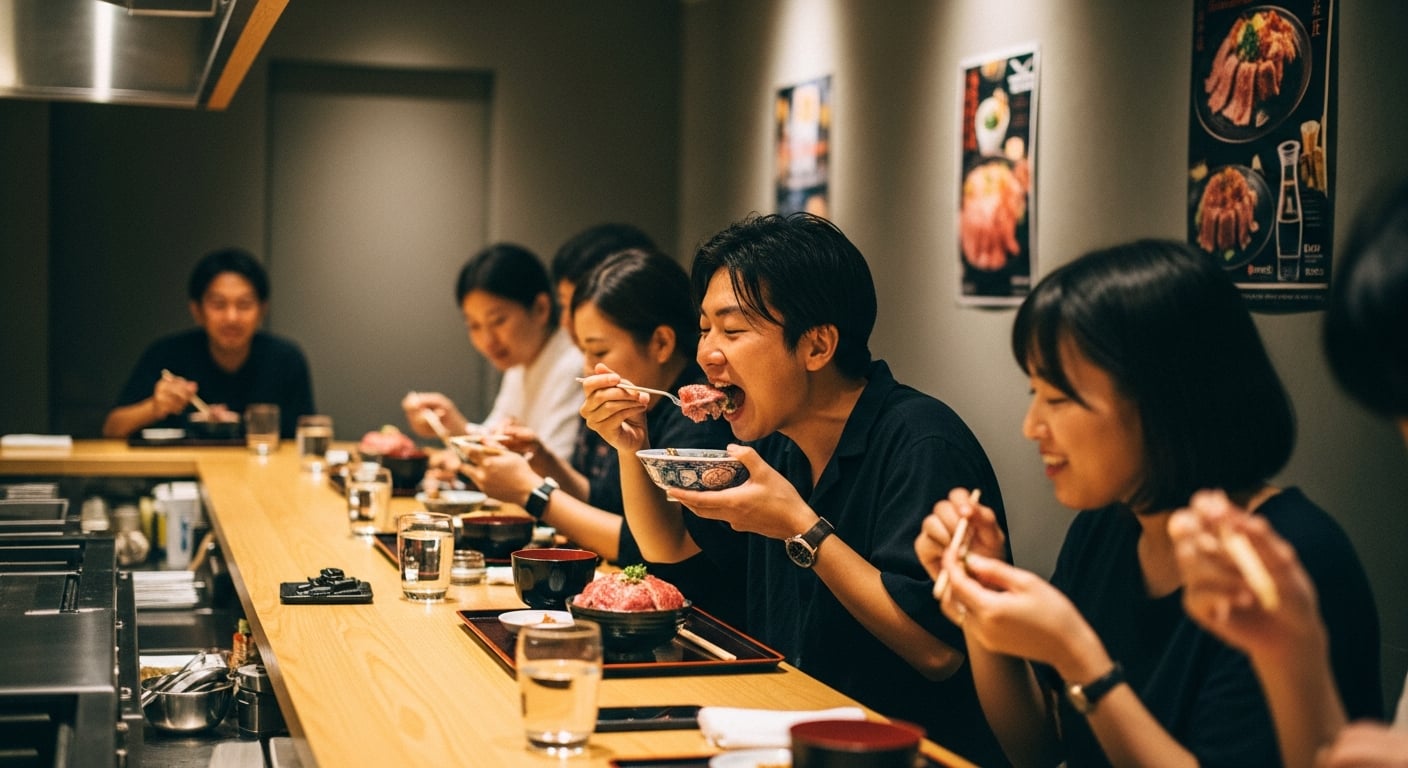
The dish that arrives at your table is visually arresting — thinly sliced wagyu arranged over rice in a traditional ceramic bowl, a raw Nagoya Cochin egg yolk resting on top, shiso leaves tucked along the edge. Before you even lift your chopsticks, you already sense that something different is happening here.
2. The Story Behind the Bowl: Why Horai Wagyu Is in a Category of Its Own
Here's a number worth sitting with: there are approximately 500,000 wagyu cattle raised in Japan at any given time. Horai Wagyu accounts for 300 of them — raised across just three farms in Okumikawa, deep in the mountains of Aichi Prefecture.
What makes those 300 cattle so different? They're fed on sake lees from Horaisen Sora, one of Aichi's finest premium sake breweries. That feeding method produces a beef with a flavor profile unlike anything you'll find in the more widely distributed wagyu brands — a balance of lean, clean meat character and delicate marbling that reveals itself most clearly in Itadaki's signature rare-style preparation.
Goto sources directly from those farms. He doesn't broker through a distributor. That direct-supply relationship is part of why Itadaki exists at all — during the COVID-19 pandemic, when small Aichi producers were struggling with unsold harvests, Goto felt compelled to build something that would support them long-term. Every bowl of Horai Wagyu Rare Gyudon you order is, in a quiet way, a vote for that model of farming.
The rare-style texture is achieved through a proprietary two-stage cooking technique that Goto developed specifically for this dish. The beef is heated to over 70°C at the core — fully meeting Japan's Ministry of Health, Labour and Welfare food safety standards — while the result on the palate still carries that silky, yielding quality that makes the experience feel genuinely unlike anything else. It is not raw. It is not simply seared. It is something that took years of development to get right, and it cannot be replicated by ordering wagyu elsewhere.
✓ Key Takeaways
- Horai Wagyu is produced by only 3 farms in Japan with just 300 heads annually — among the rarest wagyu you can access anywhere in the country
- Itadaki's two-stage cooking technique delivers a rare-style texture while fully meeting Japanese food safety standards — the concern about "raw beef" is answered by science and certification, not reassurance
- Every ingredient — from the Aichi no Kaori rice to the Nagoya Cochin egg to the white soy sauce-based magic sauce — comes exclusively from Aichi Prefecture
3. The Five Moments That Make the Meal Unforgettable
The multilingual menu at Itadaki — available in English, Simplified Chinese, and Korean — includes a five-step visual guide for how to enjoy the dish. It sounds simple. It turns out to be one of the most thoughtful things about the entire experience.
Step one: separate the egg. The white goes into your miso soup — made with Hatcho miso from Okazaki and finished with Atsumi aosa seaweed. The golden yolk stays on the beef, waiting.
Step two: taste the wagyu on its own first, before mixing anything. This is where the Horai Wagyu reveals itself — the flavor is clean, the texture unlike anything most visitors have encountered, the experience quietly extraordinary.
Step three: break the yolk into the beef. The richness wraps around each bite in a way that shifts the entire character of the dish.
Step four: the tabletop condiments come into play — pickled ginger from Inazawa, chopped Mikawa Bay seaweed, chirimen jako, Itadaki's original eight-spice blend. Each addition opens a different angle on the same bowl.
Step five: a touch of wasabi. A clean, clear finish that closes the loop.
It sounds like a lot of structure for a beef bowl. In practice, it feels like being let in on something — a meal with a beginning, a middle, and an end.
"The rare wagyu was unlike anything I've ever tasted — a life-changing culinary experience."
— A guest at Itadaki
4. Planning Your Visit Around the Asian Games Schedule
Itadaki operates on a specific schedule: open Saturday, Sunday, Monday, and Tuesday, from 11:00 to 15:00 (last order at 14:30). On public holidays, the kitchen opens at 9:00. The restaurant is closed Wednesday through Friday.
This matters for Asian Games 2026 planning. If your event tickets fall on a Thursday, Friday, or Wednesday, you'll want to schedule your Itadaki visit on an adjacent open day. The Asian Games run from late September through mid-October 2026 — a period that will include multiple open days each week.
The Horai Wagyu bowl — listed on the menu as Shinkoccho (100g beef, 200g rice, ¥2,700) — is strictly limited to 10 bowls per day. During the Asian Games period, visitor numbers in Nagoya will be elevated. If Horai Wagyu is your goal, a reservation via Tabelog Online is the only way to guarantee availability. When making your reservation, copy and paste the following into the notes field: 鳳来牛希望
If you're arriving without a reservation, Mikawa Beef Rare Gyudon is always available — starting from ¥1,800 for the Fumoto size — and prepared using the same two-stage cooking technique. Arriving right at the 11:00 opening also gives you the best walk-in chance at Horai Wagyu.
Getting there is straightforward: Yabacho Station on the Meijo Subway Line, Exit 4, four minutes on foot. From Nagoya Station, it's approximately 10 minutes by subway — Higashiyama Line to Sakae, transfer to Meijo Line, one stop to Yabacho. The restaurant is on the second floor; look for the sign at street level.
5. What Makes This the Meal You'll Actually Remember
Nagoya during Asian Games 2026 will offer a lot of good meals. What it won't offer — anywhere else, at any price — is the specific experience of eating a dish that was invented at that address, using ingredients that exist in quantities of 300 animals per year, prepared by a team that has spent years mastering a technique developed by one founder with a very specific vision.
Goto named the restaurant Itadaki — drawn from itadakimasu, the Japanese expression of gratitude spoken before eating. It's a small word that carries an enormous amount of meaning: acknowledgment that what's on the table came from somewhere, from someone, from the effort of people you'll never meet. That philosophy is present in every element of the bowl — the Horai Wagyu fed on sake lees, the Nagoya Cochin egg from Yamada Poultry Farm, the shiso leaves grown specifically in Toyohashi, the white soy sauce from Hekinan City that forms the base of the magic sauce.
You could have a fine lunch at many places in Nagoya during Asian Games 2026. Or you could have this one.
Ready to make it part of your Asian Games 2026 story? Horai Wagyu is limited to 10 bowls per day — and during peak event weeks, those 10 bowls will go quickly. Securing your spot in advance is the only way to guarantee the experience you're planning for.
Reserve Your Rare Wagyu Experience
Not sure which day works best with your event schedule? Our monthly business calendar is posted regularly on Instagram — check before you finalize your plans.
Check Our Monthly Schedule on Instagram
For our complete menu, access details, and store information, visit our official page at https://itadaki8.com/english/