My Samurai City Journey: Nagoya Castle to Itadaki Rare Wagyu Bowl
 gotowp
A guest stopped me at the counter a few weeks ago, just before sitting down. She had spent her morning at Nagoya Castle, walked through the Honmaru Palace, and made her way to Osu on foot. She was excited. But she was also hesitant.
"I really want to try it," she said, menu already in hand. "But — is it actually safe? The beef looks... rare."
I hear this question more than almost any other. And honestly, I'm glad people ask. It tells me they care about what they're putting in their body — and that they're genuinely curious, not just dismissing the dish. So I pulled up a chair, took a moment, and explained exactly how we prepare our wagyu. By the time she lifted her chopsticks for the first bite, her expression had completely changed.
That conversation is what inspired me to write this. If you're planning the same kind of day — Nagoya Castle in the morning, Osu in the afternoon — I want to answer that question properly, before you even walk through our door.
Who This Is For
- ✅ Travelers combining Nagoya Castle sightseeing with an Osu lunch stop
- ✅ Visitors who are curious about rare wagyu but have concerns about food safety
- ✅ Anyone who has tried Kobe or Matsusaka beef and wants to discover what's next
- ✅ Samurai history enthusiasts looking for an authentic Nagoya culinary experience to match their cultural day
- ✅ First-time visitors to Itadaki who want to know exactly what to expect before they arrive

A Morning with Nagoya's Samurai Heritage
I'll be honest — I walk past Nagoya Castle far more often than most people visit it. I grew up in this city, and the castle has always been part of the backdrop of daily life here. But when I actually slow down and spend time inside the grounds, I'm reminded of something powerful: Nagoya was the birthplace of Oda Nobunaga, Toyotomi Hideyoshi, and Tokugawa Ieyasu. Three of the most consequential figures in all of Japanese history, all from this one city.
There's a reason I think about this when I think about Itadaki. Nobunaga was known for rejecting convention. Hideyoshi built something from almost nothing. Ieyasu played the long game, caring deeply about foundation and sustainability. In a quiet way, those are the principles I try to carry into this restaurant every day.
If you have a morning to spend in Nagoya before lunch, the castle grounds and the Honmaru Palace restoration are genuinely worth your time. Then, from Nagoya Castle, it's a short subway ride down to Yabacho Station — and Itadaki is a 4-minute walk from Exit 4.
The Question I Get Asked More Than Any Other
So — is rare wagyu safe to eat?
This is the question, and I want to answer it completely.
I understand why visitors from Western countries hesitate. In the United States, the UK, Australia — public health authorities have long advised against consuming undercooked beef. The concern is real: E. coli, salmonella, and other bacterial contamination can occur when beef is insufficiently heated, especially in the center. That guidance exists for good reason, and I'm not here to dismiss it.
But what we do at Itadaki is not undercooked beef. It is a very different thing.
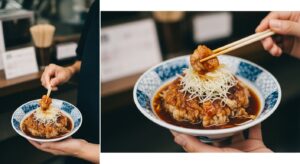
We use a proprietary two-stage cooking technique that I developed with my team before Itadaki ever opened. At no point does the beef remain below Japan's Ministry of Health, Labour and Welfare food safety threshold — the core temperature reaches over 70°C. This fully satisfies Japanese regulatory standards for safe beef preparation. The "rare" texture you experience is the result of precise heat management and technique, not the result of leaving the beef raw at the center.
Think of it this way: the goal of the technique is to preserve the silkiness and melt-in-your-mouth quality that wagyu is prized for, while ensuring that every part of the beef has been properly cooked. The sensation of eating rare beef is real. The risk of a conventionally undercooked steak is not.
I hold a Certified Food Sanitation Supervisor qualification from Japan's Ministry of Health, Labour and Welfare, and Itadaki operates under a licensed food service permit from Aichi Prefecture's Public Health Center. Food safety isn't a marketing message here — it's the technical foundation that makes this concept possible in the first place.
✓ Key Takeaways
- Itadaki's rare wagyu is cooked to over 70°C at the core using a proprietary two-stage technique — fully meeting Japan's Ministry of Health food safety standards
- The "rare" texture is the result of precise culinary technique, not raw or undercooked preparation
- All beef is sourced from Aichi Prefecture farms under strict quality control — Horai Wagyu and Mikawa Beef only
Why the Ingredients Also Matter
Food safety isn't only about cooking method. It also starts with sourcing.
Every piece of beef served at Itadaki comes from Aichi Prefecture farms I work with directly. Horai Wagyu — our most prized offering, limited to 10 bowls per day — is produced by just three farms in Japan, raising only 300 heads annually. These cattle are raised in Okumikawa, Aichi, and fed on sake lees from Horaisen Sora, a renowned local premium sake. That specificity in feed and environment isn't just a flavor story. It reflects the level of care and traceability that goes into every animal raised.
Our other signature beef, Mikawa Beef, comes from Aichi's Mikawa region and is raised on okara feed with lactic acid bacteria gut management — a practice that supports clean, healthy digestion in the cattle and results in lean, flavorful meat with consistent quality.
When I know exactly where the beef comes from, who raised it, and how, I can stand behind every bowl we serve. That's a level of supply chain clarity that most restaurants simply don't have.
"I've had Kobe beef and Matsusaka beef, but Horai Wagyu at Itadaki was on another level."
— Guest from overseas, visiting Nagoya as part of a Japan tour
I think what this guest experienced goes beyond taste alone. Horai Wagyu has a distinctive profile — both marbled and lean at once, with a clean finish rather than the overwhelming richness that sometimes comes with heavily marbled wagyu. Out of approximately 500,000 wagyu raised across Japan in any given year, only 300 are Horai. That rarity isn't manufactured. It's the natural result of a small-scale, high-care farming tradition that the rest of the country hasn't replicated.
Off-Hours Nagoya: What I Do When I'm Not Behind the Counter
Itadaki is open only during lunch — Saturday through Tuesday, plus public holidays, from 11:00 to 15:00. So my afternoons and evenings are my own.
I love basketball. When Nagoya Diamond Dolphins are playing at IG Arena — Kengo Kuma's remarkable new venue that opened in July 2025 — I try to be there. There's something about the energy of a live game in a well-designed space that genuinely recharges me. The arena is also set to host basketball and judo at the 2026 Asian Games, which I'm already looking forward to.
When I want something quieter, I walk to Shikemichi (四間道) — a preserved Edo-period merchant district near Nagoya Station that most visitors never find. The 300-year-old warehouses, cobblestone lanes, and the "Yanegami-sama" rooftop shrines are completely unlike anywhere else in the city. I've had some of my best meals in tiny restaurants tucked inside those restored buildings.
But the thing that shaped Itadaki most deeply is my passion for travel. Every time I visit another country — whether it's following a recommendation to a hole-in-the-wall ramen spot in Hong Kong or trying something I've never seen before in a market in Southeast Asia — I come back thinking about what makes a food experience genuinely memorable. Not the price. Not the fame. The specificity. The story. The feeling that this exists nowhere else.
That's what I was trying to build with Itadaki. And that's what I want every visitor who comes in after a morning at Nagoya Castle to feel when they sit down and lift their chopsticks for the first time.
Planning Your Nagoya Castle to Osu Lunch Day
If you're putting together this kind of day, here's how I'd personally structure it:
Start at Nagoya Castle when it opens — the Honmaru Palace is quiet in the early hours and the grounds are beautiful in almost any season. From there, take the Meijo Subway Line south to Yabacho Station (Exit 4), which puts you right in the heart of Osu. Spend a little time at Osu Kannon Temple and wander the shopping street before heading to us. We're on the 2nd floor at 4-1-20 Osu — look for the sign that reads 元祖レア牛丼 頂 at street level and take the stairs up.
We open at 11:00. If you're hoping for Horai Wagyu — limited to 10 bowls per day — arriving right at opening gives you the best chance without a reservation. That said, I always recommend booking in advance via Tabelog if your schedule is fixed. When you reserve, paste 鳳来牛希望 into the notes field to request Horai Wagyu specifically. If Horai Wagyu isn't available on the day, Mikawa Beef Rare Gyudon is always on the menu — same two-stage technique, equally prepared with care.
Our menu is available in English, and we have a five-step visual guide that walks you through exactly how to enjoy the dish — from separating the Nagoya Cochin egg to the final wasabi note. No Japanese required.
The guest who hesitated at the counter that afternoon? She finished every grain of rice. On her way out, she turned back and said: "I almost didn't order it. I'm really glad I asked."
So am I.
For our complete menu, access details, and store information, visit our official page at https://itadaki8.com/english/
When you're ready to secure your bowl — especially if Horai Wagyu is on your list — we'd love to have you join us: Reserve Your Rare Wagyu Experience
And since our schedule follows a monthly calendar with occasional irregular closures, it's always worth a quick check before you travel: Check Our Monthly Schedule on Instagram
Itadakimasu — and we'll see you soon.