Inside Look: A Day at Itadaki During Peak Shirakawa-go Season
 gotowp
You've planned your Japan trip down to the minute. Shirakawa-go is booked for tomorrow. Your Nagoya hotel is sorted. But somewhere between the gassho-zukuri farmhouses and the bullet train schedule, you're staring at your lunch options and thinking: Is it worth making a reservation? Will the dish I want still be available when I get there? And honestly — what even happens inside a place like this on a busy day?
Those are fair questions. And if you've ever arrived at a specialty restaurant only to find the signature item sold out, you know the particular sting of that moment. During peak Shirakawa-go season — when autumn foliage turns the UNESCO village into a painting and travelers pour through Nagoya as their staging ground — our little restaurant on the 2nd floor in Osu gets its most intense days of the year.
So here's an honest, inside look at what one of those days actually looks like for me, Masayuki Goto, founder of Itadaki.
This article is for you if you are:
- ✅ Planning a Nagoya lunch stop before or after a Shirakawa-go or Takayama day trip
- ✅ Curious whether to reserve in advance or walk in during peak season
- ✅ Wondering what makes Itadaki different from other wagyu restaurants in the area
- ✅ Interested in the story and daily rhythm behind the restaurant, not just the menu
- ✅ Traveling to Nagoya for the first time and looking for something genuinely memorable at lunch
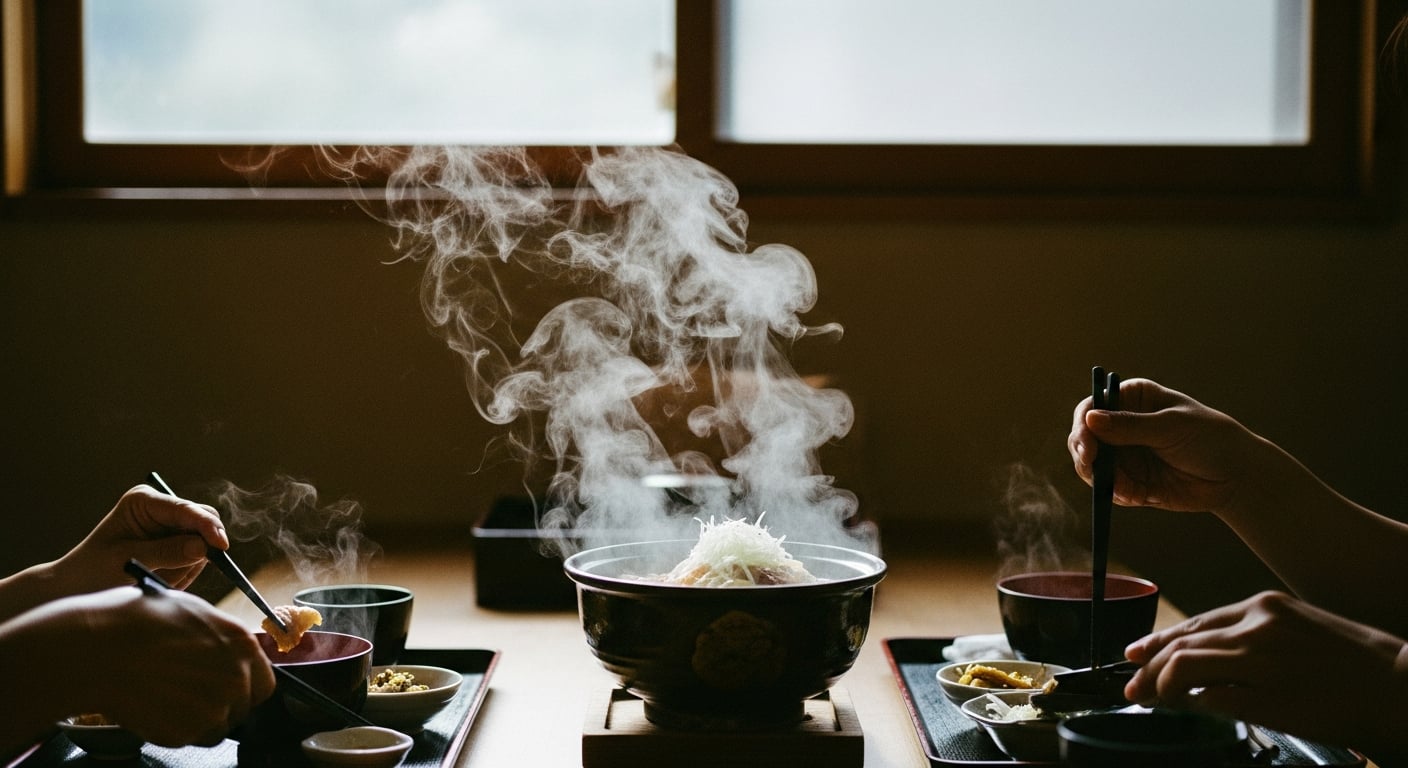
8:30 AM — Before Anyone Arrives
I'm usually here before the city wakes up properly. The Osu shopping street is quiet at this hour — shutters still down, the smell of incense drifting faintly from Osu Kannon Temple a few blocks away. There's a particular calm to it that I never take for granted.
The first thing I check is the Horai Wagyu. We receive only a limited allocation each week from the three farms in Okumikawa, Aichi that produce it. Nationwide, just 300 heads are raised annually — out of roughly 500,000 wagyu cattle across Japan. On a peak-season day, those 10 bowls will almost certainly be gone before noon. So the preparation has to be exact from the start.
During Shirakawa-go season specifically — roughly mid-October through mid-November — I notice a different energy in the reservations. Many guests have booked the Horai Wagyu days in advance via Tabelog. Others are walk-ins who arrived in Nagoya the night before their village trip and found us on Google Maps at midnight. Either way, everyone arrives with anticipation. That responsibility keeps me focused during prep.
Rice goes into the cooker — Aichi no Kaori, our Aichi-grown premium variety. We adjust the settings annually based on that year's harvest quality. The magic sauce, built on a white soy sauce base from Hekinan City and blended with wine, is ready from the previous day's preparation. The Nagoya Cochin eggs from Yamada Poultry Farm are checked. The shiso leaves — Aikei No.1 variety from Toyohashi — are arranged. Everything in this kitchen is from Aichi Prefecture. That's not a marketing line. It's a discipline I set from day one and one I hold to without exception.
11:00 AM — Doors Open, and the First Guests Arrive
On peak days, there's often someone waiting outside at 10:55. Sometimes it's a solo traveler who's been researching Nagoya food for weeks. Sometimes it's a couple who finished breakfast early at their hotel near Nagoya Station and took the Meijo Line straight to Yabacho.
The four-minute walk from Exit 4 at Yabacho Station is one of my favorite details about this location. You pass the edge of the Osu shopping district, catch a glimpse of temple rooftiles, and arrive at our staircase at street level — marked with our sign reading 元祖レア牛丼 頂. First-timers sometimes walk past and have to double back. That moment of discovery, when they look up and realize they've found it, is something I quietly enjoy watching.
The first bowls of the day go to whoever has a Tabelog reservation for the Horai Wagyu. I always remind my team: these guests may have traveled specifically for this. Some have told us they adjusted their Shirakawa-go schedule to make the timing work. That's not something we take lightly.
For guests arriving without a reservation, we always have the Mikawa Beef Rare Gyudon available — prepared with exactly the same proprietary two-stage cooking technique, and equally precise in its sourcing. The Mikawa Beef is raised in Aichi's Mikawa region on okara feed with lactic acid bacteria gut management, using only the uchimomo lean cut. It's a different character from Horai Wagyu, but it belongs on the same table.
"Perfect lunch during our Nagoya stay before our Shirakawa-go trip the following day. The bowl was extraordinary — we're still talking about it."
— Guest review via Tabelog
✓ ここまでのポイント
- Horai Wagyu is strictly limited to 10 bowls per day — during peak Shirakawa-go season, it often sells out before noon. Advance reservation via Tabelog is strongly recommended.
- Every ingredient at Itadaki — from rice and eggs to sauce and pickles — comes from Aichi Prefecture. This isn't flexibility; it's a founding commitment.
- Walk-in guests always have access to Mikawa Beef Rare Gyudon, prepared with the same technique and care as the Horai Wagyu bowl.
12:00 PM — The Rush, and What It Reveals
Noon is the most honest hour in any restaurant. You either have your systems right, or you don't. With 18 seats — five counter seats, a sofa table for five, one for four, and two for two — Itadaki is intentionally small. That was a deliberate choice I made when I conceived this place during the pandemic. I wanted a format I could operate with genuine quality control, not volume.
During peak season, I watch how guests interact with the dish. The multilingual menu — printed in English, Chinese, and Korean — includes a five-step visual guide for enjoying the Rare Wagyu Gyudon. I developed that guide because the dish isn't meant to be eaten the way you'd approach a standard beef bowl. There's a sequence: separate the Nagoya Cochin egg first (white into the miso soup, yolk over the beef), taste the wagyu in its pure rare form, then introduce the yolk, then the condiments — pickled ginger, dried nori from Mikawa Bay, chirimen jako from Minamichita, and our original 8-spice blend — and finally, a touch of wasabi to finish. When I see a table of visitors following that guide and genuinely discovering each stage, I know the concept is working.
I sometimes think about the question that started all of this: Why does gyudon — Japan's beloved beef bowl — have no premium version? Katsudon has it. Kaisendon has it. Even oyakodon has its elevated interpretations. Only gyudon was left behind, defined entirely by speed and price. That gap seemed wrong to me. And during the pandemic, when the farmers I knew were struggling with unsold harvests, it became more than a culinary question. It became a reason to build something.
"I've had Kobe beef and Matsusaka beef, but Horai Wagyu at Itadaki was on another level. The concept, the setting, the story — nothing I'd experienced before."
— Guest review (repeat Japan visitor)
2:30 PM — Last Order, and What Stays With Me
Last order is 30 minutes before we close at 3:00 PM. On a peak-season day, the Horai Wagyu is long gone. The Mikawa Beef bowls have been flowing steadily since 11. The sofa seats — something I chose specifically to make extended lunches feel comfortable, whether you're a solo traveler with a guidebook or a family with a tired toddler — have hosted a full rotation of guests from different countries, different travel itineraries, different reasons for being in Nagoya.
Some arrived straight from Nagoya Castle this morning. Others have a train to Shirakawa-go tomorrow at 8 AM. A few are business travelers who've been coming to Nagoya for Toyota-related meetings and found Itadaki between schedules. One group today was visiting the Hisaya-odori Garden Flarie — just three minutes from Yabacho Station — before walking over to us for lunch. That garden is the kind of free, unhurried Nagoya experience that I love about this city. Quiet, beautiful, and largely undiscovered by mainstream travel guides. Itadaki, in some ways, is the same.
After service ends, I do my own review. How many Horai Wagyu bowls went to reservations? How many walk-ins got the experience they came for? Is there anything we can improve for tomorrow? Running a lunch-only restaurant, four days a week, with no dinner service and a deliberate limit on volume, means every sitting carries more weight. There's no second chance in the same day to make it right.
I opened Itadaki because I believed the gyudon deserved better — and because the farmers of Aichi deserved a restaurant that would champion their work with the same seriousness they bring to raising 300 heads of Horai Wagyu a year. Most days, especially the peak-season ones, I feel like we're living up to that.
Planning Your Visit During Peak Season
If you're traveling through Nagoya during the Shirakawa-go autumn season — or any high-travel period — here are the practical things worth knowing:
For Horai Wagyu: Reserve in advance via Tabelog Online. When booking, paste this into the notes field: 鳳来牛希望 — this lets us know you're requesting the Horai Wagyu. Reservations can be made in English on the Tabelog website.
For walk-ins: Arriving at 11:00 AM when we open gives you the best chance of securing a Horai Wagyu bowl without a reservation. The Mikawa Beef Rare Gyudon is always available.
Getting here: Take the Meijo Subway Line to Yabacho Station, use Exit 4, and walk four minutes. From Nagoya Station, it's approximately 10 minutes total (Higashiyama Line to Sakae, transfer to Meijo Line, exit at Yabacho). Look for our sign at street level and take the stairs to the 2nd floor.
Hours during peak season: We're open Saturday, Sunday, Monday, and Tuesday from 11:00 AM to 3:00 PM (last order 2:30 PM). We're closed Wednesday through Friday. On public holidays, we open from 9:00 AM. Please check our monthly business calendar on Instagram before visiting, as irregular closures can occur.
For our complete menu, access details, and store information, visit our official page at https://itadaki8.com/english/
We look forward to welcoming you — whether it's the day before Shirakawa-go, the morning after Nagoya Castle, or any moment in between when you're ready for something genuinely worth the journey.
To secure your Horai Wagyu bowl, we recommend reserving ahead: Reserve Your Rare Wagyu Experience
And to check our current monthly schedule before your visit: Check Our Monthly Schedule on Instagram